Between Barrier State, National Centre, and Balkan Power Hub
Abstract
The present study examines the geopolitics of Albania as the case of a small state with disproportionately high strategic density. The significance of Albania derives primarily not from the size of its economy, population, or armed forces, but from its geographical position, the manner of its historical formation, the non-coincidence between its state borders and the broader Albanian national space, and its usefulness to more powerful external actors. From this perspective, Albania is analysed as a threefold geopolitical reality: a barrier state, a national consolidator, and a Balkan hub of power.
The study traces the formation of Albanian distinctiveness from the Ottoman period and the Albanian National Awakening to independence in 1912, the conflict over Northern Epirus, Italian penetration, communist isolation, and post-communist attachment to the West. Particular emphasis is placed upon Kosovo, North Macedonia, Montenegro, relations with Serbia, Turkey, Italy, the United States, and the European Union, and the Greek–Albanian disputes concerning Northern Epirus, Himara, property rights, maritime zones, and the Cham issue.
The analysis is organised around the Thucydidean triad of Fear, Honour, and Interest. Fear is associated with the division of the Albanian national space and the memory of foreign decisions; Honour with the aspiration for recognition of Albania as the centre of a broader nation; and Interest with attachment to the West, institutional stability, economic development, and the avoidance of an overt revision of borders. The study argues that Albanian power is partly borrowed because it derives from the strategic usefulness of the country to external actors. The central problem, therefore, is the potential gap between actual and perceived power.
For Greece, the conclusion is that the objective should not be a weak Albania, but an Albania bound by institutions, rules, and interdependencies. Overcoming the ‘paradox of proximity and intractable rivalry’ requires the transformation of shared interests into institutional bonds and of Greek rights into specific European obligations of Albania. Only in this manner can geographical proximity cease to function exclusively as a multiplier of friction and become a mechanism of predictability and mutual cost.
Keywords: Albania, Kosovo, Northern Epirus, Greek–Albanian relations, Western Balkans, Thucydidean geopolitics, Fear, Honour, Interest, barrier state, national space, European integration.
Introduction
Albania is a small state with disproportionately high geopolitical value. Its significance does not arise from the size of its population, the depth of its economy, or the strength of its armed forces. It derives from its position, its historical genesis, its relationship with a broader Albanian national space, and its usefulness to more powerful actors. It is one of the Balkan cases in which limited material power is combined with considerable strategic density.
Albania cannot be understood merely as a state confined within its borders, but as a threefold geopolitical reality. It is a barrier state because it was created and preserved as an obstacle to Serbian access to the Adriatic and as an intermediate space between competing powers. It is a national consolidator because the Albanian state does not encompass all Albanians and, consequently, attracts Kosovo, the Albanians of North Macedonia, the Albanians of Montenegro, and the wider diaspora politically, symbolically, and strategically. Finally, it is a platform for third powers because Italy, Turkey, the United States, the European Union, and other actors can project influence into the Western Balkans through it (Skendi, 1967; Fischer and Schmitt, 2022).
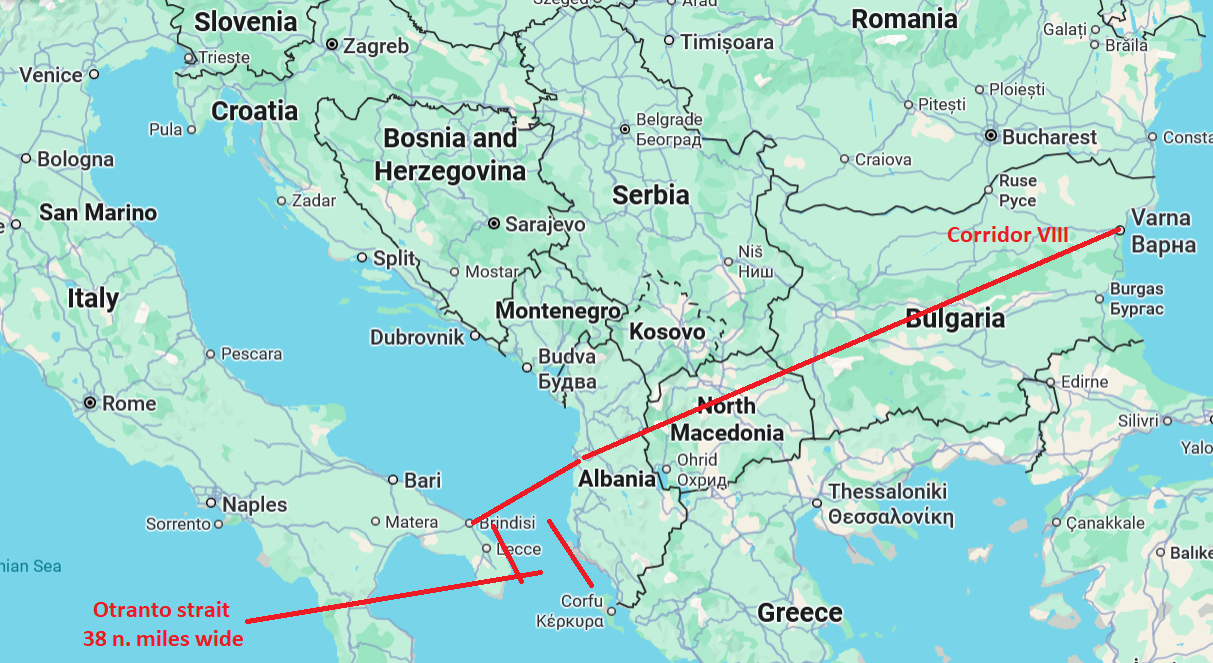
The strategic value of Albania cannot be assessed on the basis of geography alone. It depends primarily on the interaction among the smaller and larger actors in its surrounding geopolitical environment.
The Albanian question is Thucydidean in character because it cannot be explained either through purely legal language or through a single national narrative. The Fear, Honour, and Interest of several actors collide within it. In Albanian geopolitics, Fear arises from the division of the national space, the exposure of Albanian populations to the policies of neighbouring states, and the memory of periods during which others decided their fate. Honour is expressed in the desire for recognition of the Albanians not as a peripheral people under foreign tutelage, but as a nation with an autonomous historical claim in the Balkans. Interest dictates a Western orientation, economic development, institutional stability, and the utilisation of external protectors without complete dependence upon any one of them.
When these three forces remain in equilibrium, Albania acts prudently. When one predominates over the others, the danger of miscalculation arises.
In geopolitics, states do not always act according to their objective interest, but according to the manner in which they perceive it through Fear, Honour, historical memory, and the expectation of external protection. The distance between actual and perceived interest constitutes one of the principal sources of strategic miscalculation.
This applies particularly to Albania. Its actual state interest lies in stability, a European orientation, NATO membership, institutional consolidation, economic development, and the avoidance of overt border revision. Its perceived national interest, however, is strongly influenced by national aspiration and Honour, and is therefore broader: the protection and political connection of all Albanians, even when they live beyond the borders of the state. Albanian policy moves continuously between these two levels. When state logic prevails, Albania becomes a useful and stabilising Western partner. When national imagination becomes detached from actual power, the Albanian question can return as a classic Balkan problem of borders, minorities, and protecting powers.
The Ottoman Matrix of Albanian Distinctiveness
Albanian distinctiveness cannot be understood without an appreciation of the Ottoman past. The Albanians, like the Bosniaks, differed from most other Balkan peoples because a substantial proportion of them converted to Islam during Ottoman rule. This development should not be interpreted moralistically, in terms of stronger or weaker faith. It must be interpreted sociologically and politically. During the pre-Ottoman period, the territory of present-day Albania was characterised, in broad terms, by a religious division between areas of stronger Catholic influence in the north and Orthodox influence in the south. This distinction was not absolute, nor can it be extended unchanged to Kosovo, where Orthodoxy predominated during the late Middle Ages owing to the Serbian state and ecclesiastical presence. There was no unified Albanian national Church capable of acting as a vehicle of political identity, as occurred to a considerable degree among other Balkan peoples, for whom religious confession constituted the principal marker of collective identity during the pre-modern period.
The Albanian language had not yet acquired a common literary form, while society was fragmented into local and kinship structures. The absence of a unified ecclesiastical and political institution was reinforced by the local and kin-based organisation of society. In northern Albania, the fis—broad patrilineal descent groups tracing their origin to a common ancestor—possessed particular significance, while in the south the related term farë was used more frequently for groups of common descent, although the two terms did not always denote the same scale or political function. These kinship structures should not be confused with the broader linguistic and cultural division between Ghegs and Tosks: the former lived mainly to the north of the River Shkumbin, and the latter mainly to its south. The transformation of national self-designation is also noteworthy. Present-day Albanians call themselves Shqiptarë, a name associated with the common Albanian language, whereas the international terms ‘Albanian’ and ‘Albania’ preserve the older ethnonym Arbër/Arbën. The gradual prevalence of a linguistically grounded self-designation during the Ottoman period facilitated the transcendence of the division among Muslims, Catholics, and Orthodox Christians and provided a common foundation for later national consciousness. Within this ethnically and institutionally fluid framework, conversion to Islam offered fiscal, administrative, military, and social advantages, particularly to families and local elites seeking access to the Ottoman order (Fischer and Schmitt, 2022).
In Bosnia, by comparison, the process rested upon different historical conditions but followed a comparable social logic. The distinctive medieval religious history, the weakness of compact and exclusive ecclesiastical institutions, the position of the local aristocracy, and the possibility of preserving or enhancing social power within the Ottoman framework favoured conversion to Islam. Subsequent development, however, differed fundamentally from that of Albania. The Muslims of Bosnia were predominantly South Slav-speaking and did not possess a separate language that drew a clear boundary between them and the Serbs or Croats. Religious difference consequently became the principal boundary of collective identity. In socialist Yugoslavia, ‘Muslim’ was officially recognised as a national category and not merely as a religious designation; after the 1990s, the ethnonym ‘Bosniak’ became predominant. This does not demonstrate that the Bosniaks were merely Serbs or Croats who changed religion. It demonstrates that when language and kinship affinity are insufficient to create a clear boundary, religion can evolve from a confession of faith into the nucleus of national formation. The opposite occurred in Albania: because the Albanians belonged to three religious confessions, national unity had to rest upon language and a common narrative of descent rather than upon Islam (see also ‘The Formation of Albanian National Consciousness’ below) (Babuna, 2004).
Islamisation does not mean that Albanians or Bosniaks are ‘Turkic’ peoples. It means that the Ottoman legacy became integrated more deeply into their social structures than among Greeks, Serbs, Bulgarians, or Romanians. For this reason, Turkey today enjoys easier access to Albanian and Bosnian spaces than to predominantly Christian Balkan spaces. It does not control them, but it possesses bridges of memory, religion, culture, and protection.
Kosovo: From a Serbian Medieval Core to an Albanian Demographic Majority
Kosovo is the most critical point in Albanian geopolitics. It is also the point at which History, Law, and Power collide with the greatest intensity. From the Serbian perspective, Kosovo is a space of state, ecclesiastical, and national memory. It is not merely a province. The expression ‘Kosovo and Metohija’, commonly used in Serbian discourse, embodies this memory. ‘Metohija’ derives from the Greek metochion, meaning a monastic dependency, and refers to the monastic estates of the Serbian Orthodox Church in the western part of present-day Kosovo. Serbian use of the term is therefore not geographically neutral; it contains an ecclesiastical and historical claim. Kosovo was indeed an area of powerful Serbian state and ecclesiastical presence during the Middle Ages. Over the ensuing centuries, its demographic composition changed gradually. The Ottoman Empire transferred populations at various times, granted land, rewarded military service, and employed local Muslim notables to guard unstable frontiers. At the same time, wars between the Habsburgs and the Ottomans caused flight, return, and population redistribution; Islamisation favoured the social ascent of Muslim Albanian families; Albanian pastoral and martial groups moved towards the plains; and Serbian Orthodox communities were weakened in certain areas by warfare, fiscal pressure, and migration. No single cause or single moment of reversal can be identified. The Albanian demographic majority emerged through successive changes within a mixed and violently unstable frontier region.
The so-called ‘Great Migration’ of the Serbs in 1690 occupies a special place within this process. Following the retreat of the Habsburgs, whom many Orthodox subjects of the Empire had supported, Patriarch Arsenije III led clergy, notables, and numerous families northwards out of fear of Ottoman reprisals. The scale of the movement and the precise number of migrants remain matters of historiographical dispute; Serbian national memory tends to regard it as a decisive rupture, whereas more recent approaches place it within a broader sequence of wars and migrations. The defensible conclusion is that the demographic balance of Kosovo changed gradually during the Ottoman period rather than through a single, deliberate act. A competing dual claim consequently arose: the Serbs invoke historical and ecclesiastical continuity, while the Albanians invoke the more recent demographic majority, which they gradually transformed into a political demand for self-government and self-determination (Malcolm, 2020).
The Formation of Albanian National Consciousness
Albanian-speaking populations and local groups associated by the sources with the Albanian name are attested from the Middle Ages. This does not mean, however, that a modern Albanian nation with political expression existed at that time, or that there was a developed conception of a unified political nation in the modern sense. Modern Albanian national consciousness, expressed as a demand for political unity and self-government, was formed primarily during the nineteenth century. The Rilindja Kombëtare, the Albanian National Awakening, succeeded in unifying to a sufficient degree a population dispersed linguistically, socially, and locally by promoting the standardisation of the language, constructing a common historical narrative and political symbols, and developing networks of intellectuals, schools, and publications. The distinctive feature of Albanian national consciousness was that it had to transcend religious division. Pre-modern Albanians were Catholic and Orthodox, and gradually became Muslim as well. In a multi-ethnic empire in which religious confession often constituted a stronger component of collective identity than language, monotheistic and universal religions could overshadow linguistic and descent-based identities and create quasi-national communities organised around co-religionists. Internal migration, urbanisation, and administration through religious communities, as practised in the Ottoman Empire through the millet system, strengthened this tendency. Had religion become the principal foundation of Albanian identity, the emerging nation would have dissolved among Ottomanism, Catholic networks, Greek Orthodox influence, and Slav pressures. Albanian nationalists therefore grounded unity in language, common descent, and the proposition that ‘the religion of the Albanians is Albanianism’. This phrase was not mere rhetoric; it constituted a conscious reversal of the imperial logic of the millets and the subordination of individual religions to a differently defined national identity (Skendi, 1967; Babuna, 2000).
The transition from cultural fermentation to organised political action occurred through networks of intellectuals, merchants, clerics, and diaspora communities in Constantinople, Italy, Romania, and the cities of the Balkans. A common language constituted the strongest objective connective material, but the idea of common descent did not arise automatically. It was codified and disseminated by intellectuals such as Naum Veqilharxhi, Jeronim de Rada, Pashko Vasa, and the Frashëri brothers, who connected the language with historical references to the Illyrians, Skanderbeg—or George Kastrioti—and a common pre-Ottoman homeland. The Eastern Crisis of 1875–1878 and the decisions of the Congress of Berlin transformed this cultural construction into an urgent political demand. The League of Prizren was established at that point. It sought, on the one hand, to prevent the distribution of Albanian-speaking territories among neighbouring Christian states and, on the other, to unite the corresponding Ottoman administrative provinces. Albanian nationalism, therefore, did not initially arise as an exclusively anti-Ottoman movement. To a considerable degree, it emerged as a defensive nationalism against the danger of partition. Albanians feared that the retreat of the Ottoman Empire would bring not freedom, but their distribution among Serbia, Montenegro, Greece, and Bulgaria. This dual anxiety—fear of Ottoman centralisation and fear of partition by neighbouring states—explains their ambivalent relationship with the Empire (Skendi, 1967; Fischer and Schmitt, 2022).
The Uprisings of 1910–1912 and Independence
The Albanian uprisings of 1910–1912 were directed against Young Turk centralisation. Albanians resisted taxation, conscription, disarmament, administrative homogenisation, and the loss of local privileges. They were not simply pro-Ottoman; they were anti-Young Turk, while simultaneously fearing the Balkan League, because the Balkan allies would not fight for Albanian autonomy, but for the expansion of their own states. Here lay one of the fundamental Albanian weaknesses. In 1912, national momentum existed, but there was no state, unified army, unified general staff, unified diplomatic line, or position within the system of Balkan alliances. A consolidated strategic actor might have exploited the anti-Ottoman wave to secure territory. The Albanians could not. They possessed the experience of nationhood, but not the military, administrative, and diplomatic instruments available to a state. The independence of Albania was proclaimed by Albanians at Vlorë in 1912, but became an international reality because it served the contemporary balance of power. Austria-Hungary did not want a strengthened Serbia to obtain access to the Adriatic, because this would have increased the weight of Russia in the Balkan interior, facilitated Serbian economic and military autonomy, and strengthened South Slav nationalism within the Austro-Hungarian Empire itself. Italy, for its part, wanted neither Serbian nor Austro-Hungarian domination of the opposite shore of the Strait of Otranto. An independent Albania excluded Serbia from the sea, limited Greek expansion into Northern Epirus, and prevented the exclusive occupation of the Albanian coast by any rival power. Albania was thus created as a barrier state (Skendi, 1967; Fischer and Schmitt, 2022).
This genesis constituted both salvation and trauma. The international order created Albania as a state but left it incomplete as a nation. Large Albanian populations remained unredeemed beyond its borders. Since then, the Albanian state and the Albanian national space have not coincided. This is the deepest source of the geopolitical tension surrounding Albanian foreign policy.
Northern Epirus, the Protocol of Corfu, and the Greek Dimension
Northern Epirus was the point at which the Greek and Albanian positions collided from the outset. Greece regarded the southern part of Albanian territory as the northern extremity of Epirus, invoking the Orthodox ecclesiastical presence, Greek education, historical continuity, and the security of its north-western borders. The newly established Albanian state, whose borders had been determined by the Great Powers, claimed the same region within a broader arrangement of power: Italy and Austria-Hung ary sought to create an Albanian state sufficiently extensive to exclude Serbia from the Adriatic and to limit Greek expansion northwards (Fischer and Schmitt, 2022; Duka, 2013).
The Protocol of Corfu of 1914 was a compromise addressing this contradiction. It did not award Northern Epirus to Greece. It recognised a regime of extensive local self-government in the southern provinces under Albanian sovereignty. It therefore placated the Greek and Northern Epirote side through minority and self-government guarantees, while preserving Albania as a state. Its non-implementation resulted from Albanian instability and the chaos of the First World War, but the Protocol itself reveals the fundamental problem: the national logic of Greece collided with the strategic requirement of the powerful actors to preserve Albania (Duka, 2013; United States Department of State, 1914).
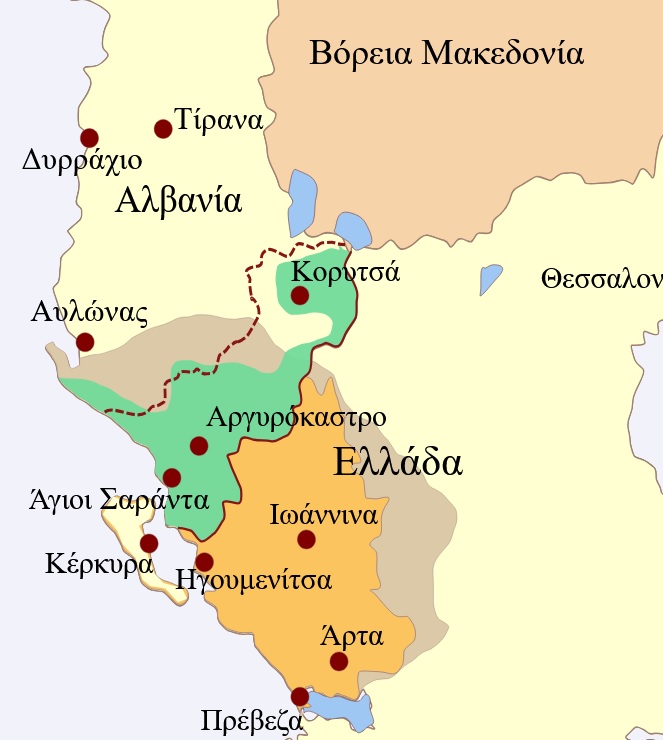
The Greek presence in Northern Epirus: the areas currently inhabited by Greeks are shown in green.
During the Second World War, the Greek advance of 1940–1941 into Northern Epirus was a military success, but it could not be transformed into a permanent political settlement because the German invasion and the collapse of the front intervened. After the war, Greece did not acquire Northern Epirus because the post-war order did not favour another revision of Balkan borders. Albania had become a communist state, Greece was experiencing civil conflict, the Soviet Union would not have accepted the loss of territory by a communist Albania under its protection, and the United States and Britain preferred stabilisation to the expansion of Greek claims. The award of the Dodecanese to Greece satisfied a different and autonomous Greek territorial claim without altering the negative attitude of the victorious powers towards revision of the Greek–Albanian border (United States Department of State, 1946; Fischer and Schmitt, 2022).
Northern Epirus is therefore the point at which the Greek ethno-minority argument repeatedly collided with the need of powerful actors to preserve Albania as a state. From a Thucydidean perspective, the justice embodied in Greek memory did not disappear; it simply lacked sufficient power to become an international reality.
Italy, Greece, and Albania
Italy was the powerful Western state that regarded Albania not merely as a neighbouring country, but as the opposite shore in immediate proximity. The geography of the Strait of Otranto gives Italy the opportunity to control the entrance to the Adriatic, provided that the Albanian coast does not fall under the control of a hostile power. Albania thus potentially becomes a question of Italian security. For Rome, the presence of a hostile power on the Albanian coast could render Italian control of the entrance to the Adriatic precarious. Italy therefore supported Albanian independence in 1912–1913, not out of pro-Albanian idealism, but because it opposed Serbian or Greek expansion on the opposite shore (Fischer and Schmitt, 2022; Tase, 2012).
This geographical imperative constituted the basis, though not the entirety, of Greek–Italian rivalry in Albania. Greece was concerned with the security of Epirus, the Greek presence in Northern Epirus, access to the Ionian Sea, and the prevention of encirclement by Italian bases in Albania and the Dodecanese. The broader Italian ambition to dominate the Adriatic and the Eastern Mediterranean, the pursuit of influence over the newly established Albanian state, and, during the interwar period, the use of Albania as a platform for pressure against Greece were added to this rivalry. Greece viewed Albania from south to north through Epirus, the minority, and the Orthodox presence. Italy viewed it from the sea towards the interior through the Adriatic, Vlorë, and Otranto. Thus, even when the two countries were not open enemies, their strategic perspectives could collide (Fischer and Schmitt, 2022).
During the interwar period, Italy moved from the protection of Albanian statehood to its subordination and, ultimately, to its abolition through the invasion of 1939. Fascist Italy used Albania as a bridgehead against Greece in 1940 and incorporated Albanian formations into the invading forces. Albanian battalions, organised under Italian command and incorporated, among other units, into the Blackshirt Legions, participated in the initial operations towards Kalpaki and elsewhere along the front; their performance was limited, and some formations became disorganised or dissolved. It is therefore inaccurate to present Albania as entirely uninvolved in the invasion. The principal decision, planning, and command of the attack were Italian, but Italian occupation had succeeded in mobilising part of the Albanian manpower. For Greece, this produced an enduring geopolitical memory: Albania becomes threatening when it is transformed into the platform of a third power (Fischer and Schmitt, 2022; Tase, 2012).
Today, Italy does not seek territorial control, but wishes to keep Albania closely connected to the Italian and European economic, political, and defence space. Geographical proximity, migration, energy, naval cooperation, trade, investment, and the European trajectory constitute a relationship of dense Adriatic interconnection. Italy is useful to Greece insofar as it keeps Albania within a Western framework and acts as a counterweight to Turkey. It is not, however, a guarantor of Greek interests. Rome will rank the security of Otranto, migration, investment, and its own influence above Himara and the other minority areas, Greek property rights, or Greek–Albanian maritime delimitation. The convergence of interests with Greece is therefore selective, not automatic.
Communist and Post-Communist Albania
The communist period under Enver Hoxha transformed Albania into one of the most isolated spaces in Europe. The country passed successively through close relations with Yugoslavia, the Soviet Union, and China, and ended in extreme autarkic deprivation and a paranoid conception of security. Albania became almost entirely marginal to Western geopolitical planning, not because it lost the characteristics conferred by geography, but because the regime isolated it from networks of power, while the great powers were unwilling to contest it within the environment of the Cold War (Fischer and Schmitt, 2022).
After 1991, the collapse of communism exposed a poor, institutionally weak, and explosive society. Migration to Greece and Italy was massive. Greece acquired immense social and economic significance for Albania because of the presence of hundreds of thousands of Albanian migrants, who worked and prospered there, but Greece failed to transform this relationship into durable strategic capital. Italy functioned as another gateway to the West and was often more readily accepted by Albanians. This does not mean that the invasion of 1939 was friendly in character or that the memory of occupation was absent. The difference is that the post-war communist regime restricted the autonomous public processing of memory, whereas after 1991 Italian television, the labour market, geographical proximity, and the image of Italy as a gateway to prosperity acquired greater practical weight than historical trauma. Moreover, after the war Italy had no active territorial or minority dispute with Albania, unlike Greece. The asymmetry of memory therefore resulted not from the friendly character of the invasion, but from the different post-war political use of the past (Fischer, 2010; Ballinger, 2018; Fischer and Schmitt, 2022).
The crisis of 1997 was caused by the collapse of extensive pyramid schemes in which a large part of the population had invested its savings. The loss of savings developed into an uprising against the government, the looting of military depots, the dissolution of police and administrative structures, the proliferation of armed groups, and a temporary loss of state control over much of the country. International intervention under Italian leadership and the political transition prevented complete collapse (United Nations Security Council, 1997). The crisis demonstrated how shallow state authority remained and how easily financial fraud could become a crisis of sovereignty. Since then, Albanian strategy has consistently sought attachment to the West—NATO, the European Union, the United States, and Italy—while simultaneously utilising Turkey as a supplementary protector. The present overconfidence of Tirana cannot be understood without this post-communist transition from complete isolation and near state dissolution to the usefulness of Albania to several powerful actors (Jarvis, 1999; Jarvis, 2000; Fischer and Schmitt, 2022).
Albania and Greece Today
Albania does not constitute primarily a direct military threat to Greece. It is a field of institutional engagement and competition for influence. The critical issues concern the entirety of the Greek minority and the historic communities of Northern Epirus—in Dropull, Gjirokastër, Sarandë, Himara, and other areas—threatened property rights, judicial security, local government, education, the census and self-identification, maritime zones, and Turkish influence. Himara requires particular attention not because it exhausts the minority issue, but because it concentrates identity, local power, tourism value, and pressure upon property within a single area (European Commission, 2021).
The Greek presence in Northern Epirus does not date only from the Byzantine and Ottoman periods. In antiquity, much of present-day southern Albania belonged to the broader region of Epirus and was inhabited primarily by Epirote groups, particularly the Chaonians, while farther south lived the Molossians and the Thesprotians. The Greek language of inscriptions, political institutions, religious cults, and the gradual integration of these areas into the Epirote League demonstrate their deep participation in the ancient Greek cultural world. This ancient presence demonstrates that the Greek cultural and linguistic relationship with the region predates by many centuries the first secure historical attestations of Albanian-speaking populations there, and even more so the formation of the modern Albanian state (Hammond, 1967).
Greek-speaking and Orthodox communities are attested with clearer continuity during the Byzantine and Ottoman periods, particularly in Gjirokastër, Dropull, Sarandë, and Himara. Their precise extent and numbers have historically been the subject of competing censuses and national classifications; the historicity of their presence, however, is sufficiently documented (Winnifrith, 2002). The problem is not merely numerical. It is political and institutional. If the property rights of the minority are systematically weakened, if local representation is restricted, and if justice operates discriminatorily, the issue is not merely a minority issue; it becomes a question of the rule of law (European Commission, 2021).
Himara is the most concentrated expression of the minority question. Greek identity, property, tourism value, local self-government, and political representation intersect there. Greece should not present it solely as Greek national space. It should present it as a European issue of institutional legality. The same logic applies to property: these are not merely the properties of members of the Greek community, but a field in which the administrative and judicial credibility of Albania is tested. With regard to maritime zones, Greece should insist upon a settlement based on the international law of the sea and prevent the transfer of Turkish conceptions into the Albanian position (European Commission, 2021; Hellenic Ministry of Foreign Affairs, 2021). Albania may fear that an agreement with Greece will be presented as a concession. It may also receive Turkish advice. Greek strategy must remain dispassionate, legally rigorous, and institutionally continuous. The idea of military protection for the minority is dangerous and should be rejected. It would annul the institutional advantage of Greece, rally Albanian nationalism, strengthen Turkey, and place Greece in a difficult position within NATO. The correct Greek approach is not threat, but institutional engagement—not theatrical power, but power exercised through institutions, dossiers, European conditions, investment, education, networks, and alliances.
Albania and Kosovo
The relationship between Albania and Kosovo is not an ordinary formal interstate relationship. It is a relationship between two political entities that form parts of the same broader national space. It displays certain analogies with the relationship between Greece and Cyprus: a common language, close cultural affinity, the experience of belonging to the same nation, and the dominant position of the larger state as the ‘national centre’. The differences, however, are equally substantial. The Republic of Cyprus is an internationally recognised member state of the United Nations and the European Union and constitutes a distinct Cypriot state entity, whereas Kosovo is not recognised by a significant number of states, and its state formation remains legally contested because it is associated with unilateral secession, NATO intervention without prior explicit authorisation from the Security Council, and the externally imposed establishment of an international administration (International Court of Justice, 2010).
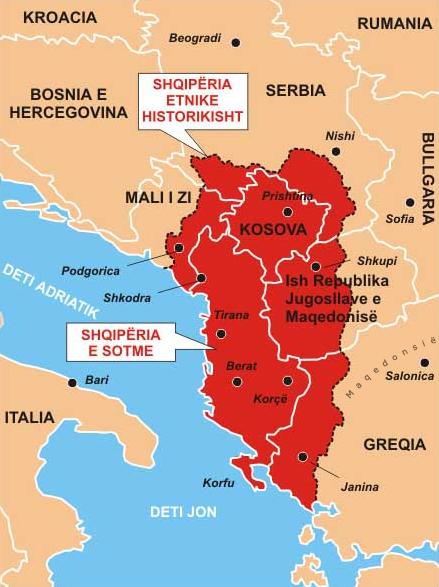
‘Greater Albania’ is a territorial concept expressing Albanian irredentist aspirations.
Moreover, the demand for union between Greece and Cyprus belongs mainly to a historical political context that has collapsed, whereas the relationship between Albania and Kosovo continues to produce functional integration. By contrast, the prospect of ‘Greater Albania’ remains alive within the national imagination. For Albania, Kosovo is the second Albanian state, even if formal union is not an immediate or realistic objective. For Kosovo, Albania is a national centre, a symbolic protector, and a practical partner. Union between Albania and Kosovo would be destabilising because it would overturn the official Western position that Kosovo constitutes a special and non-repeatable case, confirm the Serbian fear that independence was an intermediate stage towards ‘Greater Albania’, and strengthen analogous claims by Serbs in Bosnia and northern Kosovo, Albanians in North Macedonia, and other minorities in the Balkans. It would transform an already contested fait accompli into an overt revision of borders. Functional integration, however, is already present through infrastructure, trade, education, culture, defence cooperation, shared memory, and diplomatic support. The West does not desire an official ‘Greater Albania’, but it may tolerate a functionally connected Albanian space within Euro-Atlantic structures.
Kosovo is the point at which the West imposed a fait accompli in a Thucydidean manner. Serbia possessed the right of prior sovereignty and historical continuity. The Albanians possessed the more recent demographic majority, the political alienation caused by the abolition in 1989 by the Milošević regime of the broad autonomy granted in 1974, exclusion from much of the administration and public institutions, and the fear of returning to an authority they associated with police repression, displacement, and armed conflict (OSCE/ODIHR, 1999; United Nations Security Council, 1998; NATO, 2024), even though those measures were also a repressive response to unrest caused by Albanians. These considerations explain the Albanian rejection of Serbian sovereignty, but they do not automatically create a superior legal right of secession. The Western powers possessed the power to decide which claim would become reality. Albanian self-determination was accepted not as a universal principle applicable everywhere, but because it coincided with the interests of powerful international actors: the weakening of Serbia, the redefinition of the utility of NATO after the Cold War, the confirmation of American hegemony in Europe, and the establishment of German and broader Western oversight in the Western Balkans.
NATO became involved in Kosovo beyond its traditional defensive mission. Serbia had not attacked a member state, and Article 5 was not activated. The Alliance assumed the role of crisis manager beyond its original collective-defence function, invoking the humanitarian crisis and the danger of wider regional destabilisation. The intervention occurred without prior explicit authorisation from the Security Council. Resolution 1244 subsequently institutionalised the international presence and the deployment of KFOR, but did not constitute prior authorisation for the bombing campaign. The Kosovo question consequently remains a legal trauma of the international order and, simultaneously, a political fait accompli (NATO, 2026; United Nations Security Council, 1999; Simma, 1999).
The European Union seeks to manage Kosovo as a technical question of normalising the legal anomaly that was created. This is precisely one of the reasons for which it is often described as a ‘geopolitical dwarf’. It possesses economic and regulatory power, but its bureaucratic conception struggles to recognise the claim of justice and the historical trauma underlying the conflict. For Serbia, Kosovo is the violent detachment of national and sacred space. For the Albanians, it is liberation from an oppressive authority and an irreversible act of state formation. For the West, it is a fait accompli whose consequences must be rendered manageable. These three perspectives cannot be fully reconciled for as long as each side believes that recognition of the other would annul its own conception of justice. Imposition may restrain conflict, but it does not by itself produce reconciliation. Peace therefore remains closer to a suspension of conflict than to a final resolution, allowing the old image of the Balkans as a ‘powder keg’ to survive.
Albania and Serbia
Albania and Serbia represent two opposing geopolitical logics. The historical Serbian drive for access to the Adriatic was particularly intense during the Balkan Wars, when the Serbian army reached the Albanian coast but was compelled to withdraw after the establishment of Albania. Present-day Serbia is landlocked, but it does not formulate an official territorial claim for a corridor to the sea or present Albania, Croatia, and Montenegro as a coordinated barrier. It seeks practical access through rail, road, and port networks towards Bar in Montenegro, Thessaloniki, the Adriatic, and Central Europe. Its geographical enclosure strengthens its interest in regional corridors and political influence in Montenegro and Bosnia, but should not arbitrarily be transformed into a concealed territorial claim. In Kosovo, Serbia seeks to keep its legal and political claim open and to preserve its role as a central Balkan actor. Albania, which already constitutes the principal state centre of the Albanian nation, seeks to make the independence of Kosovo irreversible and to form, together with Pristina, a coordinated Albanian pole. It does not merely seek to become a centre; it seeks to transform its existing central position into broader functional leadership. The Serbian position is frequently described as ‘intransigent’. The word has a negative connotation and obscures the problem. Serbia insists upon the principles of territorial integrity and the stability of post-war borders, the historical and ecclesiastical memory of Kosovo, and Security Council Resolution 1244.
Kosovo insists upon the right of the Albanian majority, the experience of prior Serbian repression, and the impossibility of returning to Serbian sovereignty without a renewed eruption of violence. There is therefore no simple intransigence on either side, but a conflict between two opposing claims of justice: the Serbian side insists upon the primary sovereign right it lost, whereas the Kosovar side invokes a secondary legitimacy produced by a war it did not itself win and by an international administration that established a new political reality through external power. Russia exploits precisely this gap. It offers Serbia recognition of its trauma, whereas the West offers little beyond processes. Russia does not act out of disinterested friendship. It does so because Kosovo is a useful instrument against Western hegemony and in favour of the Russian presence within the Serbian political imagination. The West compressed the Serbian sense of justice, but did not eliminate it. It delivered it to those prepared to instrumentalise it.
Albania and North Macedonia
North Macedonia is the case in which the Albanian factor does not require border changes in order to alter the internal balance of a state. Albanians constitute a large proportion of the population—officially approximately 25 per cent, though possibly more—and are concentrated in areas of particular political significance, including Tetovo, Gostivar, Kičevo, Struga, Kumanovo, and parts of Skopje. The conflict of 2001 began when armed Albanian groups, organised primarily within the so-called National Liberation Army, sought through force to alter the position of Albanians within the state. In Albanian, the organisation was called Ushtria Çlirimtare Kombëtare and used the abbreviation UÇK, the same abbreviation as the Kosovo Liberation Army, although it was a different organisation. Many of its members had previously fought in Kosovo or southern Serbia, which explains the organisational and symbolic continuity.
The Ohrid Framework Agreement, achieved under strong American, European, and NATO pressure, ended the armed phase without changing the borders. It provided for decentralisation, wider use of the Albanian language, more proportional representation in public services, reinforcement of local government, and institutional recognition of the multi-ethnic character of the country. In this manner, Albanian pressure was transformed from armed contestation into institutional co-ownership of the state. North Macedonia can no longer function as a purely Slav Macedonian national state without causing serious instability. Albanians are co-shapers of the state, and their power is expressed mainly through language, decentralisation, representation, and their necessary participation in government. This institutional settlement also possessed a less equilibrating dimension. The protection of the Albanian community developed into a system of permanent ethnic distribution of political power, which allowed Albanian party elites to employ language, representation, and invocation of the Ohrid Agreement as instruments of bargaining pressure, at times beyond its original protective purpose.
At the same time, the need to preserve the internationally negotiated inter-ethnic balance gave the United States and the European Union a continuing capacity to intervene in domestic political life. The Agreement prevented the dissolution of the state, but limited the ability of the Slav Macedonian majority to translate its demographic predominance into autonomous political sovereignty. It consolidated a system in which governmental stability depends upon the consent of organised ethnic elites and the oversight of external guarantors. From the Greek perspective, this has a dual significance. On the one hand, the strong Albanian presence prevents North Macedonia from becoming a monolithic Slav Macedonian national state capable of mobilising the whole of society around an exclusive historical narrative directed against Greece. On the other hand, the contiguous Albanian-speaking zones extending from Albania and Kosovo into western North Macedonia create a functional corridor of people, trade, political parties, educational networks, and national communication. This corridor is not a military front and is not necessarily hostile towards Greece. It does, however, increase the capacity for coordination throughout the broader Albanian space and enables Tirana and Pristina to influence the internal balance of North Macedonia. Greece should therefore monitor it as a structure of political influence, rather than necessarily as a plan for territorial union.
Albania and Montenegro
Montenegro presents the moderate form of Albanian geopolitics. Albanians are fewer in number than in North Macedonia, but they are concentrated in geographically significant areas such as Ulcinj and Tuzi. The Albanian presence there does not threaten the state as a whole, but affects local political balances. Montenegro is a fragile state marked by internal tension between Montenegrin state identity and Serbian cultural, ecclesiastical, and political influence. Within this context, Albanians can function as a pro-Western factor supporting the independence and NATO orientation of Montenegro. For Albania, an independent and Western-oriented Montenegro is preferable to one absorbed into the Serbian or Russian sphere of influence.
Albania and Turkey
Turkey regards Albania as one of the gateways for its return to the Western Balkans. It does not need to revive the Ottoman Empire in order to acquire influence. For the neo-Ottoman model of influence, the utilisation of religious and cultural networks, defence and political infrastructure, and the provision of political protection in exchange for corresponding benefits are sufficient. Despite the ambitions of Turkey, Albania is not a Turkish protectorate. It is a secular state with a strong national identity and European aspirations. Turkey nevertheless offers Albania weapons, technology, religious symbolism, political support, and an alternative pole beyond the European Union. Unmanned aerial vehicles of Turkish origin, the large Namazgah Mosque, and the strategic relationship with Ankara demonstrate that Turkish influence is not merely emotional; it is also material and institutional.
For Greece, the problem is not that Albania will become an autonomous military threat tomorrow. The problem is that Turkey is acquiring a north-western channel of influence, north of Epirus and towards the maritime outlet between the Ionian and Adriatic Seas. Greece cannot demand that Albania sever relations with Turkey. It can, however, work to ensure that Turkey does not become its irreplaceable military, technological, or political protector. Cooperation with Italy and the United States is meaningful precisely in fields in which interests coincide: NATO interoperability instead of bilateral Turkish dependence, Western infrastructure funding instead of exclusively Turkish networks, control of extremist religious influence, Adriatic security, and the preservation of Albania on a European trajectory. At the same time, a continuous Greek presence is required through investment, education, local partnerships, energy interconnections, and relationships extending beyond the boundaries of the minority.
Albania and the United States
The United States is the supreme external guarantor of the contemporary Albanian position. Without the United States, neither the accession of Albania to NATO, nor the independence of Kosovo, nor the present confidence of Tirana can be explained. Washington places Albania within a broader network of pro-Western states and actors in the Western Balkans: Kosovo, North Macedonia, Montenegro, and Croatia, with Greece and Italy functioning as established NATO pillars to the south and west. Within this structure, Albania is a small but reliable ally in a region where Serbia remains strategically ambivalent, Russia interventionist, China economically present, and the European Union frequently slow to act. American support is not a blank cheque for the advancement of Albanian nationalism. The United States supports Albania and Kosovo insofar as they serve Western stability. When Pristina produces undesirable tension, Washington can restrain it. American protection therefore increases Albanian confidence while simultaneously disciplining it.
For Greece, the American presence in Albania is useful as a counterweight to Turkey and Russia, but does not replace Greek strategy. Washington may favour stability and the Euro-Atlantic integration of Albania, yet it will not automatically prioritise the Greek minority, property rights, or the maritime dispute unless Greece succeeds in linking these matters to the rule of law, regional stability, and Western institutional credibility. The growing interest of American capital in strategic investments may also provide Albanian governments with the expectation of additional political protection. It is not demonstrated that American policy is dictated by such interests; it is nevertheless reasonable to assume that an Albanian leadership will seek to employ them as an additional channel of political protection. Greece should insist that the protection of property and judicial independence concern all affected persons, Greek and Albanian alike, and cannot be suspended in the name of strategic investment.
Albania, the European Union, and Germany
The United States offers Albania security; the European Union offers an incentive for institutional transformation—rules of law and good administration, funding, a large market, and the prospect of accession. Germany, as a central power in European policy towards the Western Balkans, does not view Albania romantically. It regards it as part of a programme of stabilisation, regional cooperation, and integration. The Berlin Process—an intergovernmental framework launched in 2014 under German initiative to promote the gradual political and economic approximation of the six Western Balkan states to the European Union—the Common Regional Market, and the European Growth Plan for the Western Balkans express this logic. Because full accession is progressing slowly, the European Union seeks to create an intermediate regime of European discipline: rules, infrastructure, funding, reform, and partial access to the single market. In this manner, it seeks to integrate the Albanian space functionally without changing borders. This logic is functional, but not without danger. If the European Union accelerates enlargement for geopolitical reasons and downgrades questions of the rule of law, corruption, justice, minorities, and property, it will import into its own structures problems incompatible with the European acquis.
For Greece, the European trajectory of Albania constitutes an instrument and should be supported, but under clear conditions. Athens has an interest in transforming bilateral disputes into European criteria of compliance, so that unnecessary nationalist reflexes are not activated within Albanian society and Tirana is not permitted to equate genuine obligations towards the Greek minority with the recycling of the so-called ‘Cham issue’. The distinction is fundamental: in the one case, the matter concerns the rights of a living community under current international and European law; in the other, it concerns the retrospective transformation of complex historical events and possible individual property disputes into a collective national claim by Albania.
Albania, Russia, and China
For Albania, Russia is primarily a negative actor. It does not possess deep positive influence in Tirana. Albania is a member of NATO, is strongly pro-American, is committed to the independence of Kosovo, and is oriented towards European integration. Russia influences Albanian geopolitics primarily through Serbia and Kosovo. It supports the Serbian position, rejects the independence of Kosovo, and employs the issue as an argument against Western selectivity in the application of international law. China is a different case. Relations between the two countries possess historical depth dating from the privileged relationship of the communist period, but today China returns primarily as an economic actor through the provision of infrastructure. China does not possess in Albania the leverage that it once enjoyed there or that it currently possesses in Serbia. It may nevertheless acquire influence if the European trajectory is delayed or if Tirana seeks readily available financing without stringent institutional conditions. The Greek interest lies in keeping Albania firmly attached to the European Union and NATO. This does not automatically resolve Greek concerns, but it reduces the gaps that Russia, China, or Turkey could exploit.
Croatia, Bosnia, and Bulgaria
Relations with Croatia, Bosnia, and Bulgaria are secondary, but useful for understanding Albanian geopolitics. Euro-Atlantic-oriented Croatia reinforces the anti-Serbian and NATO dimension of the Albanian position. The emerging trilateral defence cooperation among Albania, Croatia, and Kosovo, formally inaugurated by the Joint Declaration of March 2025, constitutes a political and defence signal towards Serbia, although it should not be described simplistically as a military alliance. Bosnia offers a useful comparative example of a Muslim Balkan space under international supervision and Turkish influence. The analogy, however, has limits. In Bosnia, Republika Srpska is a constitutionally established entity with its own government, assembly, and extensive powers, capable of obstructing or delaying the functioning of the common state. This is precisely why Pristina fears that an Association of Serb-Majority Municipalities endowed with excessively broad powers could evolve into a comparable internal centre of obstruction. This concern does not justify the failure to honour agreed obligations, but it explains why Kosovo regards even forms of local Serbian self-government as potential threats to the functionality of the state. Bulgaria is connected to Albania primarily through North Macedonia and the so-called Corridor VIII. The corridor links the Adriatic with the Black Sea through Albania, North Macedonia, and Bulgaria, and gives the Albanian space an infrastructural significance extending beyond ethnic geopolitics. Albanian geopolitics therefore possesses not only a national dimension, but also a commercial, transport, and energy dimension.
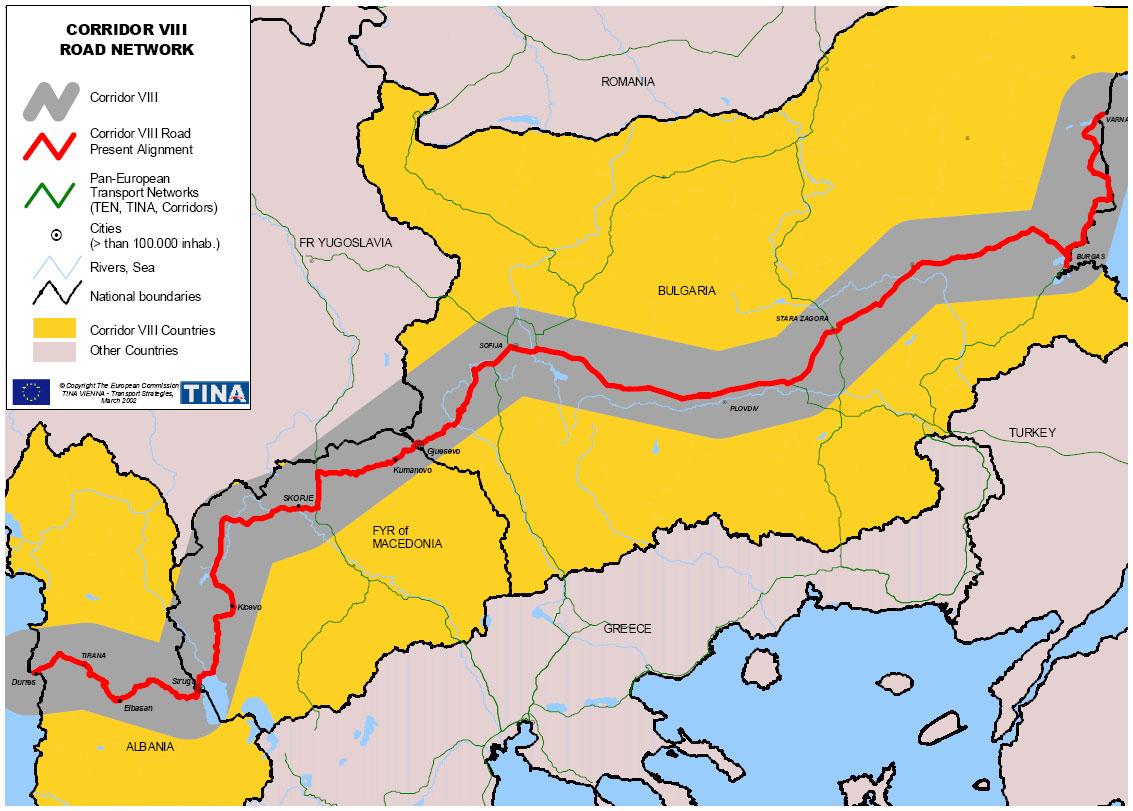
The Corridor VIII is planned to link the Adriatic with the Black Sea through Albania, North Macedonia, and Bulgaria, adding significant geopolitical importance to Albania.
Actual and Perceived Interest of Albania
The interests of Albania possess two dimensions that frequently diverge. As a state, it requires stability, institutions, European integration, a robust economy, investment, and the avoidance of war. As a national pole, it seeks to protect and politically connect Albanian populations beyond its borders. Its success depends upon whether it can transform the broader Albanian space into a functional network within the Western order without becoming a revisionist state and a source of instability. The strategically most efficient option for Albania is not the pursuit of ‘Greater Albania’, but functional integration without formal union: common infrastructure, commercial mobility, educational relations, cultural cohesion, coordination with Kosovo, and support for Albanians in North Macedonia and Montenegro. This strategy achieves much of the desired national cohesion without provoking the immediate international reaction that overt border revision would produce. The danger lies in overestimation. A small state with several protectors may confuse its own power with the power lent to it by others. American support, the European prospect, Italian proximity, and Turkish assistance can produce confidence greater than actual Albanian power warrants. Crises often arise from such gaps between actual and perceived power.
The ‘Cham Issue’
The so-called ‘Cham issue’ possesses a genuine historical background, but it does not constitute a single legal case and cannot be equated with a contemporary minority or territorial question. Following the incorporation of Thesprotia into Greece in 1913, the Muslim Albanian-speaking population of the area, known as the Chams, retained a distinct religious and linguistic identity. Its integration into the Greek state remained incomplete. Contributing factors included the distrust of the Greek authorities, property disputes, the arrival of refugees in the region after the Asia Minor Catastrophe, the Albanian national orientation of the leadership and the principal part of the community, and the broader political instability of the interwar period. The issue did not therefore originate in 1944; the Occupation, however, radically transformed its legal and political nature (Manta, 2004; Baltsiotis, 2011; Kretsi, 2002).
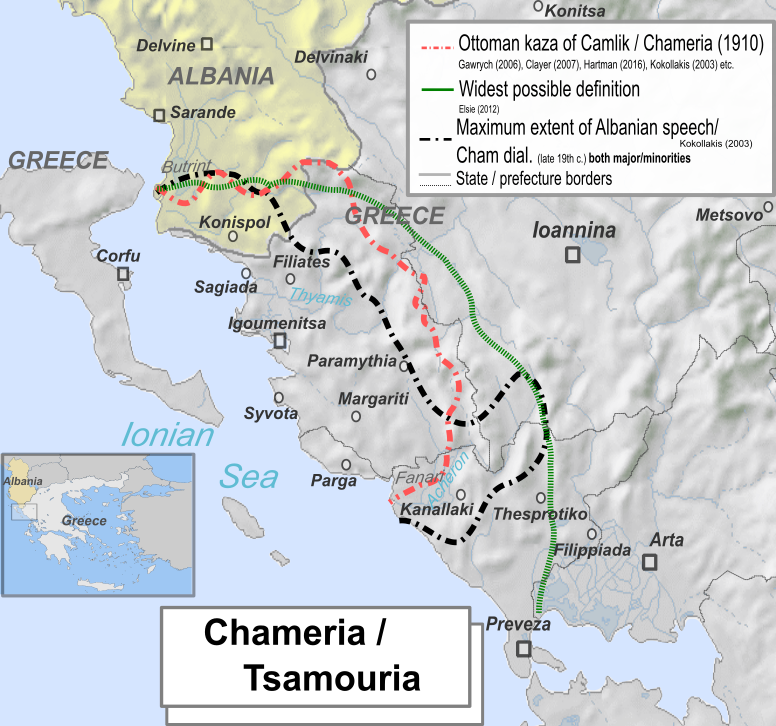
The location of Chameria. Red: the area in 1910 at the end of Ottoman rule; Green: the maximum extent claimed according to Albanian sources. Black: the maximum extent of the Cham dialect.
During the Italian and German occupations, a significant part of the political and armed leadership of the Muslim Chams collaborated with the occupying forces and participated in persecution, looting, and war crimes against the Greek population (Manta, 2004; Mazower, 2000; Vickers, 2002). This fact should neither be concealed nor extended into collective guilt. There were also Chams who did not collaborate, persons who remained passive, and a smaller number who joined the resistance. Individual responsibility must therefore remain distinct from membership of the community. After the German withdrawal and the predominance of the forces of EDES in the region, most of the community fled to Albania amid armed conflict, reprisals, and acts of vengeance. Convictions in absentia by the Special Courts for Collaborators followed, together with administrative or legislative measures affecting the citizenship and property of many of those who had departed. The historical and legal distinction among proven collaborators, members of their families, and persons without established individual responsibility remains necessary. Collective incrimination of the whole community is unacceptable; equally unacceptable is its contemporary presentation by Albania as an undifferentiated body of innocent victims (Mazower, 2000; Vickers, 2002; Kretsi, 2002; Manta, 2004; Baltsiotis, 2011).
This differentiation determines the legal nature of the property question. There is no single category of ‘Cham property’ with a common legal fate. Some properties were affected by agrarian reform and the settlement of refugees; others were subject to sequestration or confiscation following criminal convictions; others may have been considered abandoned; and some cases may involve heirs who were not personally convicted of any offence. Each potential claim must therefore be examined individually: who owned the property, whether a final conviction existed, which legal act affected it, whether the measure amounted to confiscation, compulsory purchase, sequestration, or abandonment, whether compensation was paid, what citizenship the owner possessed, and which domestic remedies were or remain available. The fact that property was subsequently used for public purposes or distributed to refugees does not, by itself, establish the legality of every original deprivation. Conversely, the absence of compensation in an individual case does not transform all Cham property into a single collective claim. The European Convention on Human Rights cannot normally be applied retroactively to completed acts predating its entry into force in respect of Greece. A distinction must also be drawn between a completed historical act that continues to produce effects and a genuinely continuing violation. This distinction is central to the case law of the European Court of Human Rights. Even where an individual property claim might remain legally arguable, it does not generate a collective right of return, does not reconstitute a minority, and does not create a territorial claim. The contemporary elevation of these heterogeneous historical and property cases into a unified ‘Cham issue’ is primarily political. It transforms individual disputes into a collective national claim, supplies Albanian nationalism with a narrative of victimhood, and is used as a counterweight to Greek concerns regarding the living Greek minority in Albania (Vickers, 2002; Kretsi, 2002).
The distinction is fundamental. In one case, the matter concerns the rights of an existing community under current international and European law. In the other, it concerns the retrospective transformation of complex historical events and possible individual property disputes into a collective national claim by Albania. The principle of reciprocity cannot erase this distinction. The treatment of the Greek minority in Albania constitutes a current obligation of the Albanian state. The Cham issue can at most produce specific individual legal claims, provided that each is examined according to the applicable law and evidence. Greece should therefore avoid both denial of the historical complexity and acceptance of the political framing imposed by Tirana. It should acknowledge that individual injustices may have occurred, insist upon individualised legal scrutiny, reject collective guilt, and equally reject the transformation of private claims into a minority, territorial, or interstate issue.
Greek Strategy towards Albania
Greece should not seek a weak Albania, but an Albania bound by institutions, rules, and interdependencies. A weak and internally destabilised Albania would readily become a field for the exercise of influence by third actors, intensify migratory and criminal flows, and make the protection of the Greek minority more difficult. By contrast, an Albania whose European trajectory depends upon specific institutional obligations can become a more predictable neighbour. Greek–Albanian relations display what is defined in Thucydidean Geopolitics as the ‘paradox of proximity and intractable rivalry’. Geographical proximity creates dense common interests, but at the same time multiplies points of friction because the two countries encounter one another along the same border, in minority questions, property disputes, maritime zones, migratory flows, and the same regional space. Overcoming this paradox cannot rest upon political goodwill alone, because goodwill changes with governments and circumstances. It requires the gradual integration of interests under a European institutional umbrella, following the model of post-war Franco-German rapprochement. The Franco-German rivalry was not overcome through historical amnesia, but by subjecting critical economic and strategic resources to common management, thereby making conflict more costly than cooperation. The Greek objective should be analogous: not the rhetorical elimination of differences, but the transformation of interdependence into a mechanism of discipline.
Greek strategy should develop along five interconnected axes: The first is support for the European trajectory of Albania, not as unconditional political favour, but as a negotiating framework containing clear criteria, timetables, and monitored implementation. Progress towards accession should be linked to measurable obligations concerning the rule of law, judicial independence, protection of property, and minority rights. The European trajectory should not be employed to bypass Greek–Albanian disputes, but to transform Greek claims into European conditions of compliance.
The second axis is the protection of the Greek minority, property rights, and local government in the historic minority areas. Athens should not confine the issue to bilateral national protests, which Tirana can easily present as Greek interference. It should consistently place it within the fields of European law, judicial security, and good administration. The protection of Himara, Dropull, and the other Greek communities is not merely a defence of co-ethnics; it is a test of the capacity of the Albanian state to apply equal rules to citizens, minorities, and property owners.
The third axis is the legal settlement of maritime zones. Greece should remain committed to the international law of the sea and exclude the introduction of Turkish conceptions into Albanian argumentation. Referral of the dispute to an international court may provide Tirana with political cover against accusations of concession, provided that the special agreement is legally precise and does not open questions beyond the specific delimitation. The Greek position must be stable, technically developed, and independent of the personal relations between individual leaders.
The fourth axis is the limitation of any monopoly of Turkish influence. Greece neither can nor needs to exclude Ankara from Albania. It can, however, reduce the relative value of Turkish influence by offering more substantial and durable benefits: access to the European market, investment, energy and transport interconnections, education, institutional expertise, and cooperation with Italy, the European Union, and the United States. Where Turkey offers weapons, personalised political relationships, and Ottoman symbolism, Greece should offer law, economic interdependence, and access to European institutions. Greek influence will not arise from sentimental invocations of friendship, but from the practical usefulness of cooperation.
The fifth axis is the development of functional relations with the whole Albanian space, including Kosovo and the Albanian political forces in North Macedonia and Montenegro. Non-recognition of Kosovo should not be equivalent to political absence. Greece can develop economic, educational, and administrative relations while preserving its legal reservations and avoiding actions that would weaken its position concerning Cyprus or the principle of territorial integrity. Absence from the broader Albanian space does not protect Greek positions; it merely leaves the field to Turkey and other actors. Greek policy should therefore move away both from inertia and from theatrical displays of power. Military rhetoric concerning protection of the minority would rally Albanian nationalism, legitimise the Turkish presence, and transform a question of rights into an interstate crisis.
The effective power of Greece lies in procedures, alliances, accession chapters, legal documentation, investment, education, and continuous presence. Greece should not threaten more than it can enforce; it should enforce more than it declares by using institutional means whose operation does not depend upon transient tensions. The Greek interest lies neither in a return to old border fantasies nor in unconditional support for an Albanian government in the name of regional stability. It lies in transforming Greek rights into specific European obligations of Albania and common economic interests into institutional bonds whose violation entails genuine political and economic cost. Where Albania seeks the privilege of European accession, Greece should demand the obligation of European compliance. Where Tirana attempts to use relations with the United States, Turkey, Italy, or European centres to detach the accession process from bilateral and European obligations, Athens should reconnect political benefit to specific institutional cost: the opening and closure of chapters, funding, judicial cooperation, and measurable guarantees of implementation.
Final Synthesis
Albania constitutes one of the most concentrated geopolitical cases in the Balkans. It is a small state in terms of population, economy, and military power, but a large one in terms of the strategic density of its position. It lies at the intersection of the Adriatic and the Ionian, the Balkan interior and the Italian coast, the Serbian and Albanian national spaces, the Greek presence in Northern Epirus, the return of Turkey, American protection, and European enlargement. Its importance therefore derives not only from what it possesses, but also from what others fear, seek, or attempt to prevent through it. Its first function is that of a barrier state. Its independence served the need to exclude Serbia from the Adriatic, limit Greek expansion northwards, and prevent the exclusive control of the Albanian coast by any great power. This historical function has not disappeared. Albania continues to stand between the Serbian interior and the sea, between Italian security and the eastern shore of Otranto, and between Greek Epirus and the broader Albanian space. Its second function is that of a national consolidator. The borders of the Albanian state do not coincide with the limits of the Albanian nation. Kosovo, the Albanian communities of North Macedonia and Montenegro, and the diaspora form a broader space of linguistic, political, and symbolic cohesion. Contemporary Albanian strategy does not need to seek an immediate revision of borders in order to strengthen this cohesion. It can advance it through infrastructure, trade, education, culture, party networks, defence cooperation, and common diplomatic action. In this manner, a large part of functional integration can be achieved without the official formation of ‘Greater Albania’ and without the international cost that overt territorial revision would provoke.
Its third function is that of a Balkan hub of power. Albania is not merely a passive platform for third powers. It exploits competition among Italy, Turkey, the United States, and the European Union in order to obtain security, investment, political protection, and international elevation. The multiplicity of protectors increases the freedom of manoeuvre of Tirana because no external actor wishes to abandon the field to its competitors. Albanian power, however, remains partly borrowed: it arises from the usefulness of the country to more powerful actors and not solely from its own material capabilities. Here lies the principal danger. A small state with several protectors may confuse its own power with that supplied by others. American support, the European prospect, Italian proximity, and Turkish assistance can produce confidence greater than the actual resources of the state justify. For as long as external objectives coincide with Albanian strategy, this asymmetry remains hidden. If the interests of the protectors change or collide, however, the gap between actual and perceived power may become a source of miscalculation.
From a Thucydidean perspective, Albanian geopolitics is organised around the interaction of Fear, Honour, and Interest. Fear arises from the historical division of the national space and the memory of foreign decisions concerning the fate of the Albanians. Honour is expressed in the aspiration for recognition of Albania as the centre of a nation extending beyond its state borders. Interest dictates attachment to the West, institutional stability, economic development, and the avoidance of overt border revision. For as long as these three forces remain in equilibrium, Albania can function as a factor of stability. When Honour and national aspiration become detached from actual power, or when Fear becomes permanent suspicion towards neighbouring states, the Albanian question can reappear as a problem of borders, minorities, and protecting powers. For Greece, the correct response is neither to underestimate nor to demonise Albania. It is to understand accurately its three functions. As a barrier state, Albania will continue to receive protection from powers that do not desire a change in the Balkan balance. As a national consolidator, it will continue to influence Kosovo, North Macedonia, and Montenegro. As a Balkan hub of power, it will seek to transform the interest of third actors into political advantage.
Greek strategy should therefore be based not upon the expectation that these functions will disappear, but upon the effort to place them within a framework of institutions, interdependencies, and cost. Albania is, ultimately, small in body but large in position. Geography made it useful, historical genesis made it necessary, and the division of the Albanian national space made it permanently restless. Its future conduct will depend upon whether it transforms borrowed power into institutional maturity or treats the protection of powerful actors as a substitute for actual power. In the first case, it may develop into a stable link between the Adriatic and the Balkan interior; in the second, it will remain another space in which the distance between power, the perception of power, and national ambition creates the conditions for the next crisis.
Bibliography
Babuna, Aydin. ‘The Albanians of Kosovo and Macedonia: Ethnic Identity Superseding Religion’. Nationalities Papers 28, no. 1 (2000): 67–92. https://doi.org/10.1080/00905990050002461.
Babuna, Aydin. ‘The Bosnian Muslims and Albanians: Islam and Nationalism’. Nationalities Papers 32, no. 2 (2004): 287–321. https://doi.org/10.1080/0090599042000230250.
Ballinger, Pamela. ‘A Sea of Difference, a History of Gaps: Migrations between Italy and Albania, 1939–1992’. Comparative Studies in Society and History 60, no. 4 (2018): 1006–1029. https://doi.org/10.1017/S0010417518000331.
Baltsiotis, Lambros. ‘The Muslim Chams of Northwestern Greece: The Grounds for the Expulsion of a “Non-Existent” Minority Community’. European Journal of Turkish Studies 12 (2011).
Duka, Valentina. ‘Wilhelm Wied and the Movement of Northern Epirus: The Protocol of Corfu’. Mediterranean Journal of Social Sciences 4, no. 10 (2013): 463–468.
European Commission. Albania 2021 Report. SWD(2021) 289 final. Brussels: European Commission, 19 October 2021.
Fischer, Bernd J. ‘Albania since 1989: The Hoxhaist Legacy’. In Central and Southeast European Politics since 1989, edited by Sabrina P. Ramet, 421–438. Cambridge: Cambridge University Press, 2010.
Fischer, Bernd J., and Oliver Jens Schmitt. A Concise History of Albania. Cambridge: Cambridge University Press, 2022.
Hammond, N. G. L. Epirus: The Geography, the Ancient Remains, the History and the Topography of Epirus and Adjacent Areas. Oxford: Clarendon Press, 1967.
Hellenic Ministry of Foreign Affairs. ‘Minister of Foreign Affairs Nikos Dendias’ Intervention in a Web Event Organised by the Jewish Institute for National Security of America’. 30 March 2021.
International Court of Justice. Accordance with International Law of the Unilateral Declaration of Independence in Respect of Kosovo, Advisory Opinion. I.C.J. Reports 2010, p. 403.
Jarvis, Christopher. ‘The Rise and Fall of Albania’s Pyramid Schemes’. Finance & Development 37, no. 1 (2000): 46–49.
Jarvis, Christopher. The Rise and Fall of the Pyramid Schemes in Albania. IMF Working Paper WP/99/98. Washington, DC: International Monetary Fund, 1999.
Kretsi, Georgia. ‘The “Secret” Past of the Greek-Albanian Borderlands: Cham Muslims and Greek Orthodox Christians in Conflict’. Ethnologia Balkanica 6 (2002): 171–195.
Malcolm, Noel. ‘The “Great Migration” of the Serbs from Kosovo (1690): History, Myth and Ideology’. In Rebels, Believers, Survivors: Studies in the History of the Albanians, 128–148. Oxford: Oxford University Press, 2020. https://doi.org/10.1093/oso/9780198857297.003.0007.
Manta, Eleftheria. Οι Μουσουλμάνοι Τσάμηδες της Ηπείρου, 1923–2000 [The Muslim Chams of Epirus, 1923–2000]. Thessaloniki: Institute for Balkan Studies, 2004.
Mazower, Mark. ‘Three Forms of Political Justice: Greece, 1944–1945’. In After the War Was Over: Reconstructing the Family, Nation, and State in Greece, 1943–1960, edited by Mark Mazower. Princeton, NJ: Princeton University Press, 2000.
NATO. ‘Kosovo Air Campaign, March–June 1999: Operation Allied Force’. Updated 21 October 2024.
NATO. ‘NATO’s Role in Kosovo’. Updated 12 June 2026.
Organization for Security and Co-operation in Europe, Office for Democratic Institutions and Human Rights. Kosovo/Kosova: As Seen, As Told—An Analysis of the Human Rights Findings of the OSCE Kosovo Verification Mission, October 1998 to June 1999. Warsaw: OSCE/ODIHR, 1999.
Simma, Bruno. ‘NATO, the UN and the Use of Force: Legal Aspects’. European Journal of International Law 10, no. 1 (1999): 1–22. https://doi.org/10.1093/ejil/10.1.1.
Skendi, Stavro. The Albanian National Awakening, 1878–1912. Princeton, NJ: Princeton University Press, 1967.
Tase, Peter. ‘Italy and Albania: The Political and Economic Alliance and the Italian Invasion of 1939’. Academic Journal of Interdisciplinary Studies 1, no. 3 (2012): 45–60.
Tsitselikis, Konstantinos. Old and New Islam in Greece: From Historical Minorities to Immigrant Newcomers. Leiden: Martinus Nijhoff Publishers, 2012.
United Nations Security Council. Resolution 1101 (1997). S/RES/1101. 28 March 1997.
United Nations Security Council. Resolution 1199 (1998). S/RES/1199. 23 September 1998.
United Nations Security Council. Resolution 1244 (1999). S/RES/1244. 10 June 1999.
United States Department of State. Foreign Relations of the United States, 1914, Supplement: The World War. Washington, DC: United States Government Printing Office, 1928.
United States Department of State. Foreign Relations of the United States, 1946, Paris Peace Conference: Proceedings, vol. IV. Washington, DC: United States Government Printing Office, 1946.
Vickers, Miranda. The Cham Issue: Albanian National and Property Claims in Greece. Camberley: Conflict Studies Research Centre, Defence Academy of the United Kingdom, 2002.
Winnifrith, Tom. Badlands—Borderlands: A History of Northern Epirus/Southern Albania. London: Duckworth, 2002.