Aspects of the transition from conventional attrition to existential threat through the destruction of survival infrastructure
This essay seeks to answer the following questions:
1. How does water dependency affect the nuclear threshold of deterrence?
2. Can the destruction of survival infrastructure impose escalation as a structural necessity?
Abstract
The ongoing Iran war (initiated late February 2026) has breached a long-standing taboo by drawing desalination plants into the conflict. Limited strikes on facilities in Iran (e.g., Qeshm Island), Bahrain, and incidental damage in Kuwait and the UAE have highlighted the acute water dependency of the Arabian Peninsula and parts of the Levant. Desalination now supplies the majority of drinking water in several Gulf states—up to 90%+ in Kuwait, Bahrain, and Qatar, ~70% in Saudi Arabia, and lower but still critical shares in the UAE and Israel.
This dependency creates concentrated vulnerability: production is dominated by a relatively small number of large coastal plants, many within missile and drone range of adversaries. Damage can disrupt supply quickly, and strategic reserves in smaller states are limited to days under normal conditions (potentially longer with rationing). Yet recent incidents show that while localized shortages occur, systemic societal collapse has not materialized. Redundancy measures, rapid response, alliances, and mutual vulnerability have so far contained escalation below the nuclear threshold. Water raises the stakes of conventional warfare in arid regions but does not structurally rewrite nuclear deterrence or render escalation to weapons of mass destruction inevitable.
Introduction
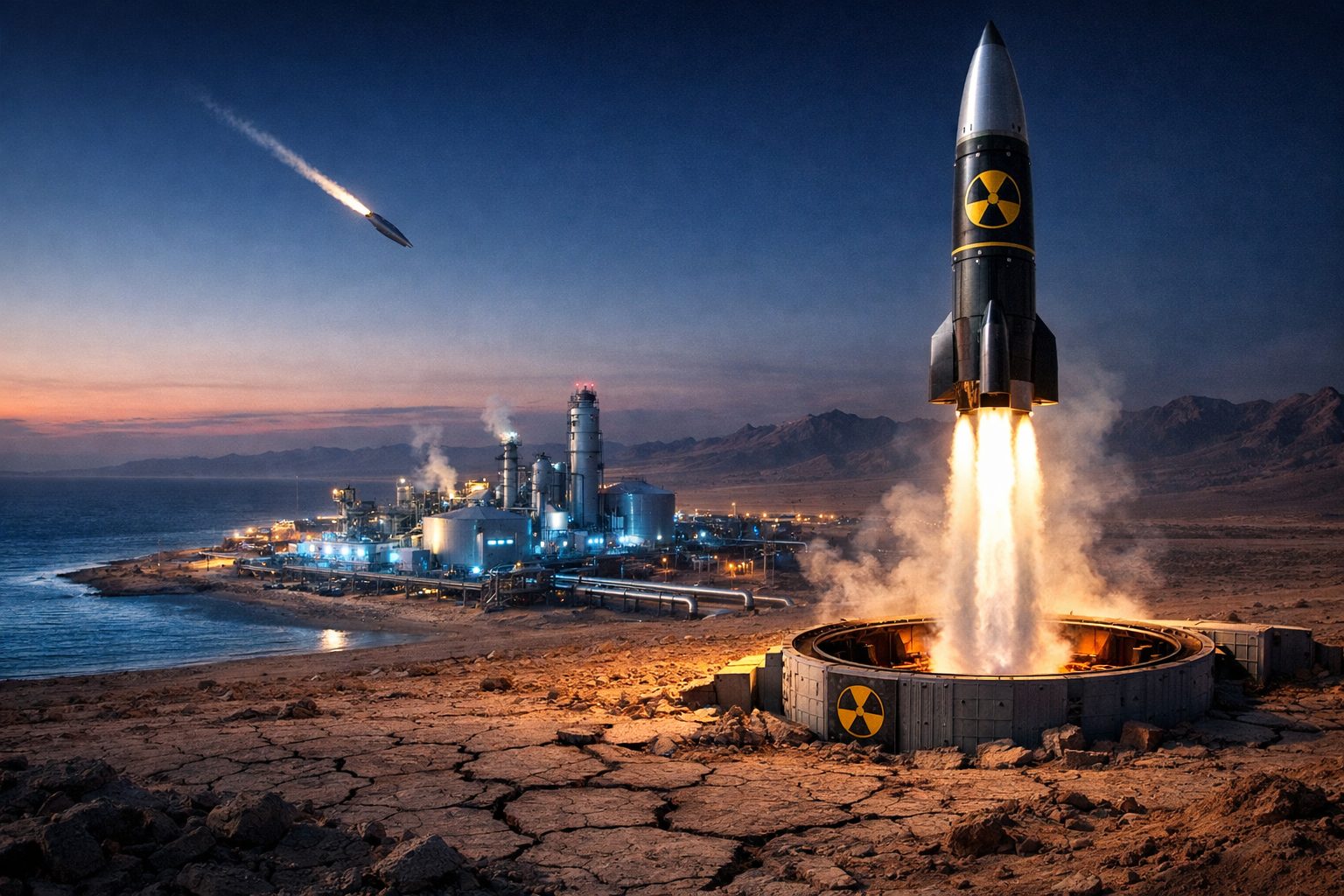
In the arid Extended Levant—encompassing the Arabian Peninsula and adjacent areas—modern states have engineered survival through massive investment in seawater desalination. This technological backbone sustains urban populations, industry, and economies that would otherwise be impossible at current scales. The Iran war has tested this system: accusations of strikes on Iranian plants (e.g., Qeshm affecting villages), followed by Iranian retaliation against a Bahraini facility, and reports of damage elsewhere, mark a dangerous precedent.
Historically, Gulf conflicts largely spared desalination infrastructure, recognizing its existential character. That restraint has frayed amid tit-for-tat threats, with Iran warning of “irreversible destruction” if its energy grid is further targeted, and counter-accusations flying. Water infrastructure targeting shifts conflict dynamics from purely economic or military attrition toward threats against biological and social sustainability. In Thucydidean terms, it amplifies Fear (of deprivation), challenges Honour (as restraint erodes), and reorients Interest toward raw survival imperatives.
However, this vulnerability does not automatically compress the nuclear threshold into structural necessity. Graduated conventional responses, technological and logistical adaptations, external alliances (particularly U.S. support for Gulf states), and reciprocal risks (coastal plants of Iran and broader drought pressures) have kept the conflict within conventional bounds so far. The essay explores these tensions without assuming inevitability.
Water Dependency and Concentrated Vulnerability
Gulf Cooperation Council (GCC) states account for a substantial share of global desalination capacity, with thousands of plants producing tens of millions of cubic meters daily. A handful of mega-plants handle the bulk of output—over 90% of desalinated water from roughly 56 large installations in some assessments—making the system linear and coastal, hence exposed to precision strikes, drones, or sabotage.
Dependency ratios are stark for potable water:
- Kuwait, Bahrain, Qatar: 90%+
- Oman: ~86%
- Saudi Arabia: ~70%
- UAE: ~42% (higher for certain cities)
- Israel: significant share (~70-80% in broader estimates for potable needs, supplemented by reuse and other sources)
Smaller states have minimal natural freshwater buffers, turning desalination into the foundational condition for social continuity in desert megacities. Plants require energy (often co-located with power facilities), specialized components (membranes, pumps), and vulnerable intakes/outfalls. Repair timelines for major damage can span weeks to months.
This concentration creates genuine strategic asymmetry: an adversary like Iran can threaten high-impact disruption with relatively limited assets, while the conventional superiority of Gulf states and air defenses offer partial mitigation.
From Material Damage to Existential Pressure: Evidence from the 2026 Conflict
Early March 2026 strikes demonstrated the risks. Iran claimed a U.S. attack on its Qeshm Island plant cut supply to 30 villages. Bahrain reported an Iranian drone causing material damage to one of its facilities (affecting some municipalities locally, though authorities stated broader supplies held). Incidental or reported damage occurred in Kuwait and UAE sites from missile/drone activity, though operations often continued.
These incidents produced localized disruptions rather than nationwide collapse. No mass social disintegration, exodus, or regime-threatening breakdown occurred. Supplies were prioritized for critical needs; repairs mobilized; emergency measures (rationing, trucking, mobile units) deployed. Larger states like Saudi Arabia and the UAE benefit from greater diversification, pipeline networks, groundwater, and ongoing investments in storage.
Reserves vary: smaller Gulf states hold limited buffers (days under normal demand; extendable via rationing to weeks). Saudi has built strategic reservoirs. Pre-war CIA warnings (declassified) about this vulnerability proved prescient; states have invested billions in mitigation precisely because of it.
Iran faces parallel pressures: severe drought, declining rivers, groundwater depletion, and sanctions complicating repairs. Mutual vulnerability creates a form of conventional deterrence—attacking the other’s water risks retaliation against one’s own.
Thucydidean Structure of Escalation: Fear, Honour, Interest
Water threats intensify classical drivers of conflict. Fear gains a biological edge when deprivation looms for populations in extreme heat with few alternatives. Honour as restraint weakens once the taboo is breached, as seen in reciprocal accusations and threats. Interest risks individualizing toward personal and familial survival, straining social cohesion and state legitimacy.
Yet this does not render prior restraints non-functional. States retain agency through alliances, international diplomacy, and calibrated responses. Gulf leaderships have coordinated defenses and avoided panic. Populations have endured prior stresses (blackouts, heat, conflicts) without wholesale breakdown. Leadership maintains control via security apparatuses and external guarantees.
Targeting dual-use or civilian-critical infrastructure raises serious international humanitarian law concerns. Additional Protocol I to the Geneva Conventions prohibits attacking objects indispensable to civilian survival (drinking water installations) if intended to deny sustenance, subject to proportionality and precautions (see also Footnote 1). Deliberate campaigns risking widespread civilian harm could violate distinction and proportionality principles, though isolated tactical strikes amid broader conflict require case-specific assessment of intent and military necessity. Reciprocity does not legally justify violations.
The Nuclear Threshold under Water Deprivation Conditions
The original concern—that water threats disrupt Mutually Assured Destruction (MAD, see also Footnote 2) by imposing time-compressed existential pressure incompatible with survival timelines—is understandable but overstated in practice. No nuclear threshold has been approached despite the strikes. Gulf states lack nuclear weapons and rely on conventional/U.S.-backed deterrence. Israel possesses undeclared nuclear capability but maintains diversified water sources (wastewater reuse, aquifers, Jordan River) alongside desalination and robust defenses; it has not invoked nuclear options.
Iran pursues threshold nuclear capabilities but has responded with conventional/missile means, constrained by its own vulnerabilities. MAD logic persists: nuclear use would invite overwhelming retaliation, destroy regional infrastructure indiscriminately, and trigger global isolation—outcomes antithetical to any rational survival calculus.
Time compression from water loss is real but mitigated by:
- Limited reserves and rationing
- Logistical prioritization (military/civilian)
- Emergency imports and mobile desalination
- Air/missile defenses protecting key sites
- Decentralized or private plants providing partial redundancy
Escalation has remained graduated. A pre-emptive nuclear strike over water deprivation would be self-defeating rather than a rational necessity: it would likely invite overwhelming retaliation, destroy the very infrastructure and populations one seeks to protect, and trigger global isolation. Realism therefore continues to favor balancing through conventional superiority, air and missile defenses, diplomacy, alliance guarantees (especially the U.S. umbrella for Gulf states—although it has practically failed), and investments in resilience—such as strategic reserves, redundancy, and decentralized facilities—over apocalyptic leaps. Water infrastructure attacks amplify coercive pressure and raise the risks of uncontrolled escalation, but they have not overridden the nuclear taboo or existing alliance structures.
That said, rational strategic calculus is not the only force at work. Domestic political pressures and ideological commitments can distort decision-making. In Israel, far-right nationalist-religious elements within Netanyahu’s coalition have exerted influence toward more uncompromising positions. In Iran, hardline factions drawing on revolutionary interpretations of Shi’a ideology have amplified calls for defiance, resistance, and even accelerated nuclear hedging under existential threat. While such factors introduce an element of unpredictability, the trajectory of the conflict to date—including limited tit-for-tat strikes on desalination facilities—suggests that mutual vulnerability, external deterrence, and the sheer costs of nuclear breakout have so far prevailed over ideological maximalism.
Conclusion
The Iran war has exposed the dual nature of desalination: an engineering triumph enabling modern life in the Extended Levant and a high-value target creating asymmetric pressures. Concentrated coastal infrastructure, high dependency ratios, and limited buffers in smaller states generate real coercive leverage and humanitarian risks. Breaching the historical taboo risks normalizing attacks on survival infrastructure, with potential for broader suffering if escalated.
Yet evidence from March 2026 shows resilience: limited strikes caused disruption without triggering societal collapse or nuclear dynamics. Adaptations—reserves, diversification, defenses—and mutual vulnerabilities have prevented the slide to structural inevitability. Thucydidean Fear, Honour, and Interest are intensified, but states retain tools for de-escalation and conventional management. That said, unpredictability of extremist factions on both sides still exists.
Post-conflict, regional security architectures must address this vulnerability explicitly: enhanced protections for water systems under international humanitarian law, investment in redundancy and storage, confidence-building measures against infrastructure targeting, and diplomatic frameworks that treat water as a shared red line rather than a weapon. Water has joined energy and oil as a domain of coercion in arid-state conflict. It raises the human and strategic costs of war but does not destiny nuclear escalation. Prudent policy combines deterrence, resilience, and restraint to preserve the delicate balance between survival and stability.
Footnote 1
According to the Convention on the Prevention and Punishment of the Crime of Genocide (1948) (UN, 1948), the attribution of genocide requires the presence of dolus specialis—the specific intent to destroy a protected group as such—beyond mens rea [the guilty mind; Encyclopaedia Britannica, (2025)] and actus reus (the act or omission constituting the commission of a crime). International jurisprudence infers such intent from factors including the systematic targeting of civilians as civilians, the selective targeting of victims on the basis of group identity, the scale and method of destruction, coordinated practices incompatible with any military objective, as well as explicit statements or orders of extermination.
The deliberate and systematic destruction of desalination infrastructure, under conditions of known dependency of the population upon such systems, renders particularly difficult the invocation of factors capable of negating the inference of relevant intent under international law. Arguments concerning incidental effects, prior warnings, or other forms of mitigation are not, in principle, sufficient to dissociate the act from its consequences for the conditions of survival of the population.
Footnote 2
Hans Morgenthau argues that, in an anarchic world lacking a central guarantor of security, states must prioritise the pursuit and balancing of power. This view provides a robust framework for the analysis of strategic competition. For example, the doctrine of nuclear deterrence during the Cold War between the United States and the Soviet Union rested upon the threat of Mutually Assured Destruction—the concept of MAD (Mutually Assured Destruction)—thereby establishing a delicate equilibrium that prevented direct conflict. Such carefully calibrated strategies illustrate the enduring relevance of realism, within which power and interest primarily determine the behaviour of states. (Excerpt from Papastavrou, A-T. (2026). Thucydidean Geopolitics for the Educated Layperson)
Bibliographical Anchors
Ambos, K. (2009). What does ‘intent to destroy’ in genocide mean? International Committee of the Red Cross (ICRC). Full text
Britannica E. (2025a). Mens rea. Encyclopedia Britannica. Full text
Britannica E. (2025b). Actus reus. Encyclopedia Britannica. Full text
Hussein, M. A. (2026). How much of the Gulf’s water comes from desalination plants? Al Jazeera. Full text
IHL Databases. (1949). Article 54 - Protection of objects indispensable to the survival of the civilian population.Full text
Office of Global Issues (author classified). (2010). _Vulnerability of Persian Gulf Desalination Systems: An Emerging Security Issue._Directorate of Intelligence, CIA. Full text
Matchett, G. (2026). _Attacks on desalination plants in the Iran war forecast a dark future._Atlantic Council. Full text
Papastavrou, A-T. (2026). Thucydidean geopolitics for the educated layperson. Ἡδυέπεια (Editors). Link
Nereim, V. (2026). Vital Desalination Plants in Iran and Bahrain Are Attacked. New York Times. Full text
UN. (1948). Convention on the Prevention and Punishment of the Crime of Genocide. United Nations. Full text