Unity versus Fragmentation in a Changing Geopolitical System
This essay addresses the following questions:
1. Is the Saudi-Emirati rivalry in Yemen merely a contingent divergence, or does it reveal a conflict between two distinct geopolitical conceptions of regional order?
2. How is this conflict connected with the maritime strategy of the UAE, with its relationship to Israel, with the case of Somaliland, and with the wider confrontation revolving around Iran?
Abstract
The present essay examines the gradual transformation of Saudi-Emirati cooperation in Yemen into a structural rivalry, bringing to light the differing geopolitical logics that animate it. It is argued that Saudi Arabia seeks to preserve a unified, or at the very least controllable, Yemen, capable of serving as a buffer zone and source of strategic depth against external threats, above all Iran. By contrast, the United Arab Emirates has developed a maritime-centred strategy directed towards the control of ports, islands, and sea-lanes, favouring the emergence of smaller, functional, and manageable political entities. The rise of the Southern Transitional Council (STC) and the progressive de facto partition of Yemen give visible form to this divergence. The essay situates this dynamic within a broader regional framework, including Emirati-Israeli convergence, the significance of Somaliland as a potential link in a maritime network of power, and the possible effects of a wider conflict involving Iran. It concludes that Yemen has ceased to be merely a local battlefield, and has instead become a nodal point at which two rival visions of regional order collide. The analysis further considers how scenarios of wider confrontation involving Iran may modify these divergences.
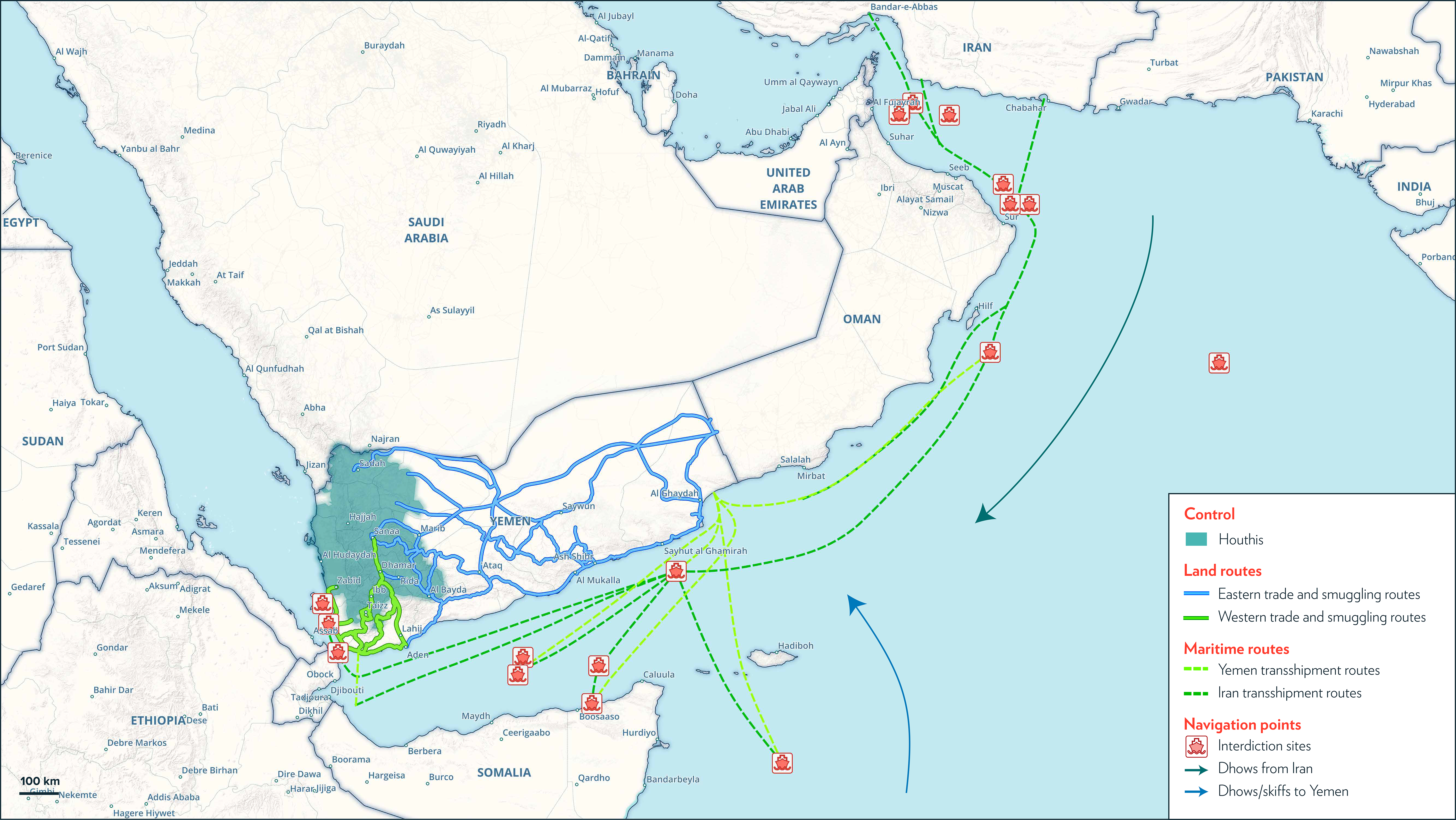
Main Transshipment Routes and Interdiction Sites between Iran and Yemen. The area controlled by the Houthi rebels is marked, with the capital Sana'a at its center.
Introduction
The conflict in Yemen was initially presented as a classic case of regional intervention, with a clear dual purpose: the containment of the Houthis and, by extension, of Iranian influence. Yet, as the war unfolded, it became increasingly evident that the two principal pillars of the anti-Houthi coalition—Saudi Arabia and the United Arab Emirates—did not share the same ultimate objective. On the contrary, they developed two distinct, and in the end competing, geopolitical designs.
At the heart of this rivalry lies a fundamental opposition: the preference of Saudi Arabia for a unified and controllable Yemen, as against the Emirati strategy, which inclines towards functional fragmentation and the creation of manageable local entities under its own wing.
Conceptual Clarification: Yemen as Theatre, not Actor
The designation of Yemen as a “theatre”, not the Actor (Papastavrou, A-T., 2026) is not rhetorical, but analytical. In contemporary geopolitical terms, Yemen does not operate as a fully autonomous actor capable of articulating and sustaining a coherent strategic vision. It functions, rather, as a terrain upon which external and regional powers project influence.
Iran supports the Houthi movement as part of a broader strategy aimed at encircling Saudi Arabia, extending pressure along the Arabian Peninsula, and projecting power toward the Red Sea and the Horn of Africa. Saudi Arabia and the United Arab Emirates, in turn, intervene to contain this expansion, while simultaneously advancing their own, increasingly divergent, strategic agendas. Western powers—most notably the United States—operate in alignment with Saudi-led priorities, contributing intelligence, logistical support, and targeted strikes. In this respect, Yemen resembles cases such as Somalia: not a geopolitical subject in the full sense, but a space of contestation—a chessboard rather than a player.
This condition is not accidental. The historical development of Yemen has favoured fragmentation over consolidation. Its integration into the Indian Ocean world and the Horn “atmosphere”, rather than into a Levantine or continental system, reinforced a maritime-commercial orientation without producing a centralised imperial structure. The absence of a durable state tradition, the persistence of tribal segmentation, the legacy of divided political authority, and the lack of sufficient economic resources for institutional consolidation have all contributed to the formation of a structurally weak polity.
As a result, Yemen occupies a paradoxical position: it lacks the capacity to shape regional order, yet possesses sufficient geographic and maritime significance to disrupt it. It is precisely this combination—internal weakness and external centrality—that renders it an ideal theatre for competing geopolitical projects. Within this framework, the Saudi-Emirati rivalry does not take place in Yemen as a bilateral dispute over a third country. It unfolds through Yemen, as two distinct visions of regional order seek material expression upon the same strategic terrain.
I. From Alliance to Divergence
In 2015, Riyadh and Abu Dhabi entered the war as partners, with the common declared aim of restoring the internationally recognised government and reversing the advance of the Houthi movement—an armed Zaydi Shi‘a insurgency that had seized Sana’a—the formal capital of Yemen and the principal political centre of Houthi-controlled territory—and, by extension, preventing the consolidation of a pro-Iranian order in Yemen. The operational division of labour was clear from the outset. Saudi Arabia assumed responsibility for the aerial dimension of the war, the northern front, and the protection of its borders, whereas the United Arab Emirates concentrated upon the south, the coastal regions, and the strategic maritime points.
Yet even in the early stages, the divergence of strategic purposes was already visible. For Saudi Arabia, Yemen was above all a security problem, since the emergence of a hostile entity upon its southern frontier would create a permanent geopolitical danger. For the United Arab Emirates, by contrast, Yemen presented an opportunity: the construction of a network of local partners and the securing of control over critical maritime nodes. After 2017, this difference ceased to be tactical and became structural.
II. The Rise of the South and the de facto Partition
The establishment of the Southern Transitional Council (STC) marked the passage from unity to division. The STC was not merely another local actor, but the nucleus of an alternative political project: the re-establishment of an independent southern yemenite state.
Backed by the UAE, the STC and associated forces succeeded in bringing large portions of the south and the coasts under their control, often bypassing or displacing forces recognised by Riyadh.
The resulting condition was peculiar: (a) formal alliance, but substantive rivalry. (b) Yemen began to assume the character of a de facto divided system, in which the south functioned as a distinct sphere of power, tied more closely to Abu Dhabi than to Riyadh.
III. The Maritime Logic of the UAE and the Wider Strategy
The strategy of the UAE in Yemen cannot be understood apart from its broader maritime policy (see endnote). Abu Dhabi has systematically invested in a network of ports, bases, and insular positions extending from the Persian Gulf to the Horn of Africa.
Within this framework, southern Yemen acquires particular significance. Its ports, islands, and maritime chokepoints—above all Bab el-Mandeb—are not merely local assets, but components of a wider strategic chain linking the Indian Ocean to the Red Sea and beyond.
After the Abraham Accords, this strategy became increasingly integrated into a broader framework of cooperation with Israel. The prospect of small, predictable, and strategically aligned entities along these maritime routes serves a shared objective: the control of flows, the monitoring of strategic corridors, and the containment of rival powers.
The case of Somaliland fits within this same geopolitical logic. The gradual elevation of its international status, coupled with the prospect of recognition by Israel, reinforces a model of regional structuring based not on large, unified states, but on smaller, functionally integrated entities embedded in maritime and security networks.
In Yemen, this logic translates into a clear preference for a controllable southern entity, rather than for a unified and potentially autonomous state.
IV. The Turning Point: Eastern Yemen
The decisive rupture occurred when the influence of the STC expanded eastward into Hadhramaut and al-Mahra. These regions, though sparsely populated, possess immense strategic value: energy resources, access to open sea, and direct proximity to Saudi territory. For Riyadh, the emergence of a southern entity aligned with Abu Dhabi, extending to its borders and controlling potential energy and transport corridors, was strategically unacceptable. The response was inevitable. Saudi Arabia moved to counter this expansion, leading to open tension with STC-aligned forces. From that point onward, the rivalry ceased to be latent and became structurally visible.
V. Two Geopolitical Logics
The Saudi-Emirati divergence reflects two fundamentally different conceptions of regional order.
Saudi Arabia favours large, relatively unified neighbouring states. Even imperfect unity offers predictability and reduces the risk of fragmentation and instability along its borders. The UAE, by contrast, operates comfortably within a fragmented environment composed of smaller, flexible, and controllable entities. This model allows for direct influence, adaptability, and integration into broader economic and security networks. This divergence is particularly evident in their respective approaches to Israel. Abu Dhabi has embraced strategic convergence, whereas Riyadh proceeds more cautiously, seeking to preserve regional balance and avoid encirclement by aligned micro-entities.
VI. The Iran Factor
The Iranian presence in Yemen operates simultaneously as a source of convergence and as a catalyst of divergence within the Saudi–Emirati relationship. Through its support for the Houthi movement, Iran does not seek full territorial control over Yemen, but rather the maintenance of a persistent pressure point against Saudi Arabia and a lever for the disruption of maritime flows in the Red Sea. This strategy is characteristically asymmetrical: it allows Tehran to project influence at relatively low cost while retaining a degree of plausible deniability.
For Saudi Arabia, this dynamic transforms Yemen into a matter of immediate national security. The consolidation of Houthi power along its southern frontier, combined with the demonstrated capacity for missile and drone strikes, creates a sustained and operationally tangible threat. Under these conditions, fragmentation is not merely undesirable but strategically dangerous: it multiplies centres of power, reduces predictability, and increases the risk of hostile penetration. The Saudi response therefore tends toward consolidation—the preservation, or reconstruction, of a unified political framework capable, at least in principle, of containing Iranian influence.
The United Arab Emirates approach the same environment through a different strategic lens. The Iranian factor is not perceived as an existential territorial threat, but as one variable within a broader system of maritime competition. The emphasis shifts accordingly from control of inland space to control of ports, islands, and sea lines of communication. Within this framework, fragmentation does not necessarily constitute a liability; it may, under certain conditions, enhance flexibility, enable indirect influence through local partners, and reduce exposure to systemic risk.
This divergence becomes more pronounced in scenarios of wider escalation involving Iran, particularly in the context of a potential American–Israeli confrontation with Tehran. Under such conditions, Saudi Arabia would have strong incentives to minimise fragmentation along its southern flank and to prevent the emergence of semi-autonomous entities beyond its effective control, which could be exploited by Iranian proxies. The United Arab Emirates, by contrast, would remain structurally capable of operating within a fragmented environment, relying on a network of aligned nodes and maritime positions to secure their strategic interests.
The Iranian factor, therefore, does not resolve the divergence between the two actors; it renders it more explicit. It reinforces the Saudi preference for territorial coherence and strategic depth, while simultaneously allowing the United Arab Emirates to deepen a model of distributed, network-based power projection.
VII. Regional Implications
The Saudi–Emirati rivalry in Yemen extends far beyond the confines of the Yemeni theatre, affecting the wider strategic configuration of the Red Sea basin and its adjacent regions. It directly shapes the balance of maritime power along one of the most critical global trade corridors, where control over chokepoints—above all the Bab al-Mandab—translates into influence over flows of energy, commerce, and military movement between the Indian Ocean and the Mediterranean.
In the Horn of Africa, this rivalry intersects with an emerging pattern of external penetration through port infrastructure, logistical networks, and security arrangements. Emirati involvement in locations such as Assab and Berbera illustrates a broader effort to establish a durable presence across the western flank of the Red Sea, while also linking these positions to developments on the Arabian side, including southern Yemen and offshore islands. The prospective consolidation or recognition of entities such as Somaliland further reinforces a model of regional structuring based on nodal control rather than territorial continuity.
At the same time, the evolving alignment between the United Arab Emirates and Israel introduces an additional layer of strategic complexity. Cooperation in maritime security, intelligence, and logistics contributes to the emergence of a loosely integrated axis extending from the Gulf to the Eastern Mediterranean. Within this framework, a fragmented and partially aligned southern Yemen would function not as a sovereign actor, but as a supporting node within a wider system of access and surveillance.
For Saudi Arabia, these developments raise the prospect of gradual strategic encirclement—not in the classical military sense, but through the accumulation of externally aligned nodes along its maritime and southern periphery. The response, therefore, is not merely reactive but structural: an effort to preserve territorial coherence in Yemen as a buffer space and to prevent the consolidation of an alternative regional architecture in which Saudi influence would be diluted.
Yemen, in this sense, ceases to be understood as an autonomous geopolitical actor. It emerges instead as a nodal space—a theatre in which local fragmentation becomes the medium through which broader systemic transformations are articulated and contested.
A further dimension of this divergence emerges in scenarios of wider escalation involving Iran, particularly in the context of a direct confrontation with a United States–Israel coalition. In such circumstances, the reactivation of the Houthi front in the Bab el-Mandeb, in conjunction with pressure in the Strait of Hormuz, would become a structurally plausible option. Such a development would not only disrupt global maritime flows, but would also impose simultaneous pressure on both Saudi territorial security and Emirati maritime infrastructure. Saudi Arabia would be compelled to respond through renewed air operations and missile-based containment, seeking to neutralise the threat along its southern frontier. The United Arab Emirates, for their part, would face direct exposure across the network of ports and maritime nodes through which their strategic model operates. Under these conditions, intra-coalition divergence would likely be subordinated to systemic threat, leading to a tightening of alignment within a broader security framework centred on the United States, and potentially extending to tacit coordination with Israel in the domain of maritime security. It is precisely this risk of enforced strategic convergence among its adversaries that helps explain Iranian restraint: the activation of a dual-chokepoint disruption would not merely expand the theatre of conflict, but could also consolidate a countervailing coalition with both regional and global reach.
Conclusion
The Saudi–Emirati rivalry in Yemen does not constitute a deviation from an otherwise coherent alliance, but rather the visible expression of a deeper structural divergence in strategic orientation. What appears, at the level of events, as tension between partners is, at the level of analysis, the unfolding of two distinct conceptions of regional order.
For Saudi Arabia, the preservation of territorial coherence in its immediate periphery remains a condition of security. Yemen is thus approached as a buffer space whose fragmentation would generate instability, multiply centres of power, and create openings for hostile penetration. The strategic preference, accordingly, is for a unified or at least controllable political framework capable of imposing a minimum degree of order along the southern frontier.
The United Arab Emirates operate within a different strategic logic. Their approach privileges control over flows rather than territories, access rather than sovereignty, and networks rather than hierarchical state structures. Within such a framework, fragmentation does not necessarily represent disorder; it may instead constitute a functional environment in which influence can be exercised indirectly through aligned local actors and strategic nodes.
Yemen, therefore, is not merely a battlefield in the conventional sense. It is a theatre in which two competing models of geopolitical organisation—territorial consolidation and network-based fragmentation—are projected, tested, and contested. The outcome of this interaction will not only shape the future of Yemen itself, but will also contribute to defining the emerging architecture of power across the Red Sea, the Arabian Peninsula, and the wider maritime corridor linking the Indian Ocean to the Mediterranean.
Endnote
On the maritime-commercial strategy of the United Arab Emirates and its convergence with Israeli interests:
The maritime power of the United Arab Emirates does not primarily rest upon the size of its national merchant fleet, which remains limited in comparison with major ship-owning states such as Greece, China, or Japan. Instead, it is expressed through control over infrastructure, logistics, and maritime nodes. The port of Jebel Ali constitutes one of the most significant global hubs of container traffic, while the company DP World operates an extensive international network of terminals across the Red Sea, the Indian Ocean, and beyond. In parallel, the United Arab Emirates have developed a system of strategic positions—commercial and, in certain cases, military—in locations such as the Bab al-Mandab strait, Socotra, Berbera, and Assab, forming a chain of influence along critical sea lines of communication. Their role is further reinforced by activity in ship management, bunkering, re-export logistics, and maritime services. In this sense, the United Arab Emirates are better understood not as a classical fleet-based maritime power, but as a network-based thalassocratic actor, exercising influence through control of flows, access points, and logistical infrastructure rather than through ownership of tonnage.
This network-based approach exhibits a clear structural convergence with the strategic logic of Israel, particularly following the Abraham Accords. For Israel, secure access to the Red Sea and the Indian Ocean constitutes a matter of strategic necessity, rendering the stability and monitoring of maritime chokepoints—above all Bab al-Mandab—of critical importance. The emergence of a system of cooperative or aligned nodes along these routes serves this objective. More broadly, this configuration reflects a shared preference for a geopolitical environment structured not around large, potentially hostile territorial states, but around smaller, more predictable and functionally integrated entities. The cases of southern Yemen and Somaliland illustrate this tendency: both can be understood as potential nodes within a wider maritime-security architecture, in which influence is exercised indirectly through access, partnerships, and infrastructure rather than through formal sovereignty.
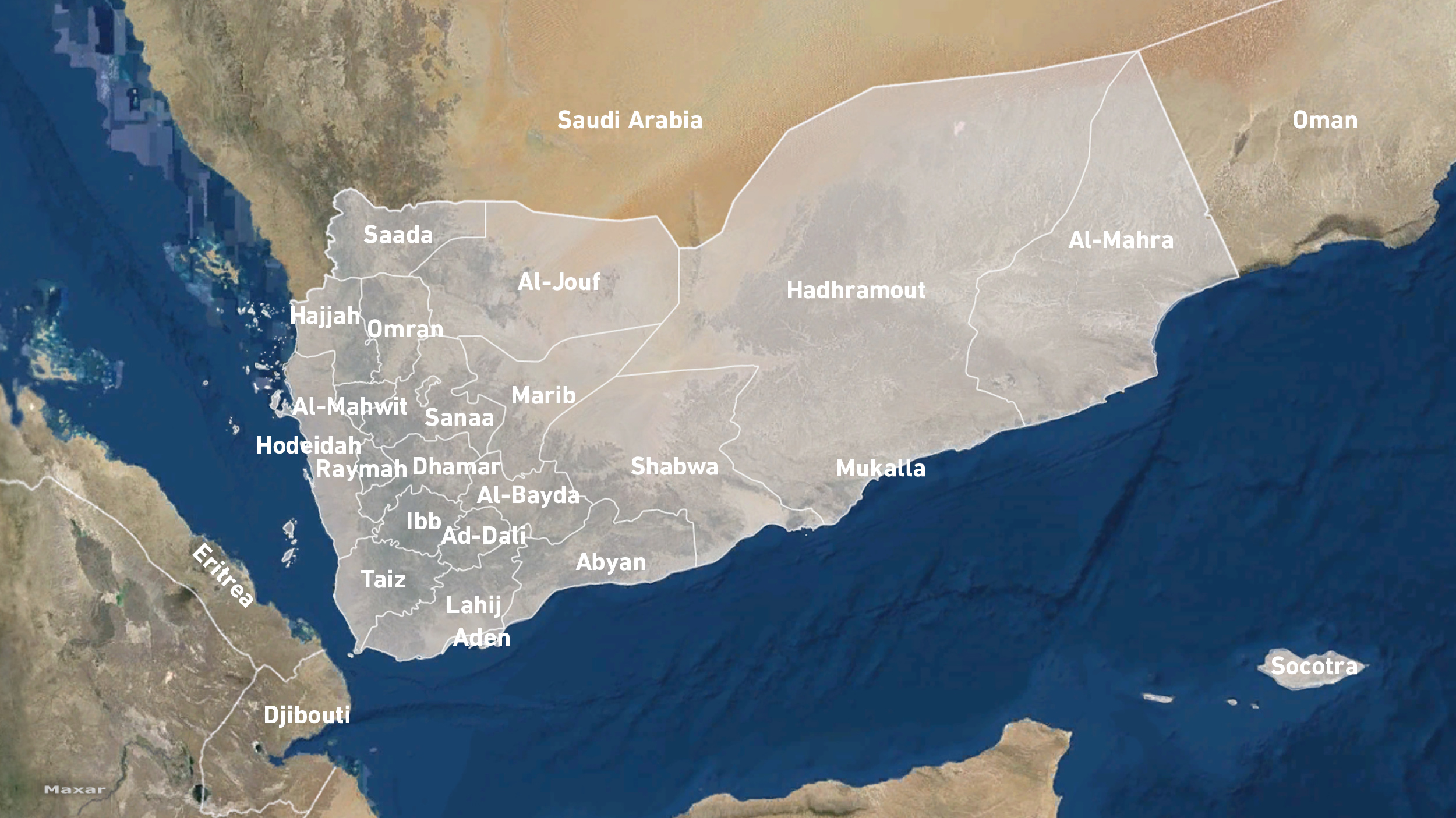
The provincial division of Yemen largely reflects its tribal fragmentation. Hadhramout and Al-Mahra are scarcely populated areas. The strategic island of Socotra, although remotely situated, belongs to Yemen
Bibliographical References
Al-Dawsari, N. (2026). From coalition to confrontation: Saudi-UAE rivalry in Yemen and its regional implications. Middle East Institute (MEI).
Full text
Al-Haj, A., Khaled, F. (2026). Saudi-backed forces regain control of Yemen’s Hadramout from UAE-backed separatists. The Times of Israel.
Full text
Editorial. (2026). Escalation in Eastern Yemen and the Test of the Saudi-Emirati Partnership. Al-Jazeera Centre for Studies.
Full text
Hearst, D. (2026). By standing up to Abu Dhabi, Riyadh could reshape the Middle East. Middle East Eye.
Full text
Khoury, N. A. (2026). The Saudi–Emirati Drama in Yemen. Arab Center Washington DC.
Full text
Lons, C. (2026). Power struggle: What the Saudi-UAE rivalry means for the Red Sea—and Europe. ECFR.
Full text
Ozcelik, B., Shiban, B., Zoubi, A. (2025). Southern Yemen’s Power Shift. RUSI.
Full text
Papastavrou, A-T. (2026). Thucydidean geopolitics for the educated layperson. Ἡδυέπεια (Editors). Link