A Thucydidean Reading of Shi‘a Political Theology
This essay seeks to answer the following questions:
Is Iran an irrational, ideologically driven outlier, or a rational state whose strategic behaviour is shaped by a distinct metaphysical framework?
Can Thucydides’ Triad of Fear, Honour, and Interest be reformulated to account for the fusion of realist calculation with the metaphysical and eschatological meanings that prevail in Iran?
Abstract
This essay argues that the Islamic Republic of Iran is not an irrational or purely ideological actor, but a rational state operating within a metaphysically structured strategic framework. Rather than dismissing its behaviour as religious fanaticism, the analysis embeds realist concepts—above all the Thucydidean triad of Fear, Honour, and Interest—within Shi‘a political theology and the doctrine of the Imamate. The essay contrasts Sunni Islam’s horizontal, juristic dispersion of authority with the vertical model of Shi‘ism centred on a sacralised line of Imams and, in their occultation, the institutionalised guardianship of the jurist (Velāyat-e Faqīh). It examines how the memory of Karbala, the expectation of the Hidden Imam’s return, and a teleological conception of history shape the strategic culture of Iran, legitimising endurance, asymmetry, and sacrifice. Within this framework, Fear extends to metaphysical failure, Honour is anchored in martyrdom and sacred resistance, and Interest stretches across eschatological horizons while still encompassing familiar material stakes. The essay concludes that the actions of Iran—proxy warfare, deterrence-building, calibrated escalation—are best understood as rational optimisation of means toward ends defined by a fused realist–theological worldview, in which metaphysical and empirical calculations form a single, coherent field.
Iran is best understood not as an irrational or purely ideological actor, but as a rational state operating within a metaphysically structured strategic framework. The analytical error in much Western discourse lies in equating religiously grounded motivation with a deficiency of rationality, rather than recognising that rational calculation is deployed within a hierarchy of ends that are not themselves open to negotiation. The Islamic Republic optimises means with considerable strategic sophistication, while treating its ultimate purposes—justice, resistance, and alignment with a divinely ordered history—as fixed parameters rather than variables. To understand Iranian geopolitical behaviour, one must therefore move beyond a flattened realism without abandoning realism itself. The task is to situate rational choice within the architecture of Shi‘a political theology that shapes how Fear, Honour, and Interest are perceived, weighted, and projected over time. In practical terms, the same empirical moves—proxy warfare, deterrence, calibrated escalation—must be read through a horizon in which present calculation and eschatological expectation form a single field.
I. Authority and Order: The Shi‘a–Sunni Divergence
The most consequential difference between Shi‘ism and Sunnism lies less in abstract doctrine than in the structure of authority each tradition generates. Sunni Islam, in its classical form, developed as a system of distributed legitimacy in which authority emerges from the interaction between rulers, jurists, and the wider community. In the absence of a divinely guided human authority after the Prophet, interpretive authority is exercised through legal scholarship and diffuse scholarly networks, producing multiple centres of recognised jurisprudential authority rather than a single metaphysical apex. The result is a horizontal structure of legitimacy in which plurality, contestation, and adaptation are not anomalies but constitutive features of the system.
By contrast, Twelver Shi‘ism rests on the doctrine of the Imamate. Authority is divinely designated and transmitted through a sacred lineage beginning with ʿAlī, presenting continuity of divine guidance beyond the Prophet himself. The Imam is conceived as endowed with spiritual protection from error (ʿisma), not as an institutional privilege but as an ontological quality that secures correctness in guidance; and as epistemically privileged, with access to the inner dimension of revelation (bāṭin). He is thus not merely a jurist or political ruler, but a metaphysical axis in whom authority, knowledge, and legitimacy converge. In this sense, authority is vertical and unitary, flowing from a single sacralised source. The structural implication is decisive: Shi‘ism generates a vertical model of authority anchored in a single sacred centre, whereas Sunnism produces a horizontal field of juristic legitimacy lacking a unique metaphysical focal point. This divergence shapes both internal governance and external projection of power. Where Sunni Islam distributes rational calculation across overlapping and competing authorities, Shi‘a Islam tends to consolidate it along a vertical line of command and legitimacy. Coherence is strengthened, but the ultimate ends that anchor the system are less easily revised.
II. Social Substrate and Political Form
A common intuition suggests that Sunni Islam is more easily compatible with loosely organised or mobile social formations, whereas Shi‘a Islam aligns more naturally with centralised and historically rooted political orders. As a claim about origins, this is too simple. Both traditions emerged from the same Arabian environment of segmentary, tribal organisation. The original divergence was political and theological, concerning succession and legitimacy, rather than a direct expression of distinct social substrates.
As an account of subsequent historical development, however, the intuition gains explanatory value. Sunni Islam evolved into a system marked by distributed authority and juristic pluralism, enabling it to operate across tribal confederations, mercantile networks, and imperial structures without requiring a single sacralised centre of command. Fragmentation, in this context, does not automatically entail collapse; institutional elasticity and doctrinal plurality allow adaptation to heterogeneous political landscapes. Shi‘a Islam, by contrast, is oriented around the principle of unified, divinely sanctioned authority embodied in the Imam, and this vertical logic persists even in his absence. Authority is conceived as ultimately flowing from a single source, and all legitimate power is derivative of that origin.
The embedding of Shi‘ism in Iran from the Safavid period onward illustrates a historically contingent alignment between doctrine and political form. When the Safavids established their rule in 1501 and declared Twelver Shi‘ism the state religion, they imposed a confessional transformation upon a largely Sunni population, thereby initiating a process through which doctrine and state would be progressively brought into alignment. The Safavid movement itself originated as a Sufi order two centuries before, with fluid and evolving religious orientations, only later crystallising into a Twelver Shi‘a polity. In order to sustain this transformation, the Safavid state actively cultivated a clerical class, while simultaneously redefining the relationship between religious authority and secular power.
This alignment, however, did not produce a stable doctrine of governance. That task would only be undertaken in the twentieth century by Ruhollah Khomeini; while in exile, and by applying gradual slippage of concepts, he reformulated Shi‘a political theology, mainly through the doctrine of Velāyat-e Faqīh. In doing so, he transformed a tradition historically marked by political quietism into a theory of active clerical rule. Khomeini’s project may be understood as an attempt to construct a transnational structure of religious-political authority—functionally analogous to a form of papal Islamism—a centralised clerical sovereignty with universalist claim capable of extending beyond the territorial limits of Iran. Yet this ambition achieved only partial realisation. Its effective projection has remained confined to specific movements and theatres, notably Hezbollah in Lebanon, the Islamic Movement of Nigeria (IMN, distnct from Sunni Boko Haram), the Houthi movement in Yemen, and the Badr Organisation in Iraq. Iran, therefore, did not inherit a ready-made political theology; it became the principal site of its modern reconstruction, and the primary—but not universally successful—vehicle of its external projection.
The geopolitical consequences of this divergence are significant. Systems of distributed legitimacy exhibit flexibility and adaptability, particularly under conditions of internal diversity, but may struggle to sustain a single, cohesive ideological narrative over long periods. Systems organised around vertical authority display greater unity and strategic continuity, especially under external pressure, yet are less permeable to outside intellectual frameworks and less inclined to revise foundational premises. In Thucydidean terms, Sunni political forms tend to disperse Honour across multiple actors and institutions, while Shi‘a political forms concentrate Honour along a single axis of sacred authority. This concentration enhances cohesion but also heightens the stakes of contestation, both domestically and externally.
III. The Twelfth Imam and the Politics of Absence

Imam Mahdi: I am the remembrance of God on earth, and I am His representative and His Proof for all of you (Kamaluddin σ. 221)
At the centre of Shi‘a political theology lies the doctrine of the Twelfth Imam, al-Mahdi, “the Guided One”—a title rather than a personal name—who completes the line of twelve divinely designated Imams. The defining feature of this doctrine is Occultation (ghaybah): the belief that the Twelfth Imam is alive but withdrawn from manifest political life. His hiddenness is not a matter of unknown geographical location; it is a mode of ontological absence. He is the rightful sovereign, yet unavailable as a concrete political actor.
This condition produces a unique political and metaphysical configuration. Sovereignty is, in principle, present but inaccessible, real but not exercisable in ordinary terms. All existing authority, no matter how extensive, is therefore incomplete and provisional, exercised in the shadow of an absent but legitimate ruler. The Imam is expected to return at the end of history to establish universal justice, but until then, political authority operates under a deficit of fullness. Legitimacy must be articulated under conditions of acknowledged incompleteness.
Absence, in this framework, is not mere lack. It functions as an organising principle that structures expectation, constrains authority, and orients political imagination. The Hidden Imam is not analogous to a purely future Messiah nor to a localised heroic protector; he is a simultaneously present and inaccessible source of sovereignty whose anticipated return gives direction to history. Political authority is thus defined as an approximation that must regulate life while never mistaking itself for the final, divinely guaranteed order.
IV. The Iranian Resolution: Governance under Incomplete Legitimacy
The Islamic Republic resolves this condition through the doctrine of Velāyat-e Faqīh—the guardianship of the jurist. In the absence of the Twelfth Imam, a qualified jurist assumes authority as guardian of the community, institutionalised in the office of the Supreme Leader. This solution is explicitly framed as a response to the question of who governs during the occultation: authority is delegated to the jurist as a trustee, not as a replacement for the Imam.
In Khomeini’s formulation, the jurist exercises governmental authority because the requirements of Islamic law and the protection of the community persist even when the Imam is hidden. The guardianship of the jurist thus represents an institutional answer to a theological problem: how to maintain order and uphold divine law in a world where the legitimate sovereign is absent. The Supreme Leader, as the deputy of the occultated Imam, claims infallibility in the same ontological sense as the Imam himself; his authority is grounded in the Imam’s continuing sovereignty and in the mandate to preserve the Islamic character of the community until the Imam’s return.
He is therefore neither a secular rational actor in the standard Weberian sense nor a substitute Imam. He is best understood as an agent of structured approximation, tasked with governing under conditions of incomplete legitimacy while remaining bound by a metaphysical horizon he cannot alter. The vertical logic of Shi‘a authority is preserved, but translated into an institutional architecture that can function in the Imam’s absence. Rational governance is thus nested within a structure of delegated guardianship and anticipated restoration.
V. Strategic Culture: Time, Suffering, and Legitimacy
This theological architecture produces a distinctive strategic culture in which time, suffering, and legitimacy acquire particular weight. First, it introduces a teleological conception of history oriented toward the eventual establishment of justice under the Mahdi. History is not an open-ended process of indefinite adjustment; it is a field in which human agency operates within a divinely guided trajectory. This does not abolish strategic calculation, but stretches its temporal horizon. Decisions can be evaluated not only in terms of immediate payoff, but also in relation to an eschatological end-state in which actions are retrospectively judged.
Second, Shi‘a identity is profoundly shaped by the memory of Karbala, where Husayn ibn ʿAlī and his small band were killed in 680 CE after refusing to legitimise what they considered an unjust and impious rule. Karbala is not merely a historical event; it is a foundational drama encoding martyrdom, injustice, and principled resistance as constitutive elements of communal self-understanding. In political terms, it sacralises suffering and sacrifice when undertaken in defence of justice, providing a narrative template in which asymmetry and endurance are not signs of weakness but marks of fidelity.
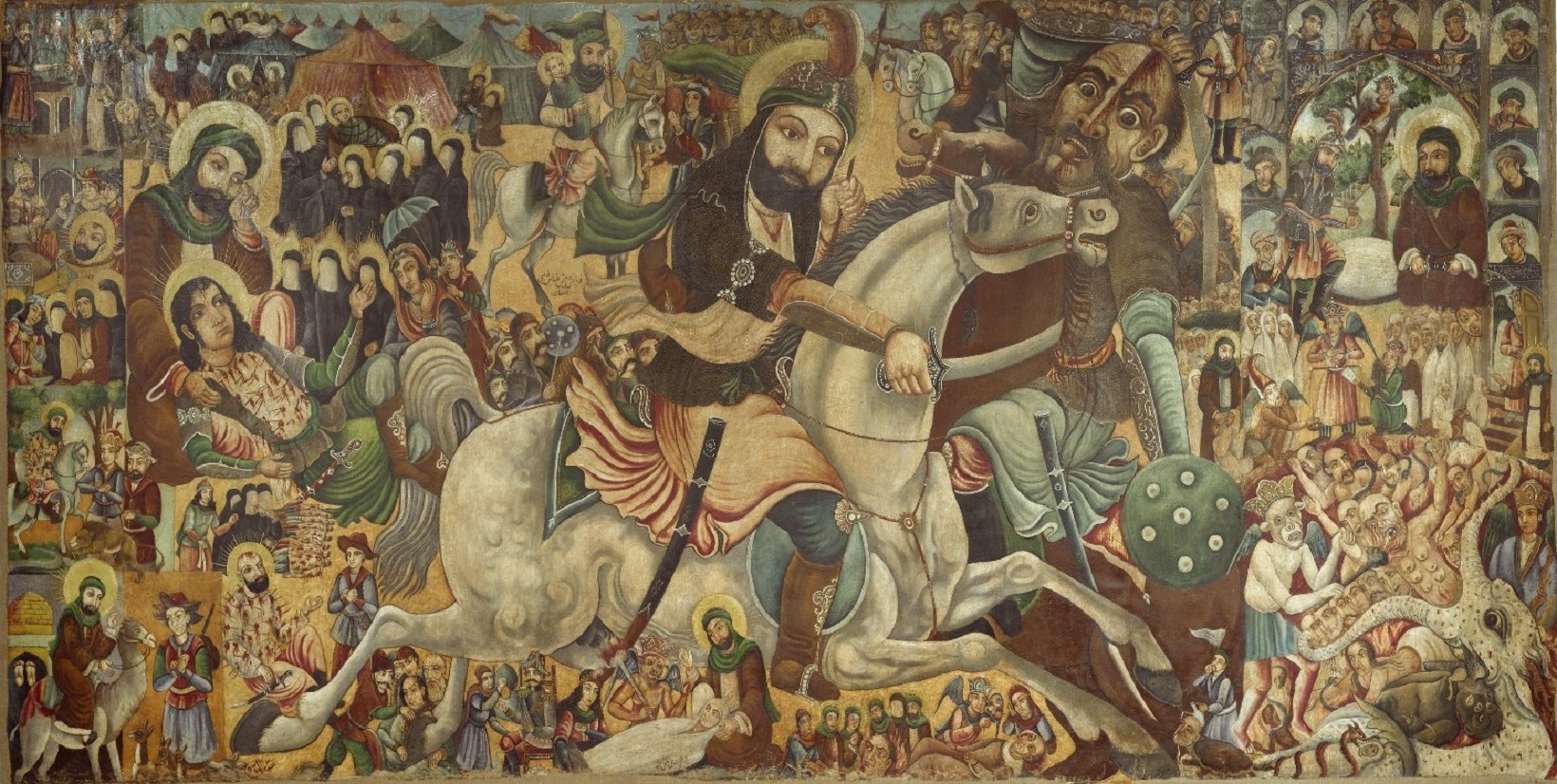
The well-known depiction of the battle in Karbala, Iraq, (680 CE, or 61 AH in the Islamic calendar)
Third, legitimacy in this system extends beyond procedural or merely performance-based criteria. It includes a moral–eschatological dimension grounded in justice, resistance to oppression, and alignment with a divinely oriented historical trajectory. Claims to power must be framed, and are judged, in light of this horizon. While Sunni actors may also mobilise rhetoric of justice and resistance, such language is not as tightly integrated with a doctrine of sacred succession, occulted sovereignty, and ultimate restoration.
The practical strategic effect is that Iran can absorb costs, sustain proxy commitments, and endure sanctions in ways that appear, to strictly secular observers, as excessive or irrationally rigid, yet are experienced internally as consistent with a narrative of redemptive suffering and deferred vindication. Strategic patience, calibrated brinkmanship, and long-term investment in the “Axis of Resistance” become legible only when the metaphysical dimension of time and suffering is taken seriously.
VI. Rationality within a Metaphysical Framework
Does this structure diminish rationality? It does not. Iranian policymakers evaluate risks, calibrate escalation, manage alliances, and employ proxies with evident strategic awareness. Deterrence is pursued through layered regional depth, missile and drone capabilities, and networked non-state partners. In these domains, rational calculation is clearly operative.
However, rationality is not sovereign. It functions within a hierarchy of ends supplied by revelation and tradition. The system does not subject its ultimate purposes—resistance to perceived oppression, preservation of Islamic governance, preparation for the Imam’s eventual return—to rational revision. Rather, rationality is tasked with optimising the means by which these ends are pursued. The question is not “Should these ends be pursued?” but “How can they be pursued most effectively under current conditions?” Within this framework, rationality organises, sequences, and calibrates action, but does not generate the final goals of policy.
In this sense, realism is not rejected but bounded. Fear, Honour, and Interest are all operative, yet they are perceived and weighted through a metaphysical lens. Rationality remains indispensable for survival and efficacy, but it is always already inscribed within a theological architecture that defines what survival means, what constitutes honour, and which interests are truly worth sacrificing for.
VII. A Thucydidean Reformulation
The relationship between this theological structure and Iranian strategic behaviour may be further clarified through a reformulation of the Thucydidean triad. Within what Oswald Spengler termed the Magian worldview—a civilisational form structured by revelation, hidden truth, and the primacy of the unseen—Fear, Honour, and Interest do not disappear. They are redefined and extended across both empirical and eschatological dimensions. The triad persists, but its field of operation is enlarged.
In a strictly secular framework, Fear refers primarily to material threats: invasion, regime change, loss of deterrent capability. In the Iranian context, such fears are real and central—encirclement by hostile powers, economic strangulation, internal destabilisation. Yet Fear also includes metaphysical punishment: the dread of failing in one’s obligation to defend the community of believers, of betraying the legacy of Husayn by acquiescing to perceived injustice, of facing divine judgement for cowardice or complicity. To yield under pressure is not only a strategic error; it risks becoming a sin against the narrative of resistance that structures Shi‘a memory.
Honour, in a secular reading, concerns prestige, status, and recognition by other states. Iran certainly seeks recognition as a regional power and defender of its interests. But in the Shi‘a political-theological frame, Honour is also fulfilled—and perhaps more deeply fulfilled—through sacrifice, steadfastness, and martyrdom. The paradigmatic honourable act is not merely victory, but principled endurance in the face of overwhelming force, as at Karbala. Martyrdom in the Axis of Resistance, whether in Lebanon, Iraq, or Yemen, is interpreted as participation in that same drama. Honour thus acquires a vertical dimension: it is conferred not only by other states, but by alignment with a sacred history and ultimately by God.
Interest, in conventional realist analysis, denotes tangible gains: territorial depth, economic advantage, security of trade routes, technological capacity. Iran pursues all of these with clear calculation. Yet Interest also incorporates eschatological reward and long-duration positioning within a providential history. Support for allies, even when costly, can be interpreted as an investment not only in future security but in one’s standing at the moment of the Imam’s return and in the final judgement. Interest extends into a temporality in which the ultimate return on action is assessed beyond the span of any single regime.
If one thinks of Fear, Honour, and Interest as forces structuring political behaviour, the Shi‘a–Iranian case does not replace them with theological abstractions. It projects them across a wider domain of meaning in which material survival coexists with salvation, in which prestige is refracted through sacrifice, and in which gains are measured in both secular and eschatological terms. What appears, from a strictly secular vantage point, as distortion, excess, or self-defeating stubbornness often reflects the consistent application of this extended triad.
Within this reformulated Thucydidean frame, Iranian behaviour appears less as a deviation from rationality and more as the rational pursuit of ends that extend beyond the empirical horizon. Shi‘a political theology does not abolish Fear, Honour, and Interest; it reorganises and elevates them. Fear is deepened by the prospect of metaphysical failure, Honour is intensified by its anchoring in martyrdom and sacred history, and Interest is stretched along a temporal axis that includes deferred justice and final judgement. Rational strategy is thereby woven into a metaphysical order that grants it continuity and direction.
Conclusion
Iran is neither a mystical anomaly nor a purely technical actor. It is a strategically rational state whose perception of reality is structured by a theology of occulted sovereignty, redemptive suffering, and deferred justice. Rationality remains fully operative, but it is embedded within a broader metaphysical architecture that shapes what counts as survival, how Honour is understood, and which Interests are considered worthy of sacrifice. Fear, Honour, and Interest persist as Thucydidean forces, yet are refracted through a Shi‘a lens that binds them to revelation, memory, and eschatological expectation.
To understand Iran, one need not choose between realism and theology. One must instead grasp how the two are fused into a single, coherent—if complex—strategic worldview, in which calculations over sanctions, missiles, and proxies are inseparable from the drama of Karbala and the anticipated return of the Hidden Imam. Only within this integrated horizon can Iranian actions be interpreted as both rational and metaphysically ordered.
Bibliographic Anchors
Aarabi, K. (2019). What Is Velayat-e Faqih? Tony Blair Institute for Global Change.
Admin. (2011). Spenglerian terms. Faust.
Alenezi, MJMM. (2009). Usuli Shi’ism and state approaches to Islamic unity: the ecumenical movement in post-Safavid Iran. Doctoral thesis, Durham University.
Amir-Moezzi, MA., Jambet, C. (2018). What Is Shī Ī Islām. Routledge (Editors). ISBN 9781315106441 (e-book)
Khomeini, SAR. (1970). Khomeini, R. (1979). Islamic government (JPRS Trans.). Manor Books. (Original lectures 1970). ISBN 9780532231660.
Devereaux, Β. (2019). Collections: A Trip Through Thucydides (Fear, Honor and Interest). A Collection of Unmitigated Pedantry.
Editorial (2026). The Shia–Sunni Divide: History, Theology and the Politics of Memory. Lviv Herald. (Parish, M. Editor).
Kagan, FK. (2009). Velayat-e Faqih. CriticalThreats.org - American Enterprise Institute.
Papastavrou, A-T. (2026). Thucydidean geopoliticcs for the educated layperson
Parchami, A. (). An Iranian Worldview - The Strategic Culture of the Islamic Republic. Marine Corps University.
Qutbuddin, Μ. Lessons from the Martyrdom of Hussain (A.S.). Muslim Mirror.
Rahimi, B. (2009). Shi‘a Politics in Iran after 30 Years of Revolution. Middle East Institute.
Sinaiee, M. (2025). The expected one: Shi'ite messiah animates and divides Islamic Republic.
Sabir, R. (2025). Karbala, the Chain of Events. Al-Islam.org.
Tawhidi, M. (2026). The Declining Legitimacy Of Absolute Velayat-E Faqih: Security Implications for Iran, the Region, and the World. Trends, Research and Advisory.
Wikipedia (a). (2026). Twelver Shi'ism
Wikipedia (b). (2026). Guardianship of the Islamic Jurist
Zimmermann, R. (1996). The Law of Obligations: Roman Foundations of the Civilian Tradition. Oxford
Zulkifli. (2013). The Struggle of the Shi‘is in Indonesia (Ch. 8-Sunni Responses to Shi‘ism (pp. 229-270). Australian National University. ISBN 9781925021301 (ebook).