From Naval Power to Insurance Markets: The Real Constraints of Securing the Strait
This essay seeks to provide answers to the following questions:
• Why does the U.S. initiative to “protect freedom of navigation” in the Strait of Hormuz display such a pronounced mismatch between political rhetoric and the actual strategic, military, and economic requirements?
• How does this mismatch shape the stance of potential allies—and particularly Greece—regarding participation in a naval force in the region?
Abstract
The crisis in the Strait of Hormuz reveals a fundamental mismatch between political rhetoric and military reality. Washington has called for an international naval force to “protect freedom of navigation” and restore commercial flows, yet the operational content of this objective remains vague and strategically incoherent. In military terms, securing navigation requires the sustained movement of commercial traffic under acceptable levels of risk, measured through transit rates, loss probabilities, and insurance costs—none of which are addressed in current policy discourse.
The geography of the strait, combined with Iran’s layered anti-access/area-denial (A2/AD) architecture, renders limited escort operations ineffective without prior suppression of coastal threats, mine clearance, and sustained air–sea control. This implies a scale of military effort far exceeding what is politically articulated. At the same time, U.S. operational restraint—particularly the avoidance of strikes on critical economic infrastructure—suggests competing strategic calculations, including escalation management and the preservation of post-conflict leverage.
The campaign further exposes structural miscalculations, notably in the munitions balance, the decentralised nature of Iranian command, and the assumption that maritime flows could be rapidly restored through military superiority alone. Crucially, the paralysis of shipping has been driven less by kinetic threat than by the withdrawal of insurance and reinsurance coverage, highlighting the decisive role of financial mechanisms in modern maritime security.
The resulting mismatch shapes allied hesitation and complicates participation decisions, as illustrated by the Greek case, where maritime interests, deterrence requirements, and resource constraints collide.
Political Rhetoric Without Operational Definition
The crisis in the Strait of Hormuz exposes a deeper mismatch between political rhetoric and military reality. Washington has called for the formation of an international naval force, ostensibly to “protect freedom of navigation” and restore commercial flows. Yet the content of this request remains vague and militarily unsound. No one has clarified how many warships are required, in what ratio to merchant vessels, with which precise capabilities, nor how their survivability will be ensured within a narrow maritime corridor lying directly off Iranian coasts and islands saturated with military infrastructure. This vagueness is not a technical detail; it is the strategic problem itself, because in military terms “security of navigation” means maintaining a steady commercial flow under an acceptable risk of losses, with clear indicators for transit rates, potential losses, and insurance costs. At the same time, this ambiguity allows Washington to seek allied flags and political endorsement without binding itself to a clearly defined scale of military effort or a tightly defined strategic end‑state, turning the initiative into a tool of alliance management rather than a coherent operational plan.
A Chokepoint by Design
The Strait of Hormuz, linking the Persian Gulf with the Gulf of Oman and the Arabian Sea, is a geographical space with particularly unfavourable operational characteristics for any outside force seeking to enter and dominate it. Its width is theoretically about 20–21 nautical miles at its narrowest point, but shallow waters on the southern side make the usable width much smaller. In practice, tanker traffic is channeled into two constrained shipping lanes only a few miles wide, separated by a safety buffer, which makes the area a maritime choke point in the strictest sense of the term. Roughly one fifth of global seaborne hydrocarbon trade passes through this bottleneck, along with virtually all import flows of the Gulf monarchies, whose food security depends almost entirely on maritime imports.
The Architecture of Denial
The geography of the strait favours the defender. Iran controls the entire northern shoreline, including the port city of Bandar Abbas and major naval facilities, as well as some 30‑plus islands that provide sites for the deployment and concealment of sensors, missile systems, and a dispersed mix of naval combat assets. This disposition allows Iran to weave a strategic anti‑access/area‑denial (A2/AD) grid, that is, a set of capabilities designed, first, to deter or impede the entry of foreign forces into a given area (anti‑access) and, second, to restrict their freedom of manoeuvre within that area (area denial), making operations disproportionately costly and risky. These means include coastal anti‑ship missiles, fast attack craft of the Islamic Revolutionary Guard Corps Navy, unmanned aerial and maritime systems, midget submarines, minelayers, and infrastructure dispersed across ports and inlets. The value of this system does not lie in its ability to defeat a superior fleet in a conventional set‑piece battle, but in its ability to generate permanent uncertainty and risk for commercial shipping, especially when traffic is funnelled into narrow channels where even a limited number of naval mines or improvised floating explosive devices (IEDs) can trigger cascading delays. For the U.S. Navy (and any European or other fleet), operating large surface combatants inside the strait is practically impossible, because the environment does not allow sufficient sea room for manoeuvre. Any attempt to force major units into this space would risk a naval disaster reminiscent, in strategic terms, of Xerxes’ defeat in the narrows of Salamis.
The Illusion of Escort
This is where the contradiction between political rhetoric and military logic becomes evident. Political rhetoric speaks of escorting merchant ships with warships. But escort operations, without prior suppression of the coastal threat, are operationally suicidal. A handful of frigates cannot effectively protect a tanker if they are simultaneously exposed to missile strikes, swarms of fast boats, unmanned systems, and mines. Without neutralising coastal observation posts, missile batteries, fast‑boat bases, and achieving at least a minimal degree of mine clearance (if mines have indeed been laid), escorting convoys simply extends the risk from the merchant vessel to the warship. The political image of “protective flags” thus collides with the military requirement for a prior campaign to strip away Iran’s A2/AD architecture – a campaign that very few governments are willing to support openly.
The Logic of Escalation
Military logic therefore dictates a different, clearly prioritised sequence of actions. First, suppression and destruction of coastal missile systems and the sensors underpinning Iran’s targeting hierarchy through Suppression of Enemy Air Defences (SEAD) and Destruction of Enemy Air Defences (DEAD) operations. Second, neutralisation of fast attack craft, of launch facilities for unmanned systems, and reduction of the adversary’s capacity to reconstitute these threats quickly. Third, basic mine clearance and establishment of control over specific corridors through mine‑countermeasure operations. Fourth, establishment and maintenance of local air‑sea control in the immediate approaches to the strait in order to reduce the risk of surprise attacks. Only after such operations have taken place does the notion of escorting merchant vessels or deploying specialised assets acquire substantive meaning. Air control has the inherent drawback that overflight of the target area cannot be sustained indefinitely, unless a constant succession of dense air packages is feasible. This, in turn, makes the presence of ground forces almost indispensable, at least in the form of special operations forces and forward observers deployed on islets and headlands, acting as advanced bases for sensors and fires.
Selective Targeting and Strategic Restraint
Nonetheless, Washington’s behaviour so far displays a marked restraint with respect to full‑scale clearance of the coastal battlespace. Official statements indicate that operations focus exclusively on military targets, without systematically extending to ammunition resupply networks or to the critical energy infrastructure that underpins Iran’s economic power. The island of Kharg is a characteristic example: it is the country’s main oil export terminal, located deep inside the Persian Gulf. Under a strategy of comprehensive enemy exhaustion, it would present itself as an obvious target, especially given that a large share of exports is destined for the Chinese market. Yet these facilities have not been subject to sustained attack. This restraint may reflect both fear of uncontrollable escalation and a logic of future resource exploitation: a politically or militarily weakened Iran, with much of its infrastructure intact, is easier to plug into the geo‑commercial architecture that Washington would like to shape.
Escalation Control or Future Capture
This restraint admits several interpretations. It may reflect a desire to avoid further escalation or an attempt to preserve bargaining chips for future negotiations. It may also fit into a logic of future resource capture: if the Iranian regime is weakened or compelled to capitulate, these energy assets could fall into the victor’s hands, provided they have not been destroyed beforehand. Destroyed, they would lose their value. This latter scenario seems to align with the geo‑business pattern that has recently taken root in Washington.
The Economics of Firepower
Yet the campaign itself shows that the United States entered the war with at least one serious miscalculation: the munitions balance. The structural asymmetry in the missile–interceptor duel had been publicly underlined long before operations began. Iran produces significant quantities of ballistic and cruise missiles, as well as large numbers of unmanned aerial vehicles, at unit costs in the tens of thousands of dollars, whereas U.S. and Western production of high‑tech interceptors is far slower and the cost per missile reaches hundreds of thousands or even millions of dollars. The economic asymmetry is even starker at the tactical level: a Shahed‑136 loitering munition may cost around 20–35 thousand dollars, while the interceptors used against it may cost hundreds of thousands or millions per shot.
Scarcity and Strategic Choice
As has already been noted, the operations of recent months have consumed a significant portion of available stocks. The United States has decided to ramp up production of interceptors, but it will take years before new quantities appear in numbers that make a meaningful operational difference. This creates a problem of strategic prioritisation: the United States may be forced to choose which theatre of operations it is prepared to defend with the limited munitions that remain. Shortages can also skew operational judgement in specific cases, generating a kind of “strategic self‑censorship” in the employment of force, when a commander avoids the escalation that would normally be required in order not to draw down stocks needed in other theatres. Against this background, the need for low‑cost air‑defence and interception doctrines becomes clear – combining artillery, electronic warfare, deception, and other hard‑kill/soft‑kill systems – so that the cost per interception remains sustainable.
(See also here for an analysis on the Depletion of Critical Munitions and the Shifting Geometry of Readiness
Where War Becomes Finance
The crisis in Hormuz has also revealed a deeper problem that does not concern military power per se. Global maritime trade does not rest solely on naval protection. It rests on the insurance and re‑insurance markets and on constraints imposed by the regulatory framework of international financial supervision. When insurers withdraw war‑risk cover, shipping ceases to be economically viable even if the local military balance looks favourable. If the strategic objective is defined realistically as “restoring insurance coverage and war‑risk premiums to acceptable levels within a given timeframe”, then the campaign must be designed differently, with an emphasis not only on reducing the probability of attacks, but also on managing risk perception on the part of insurers and financial institutions. In reality, the surge in war‑risk premiums and the temporary cancellation of coverage have already produced a de facto embargo on transits – not through decisions of international organisations, but through private corporate decisions that internalise the fear of further escalation. This factor, too, was not adequately considered.
The Failure of Initial Assumptions
The U.S. campaign was built on three core assumptions. The first was that the Strait of Hormuz would never actually close, on the premise that the economic cost would be excessive for any rational actor and that Iran, in particular, would not deprive itself of its main source of defence funding. This assumption underestimated the structure of Iran’s military command, which is fundamentally decentralised. U.S. decapitation strikes against key leaders have themselves reinforced this trend towards decentralisation, creating a command system that is practically immune to single, centrally focused blows.
The second assumption was that even if navigation were disrupted, U.S. military superiority could quickly restore it. Despite undeniable tactical successes – destruction of a considerable portion of Iran’s defensive systems and a sharp reduction in missile launches – commercial traffic through the strait has remained minimal. This paralysis is not due only to the presence of weapons but to the fact that they have already been used. The insurance market has responded by withdrawing war‑risk cover, and that alone has been enough to keep hundreds of ships idle.
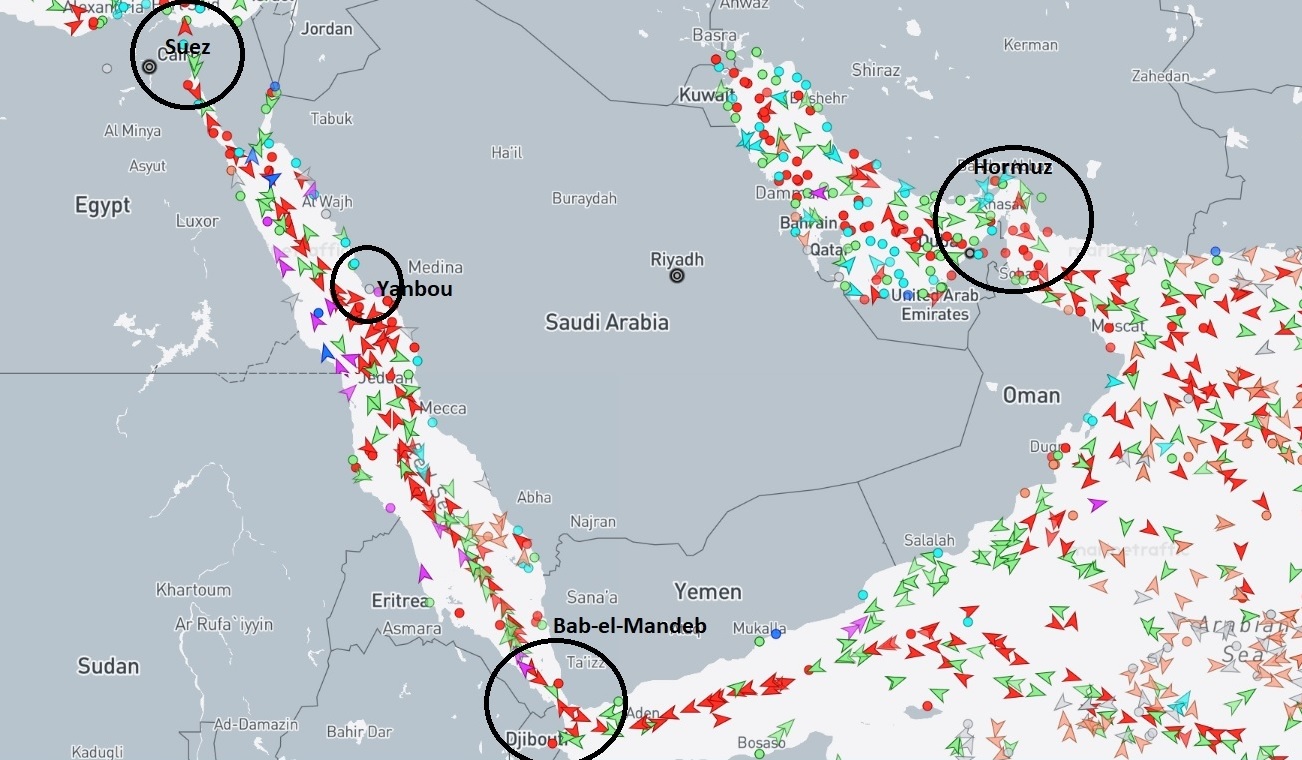
The third assumption was that alternative routes and strategic stocks could compensate for a temporary shutdown. In practice, the scale of energy flows through Hormuz far exceeds the capacity of alternative infrastructures, such as the Emirati pipelines to Fujairah or the Saudi routes to Yanbu on the Red Sea. Together, these outlets cannot carry more than some 6.5–7 million barrels per day, compared with roughly 20 million that normally transit the strait.
Interests and the reservations of the “willing”
Interests Without Commitment
The attempt to assemble an international naval force runs up against precisely this mismatch between political declarations and military reality. Several countries have an obvious interest in preserving freedom of navigation through Hormuz. The major economies of East and South Asia – Japan, South Korea, and to a significant extent India – depend heavily on oil and LNG imports from the Persian Gulf. For these states, keeping the strait open is a matter of energy security.
Gulf monarchies such as Saudi Arabia and the United Arab Emirates have similar stakes, as their economies depend on hydrocarbon exports. Yet they face a dilemma: on one hand, they need their export routes protected; on the other, an active role in military operations risks making them prime targets of Iranian retaliation. Politically, they also reason that the idiosyncratic U.S. President is temporary, whereas their neighbourhood with Iran is permanent. The long‑term costs of an open confrontation with Tehran will be borne by them for decades, while Washington can adjust its policy and priorities far more quickly. In Europe, countries such as the United Kingdom and France possess naval capabilities that could, in principle, contribute to such a mission. Yet many European governments remain hesitant. The primary reason is political: this conflict is not perceived as the outcome of a genuinely collective Western decision, but as the result of a U.S. initiative in which several allies had little say. Moreover, relations between many European capitals and Washington have been badly strained by the imposition of tariffs on allies, divergences over Ukraine policy, and repeated public personal insults directed at European leaders by the U.S. President – all of which erode the older political and emotional bond with the United States. Under these conditions, sending naval forces into an active war zone is seen in many capitals as a disproportionate risk. The familiar distinction between “political participation” (statements of support, limited roles in planning structures) and “high‑risk military participation” pushes many governments towards the lower‑risk end of the spectrum. And, crucially, Iran does not appear decisively defeated, so taking a hostile military stance against it may carry long‑term negative consequences. Many partners are simply unwilling to share political responsibility for an operation whose failure – in terms of restoring safe commercial navigation and insurance normality – already looks like the most likely outcome, and they perceive Washington as asking them to share the costs of a venture over which they had no real control.
Even states with a clear interest in energy‑market stability may prefer to contribute financially or diplomatically rather than militarily. Some governments fear that direct military involvement could trigger a wider regional escalation with no guarantee that commercial navigation would, in fact, be restored. In the background, there is also an expectation that if the U.S. initiative fails, the political cost will fall primarily on Washington, while those who kept their distance will retain greater room for manoeuvre.
Leverage Without Guarantee
Against this backdrop, U.S. diplomacy does possess levers of pressure. Defence relationships, access to U.S. weapon systems, trade agreements and tariff policy, and even the broader political cohesion of NATO can all be used as tools of encouragement or coercion towards allies. However, the use of such levers does not guarantee success. States tend to avoid high‑risk military ventures when the objectives are unclear, when the scale of operational demands does not match the level of political rhetoric, and when there is a widespread belief that failure is more likely than success.
The Greek case
Maritime Power Under Constraint
Within this context, the Greek case is particularly instructive. Greece controls the world’s largest merchant fleet and has a direct interest in the security of navigation through the Strait of Hormuz. Yet the operational capabilities of the Hellenic Navy are limited relative to the demands of such a mission. One Greek frigate is already deployed in the Red Sea as part of the EU mission Aspides, while two more frigates operate in the area around Cyprus due to Iranian drone attacks. Sending additional units to Hormuz would dangerously dilute Greece’s naval presence vis‑à‑vis the constant Turkish threat. For Greece, every unit tied down far from the Aegean and the Eastern Mediterranean increases Turkey’s relative freedom of action and erodes the credibility of national deterrence. This weakening is particularly problematic at a time when neither NATO nor European partners provide clear security guarantees to Greece, while some of the very same states supply arms to Turkey.
There is, however, a countervailing consideration. If Turkey were to participate in the Hormuz operation for reasons of geopolitical prestige, a total Greek absence could disturb the regional balance. Ankara could use its participation to rehabilitate its international image as an indispensable strategic partner of the West and strengthen its bargaining position on other issues, including disputes in the Aegean and the Eastern Mediterranean. Furthermore, Greece has already developed critical know‑how in low‑cost counter‑drone defence through the experience of frigates such as HS Psara in the Red Sea and Eastern Mediterranean – a capability that has diplomatic value, but is not an unlimited resource. Greek policy must therefore balance between two conflicting realities: the need to protect Greek shipping and preserve national deterrence against Turkey on one side, and the country’s long‑standing pro‑peace stance, its finite capabilities, and the need to avoid strategic overstretch and overreach on the other.
Conclusion
Strategy Without Alignment
Ultimately, the Hormuz crisis shows that the debate about escorting merchant vessels often conceals a deeper strategic reality. Security of navigation in such a narrow and dangerous maritime space cannot be guaranteed by symbolic gestures or a token presence of a few frigates. It requires a clear strategic objective, defined in operational and financial terms, and a corresponding military effort that takes into account the A2/AD grid, the munitions balance, the economics of interception, and the behaviour of the insurance market. As long as political declarations and operational requirements remain misaligned, any international coalition assembled for this purpose will remain unstable, and the crisis will retain its full capacity for danger.