Power, Repression, and the Limits of External Intervention
The essay answers this question: Why is the Islamic Republic both fragile and resilient?
Strategic abstract
Iran’s latest wave of unrest reveals a regime that is simultaneously resilient and fragile. While protests driven by economic collapse, social repression, and elite fragmentation expose unprecedented strain within the Islamic Republic, they do not yet constitute a revolutionary rupture. Instead, they illuminate a system whose coercive architecture remains intact even as its social legitimacy erodes.
The essay argues that the apparent fragility of the regime paradoxically constrains both internal transformation and external intervention. Iran’s power rests on overlapping institutions—clerical authority, the Islamic Revolutionary Guard Corps, and fragmented security organs—designed to suppress dissent while preventing unified defection. At the same time, ethnic diversity, succession uncertainty, and economic exhaustion deepen systemic stress without offering a clear path to regime replacement. Viewed through a Thucydidean lens, the crisis is structured by Fear of collapse and intervention, Honour tied to revolutionary identity and regional posture, and Interest centred on regime survival, sanctions relief, and control of economic assets. External actors face no low-risk options: pressure risks escalation, while disengagement invites regional instability. The result is not imminent collapse, but a dangerous equilibrium of progressive weakening.
Introduction
Iran’s latest wave of unrest, unfolding during 2025–2026, reveals a regime that is simultaneously resilient and brittle. The protests—initially triggered by economic collapse and led by bazaar merchants before spreading to students, women, workers, and ethnic minorities—do not yet constitute a revolutionary rupture. They nevertheless expose an Islamic Republic whose traditional pillars of authority appear more fragmented than at any point since 1979. Paradoxically, this very fragility also constrains external intervention: any collapse would unleash a regional contest that all actors fear, and in which no outside power possesses a low-risk path to decisive influence.
A legacy of repression
Modern Iranian politics has been shaped by repression long before the Islamic Republic. The Pahlavi monarchy pursued authoritarian modernisation supported by a formidable security apparatus, most notably SAVAK, while suppressing Islamist and leftist opposition. This model ultimately collapsed under the weight of social alienation and political exclusion, culminating in the 1979 Islamic revolution.
The Islamic Republic that replaced it did not abandon repression; it reconfigured it. Clerical authority was fused with revolutionary ideology and new security institutions, embedding coercion into both theology and statecraft. Repression became not merely a tool of rule but a constitutive element of regime identity.
The Islamic Republic’s coercive architecture
Since 1979, power has rested on a complex and deliberately overlapping structure: the Supreme Leader, clerical councils such as the Guardian Council and Assembly of Experts, the judiciary, the Islamic Revolutionary Guard Corps (IRGC), the Basij militias, the intelligence and security services, and the religious enforcement bodies tasked with policing public morality and compliance with Shariah. This architecture is designed to prevent any single institution from monopolising coercive power, while ensuring that dissent—whether political, social, or cultural—can be suppressed from multiple directions.
Key episodes—the student protests of 1999, the Green Movement of 2009, the fuel-price protests of 2019, and the nationwide uprisings of 2017–2018 and 2022–2023 following the death of Mahsa Amini in the custody of morality police—display a recurring pattern. Localised grievances rapidly escalate into regime-challenging slogans, followed by lethal force, mass arrests, and enforced silence. What has changed is not the repertoire of repression, but the social breadth of resistance.
Recurring unrest, new configuration
Earlier protest waves often originated among students, middle-class reformists, or discrete sectors and, although geographically widespread, remained socially segmented. The 2025–2026 protests differ in both scale and composition. They are the largest since the Islamic revolution and began not in universities but in the bazaars, amid record inflation, food price shocks, and the collapse of the local currency.
From there, the unrest spread outward—to students, women, industrial workers, and ethnic minorities—transforming an economic revolt into a systemic challenge.
From bazaar to street
The bazaars occupy a symbolic and structural position in Iranian history. Traditionally conservative and once allied with the clergy, bazaar merchants now find themselves squeezed by sanctions, mismanagement, and currency debasement. Strikes and demonstrations in Tehran’s Grand Bazaar and other commercial hubs signalled a rupture in one of the regime’s historic social buffers.
As protests spread, long-suppressed grievances resurfaced. Students and women joined to denounce social repression; minorities, to articulate\ longstanding economic and cultural marginalisation; slogans targeted not only domestic coercion but the regime’s external priorities, condemning expenditure on regional proxies with chants such as “no more Lebanon, no more Gaza”.
Why the regime is weaker now
Structurally, the Islamic Republic enters this crisis from a position of economic exhaustion. Years of sanctions, corruption, and misallocation—combined with the cost of regional interventions—have hollowed out real incomes. Between late 2024 and late 2025, inflation and currency depreciation sharply reduced purchasing power, eroding even regime-aligned constituencies. Regionally, the picture has also darkened. After the brief but intense “12-Day War” with Israel and subsequent blows to Hezbollah and Hamas, Iran’s proxy network appears degraded. The costs of sustaining the so-called “axis of resistance” are increasingly visible at home, while its strategic returns appear diminished. Most importantly, the protests now draw in segments of the urban middle class and economic elite that once functioned as intermediaries between state and society. This signals not merely discontent, but a deeper legitimacy crisis.
Power poles inside the regime
The clerical establishment still controls key institutions, yet its social prestige has declined sharply, especially among younger Iranians. Corruption scandals and perceived hypocrisy have eroded its moral authority.
The IRGC, by contrast, has emerged as the dominant power centre. Over two decades, it has consolidated control over elite military units, intelligence, and large swathes of the economy. Its power is increasingly autonomous from clerical oversight. The regular army (Artesh) remains defensive, professional, and ideologically restrained. Subordinated to the Supreme Leader and the IRGC, it plays little role in domestic repression, though any future split between army and IRGC remains a critical variable in regime-change scenarios.
Elected institutions—the presidency and parliament—are constrained by candidate preliminary vetting and unelected bodies, deriving influence largely from loyalty and patronage rather than popular mandate.
Succession and clerical decline
The eventual succession to Ali Khamenei looms as a central uncertainty for the Islamic Republic. While the constitutional framework still requires a cleric to occupy the position of Supreme Leader, the entrenched political, economic, and security power of the IRGC increasingly constrains the substance of clerical authority. This imbalance raises the prospect not of a clear institutional rupture, but of a de facto military–clerical order or a collective leadership arrangement in which clerical figures retain formal legitimacy while strategic decision-making shifts decisively toward security elites. Clerical decline thus appears less as institutional disappearance than as a reconfiguration of real authority within the regime.
Fragmented coercion and ethnic fault lines
The regime’s maintenance of overlapping armed organs—the IRGC, Basij, police, and regular army—reflects a deliberate strategy to prevent unified opposition within the coercive apparatus. Yet this fragmentation also complicates control during prolonged unrest.
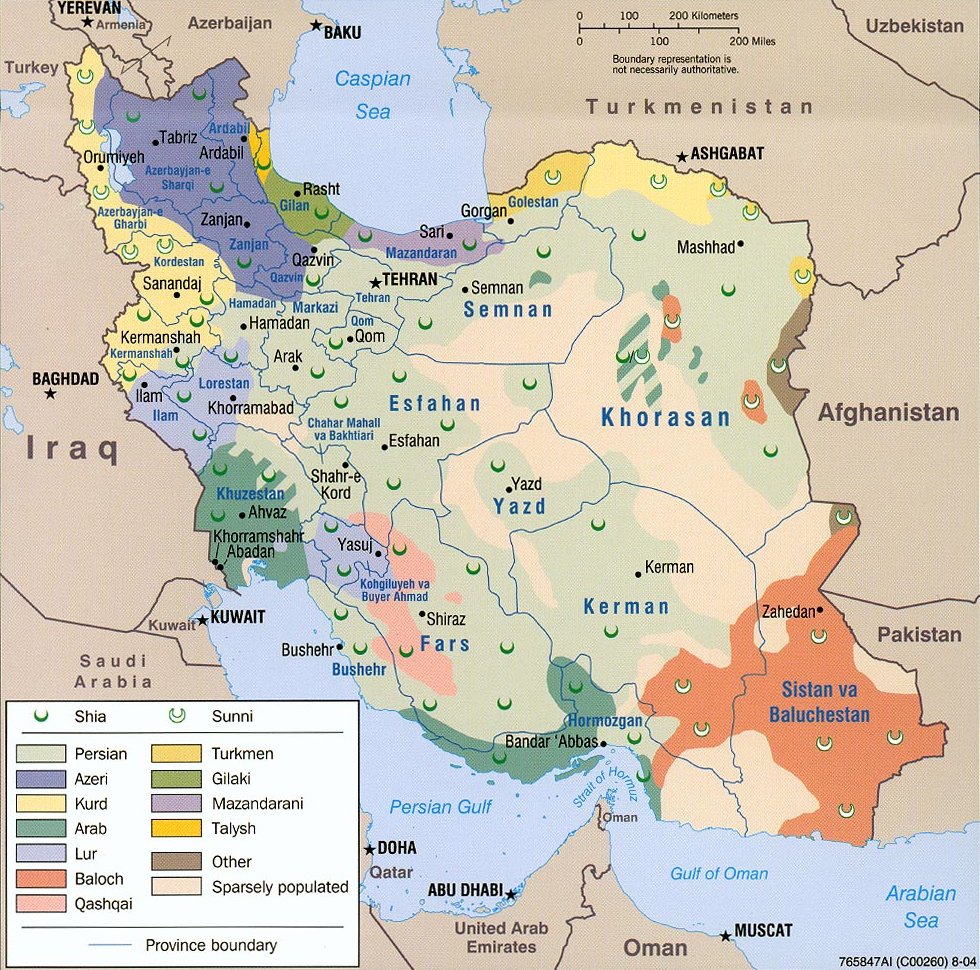
Iran’s ethnic mosaic adds further structural stress to the crisis. Kurds, one of the region’s most numerous stateless groups, inhabit a contiguous arc of territory that crosses four states—southeastern Turkey, northern Iraq, northeastern Syria, and northwestern Iran—making them geopolitically distinctive in both scale and directionality. Estimates suggest millions of Kurds in each of these countries, with significant concentrations near the borders, including an autonomous region in Iraq and longstanding communities in Iranian provinces such as Kermanshah and West Azerbaijan.
Alongside Kurds are Baluch in the southeast, Arabs in Khuzestan on the Iraqi and Gulf frontiers, and Azeris in the northwest near Azerbaijan and Armenia, each with historical grievances and cross-border affinities. These minorities are disproportionately located in border regions, where their mobilisation can have direction-dependent spillover effects: unrest among Kurdish populations can resonate across Turkey, Iraq, and Syria, while Azeri discontent interfaces with the Caucasus and Azerbaijan, and Baluch involvement echoes into Pakistan’s Balochistan. Such fault lines magnify the potential for internal instability to acquire external dimensions, especially if regional actors perceive opportunity or threat in adjacent cross-border communities.
External actors and constrained choices
For the United States, Iran presents a familiar dilemma. Washington seeks to reduce its footprint in the extended Levant, yet cannot ignore Tehran’s nuclear programme, regional reach, or the destabilising potential of regime collapse—an outcome that could set Pakistan, Turkey, and Saudi Arabia in unwanted motion. Sanctions and rhetorical support increase pressure on the regime but also deepen economic suffering, enabling Tehran to frame unrest as externally orchestrated subversion. Limited strikes, recently assessed and set aside, offer little prospect of regime change while carrying a high risk of escalation. Russia and China, by contrast, view Iran as a strategic asset. Russia values it primarily as a military and energy partner; China as a critical node in its Belt and Road Initiative and a source of discounted energy, at least for as long as Western sanctions persist. Both are therefore positioned to exploit any sustained Western disengagement.
Scenarios without prediction
Analytically, several trajectories emerge. Monarchist or secular republican visions promoted by exile figures resonate symbolically but lack organisational depth inside Iran. Military scenarios are more plausible, yet given IRGC dominance, any “coup” would likely resemble internal reshuffling rather than a conventional army takeover. The most probable near-term outcome remains managed decay: prolonged instability, harsher repression, elite bargaining over succession, and cosmetic reforms without genuine democratisation.
On intervention and illusion
Within United States policy debates, the allure of “surgical strikes” persists. Yet analysts widely judge that strikes capable of weakening the regime without triggering nationalist backlash or a broader regional war are strategically implausible. The risk–reward balance remains heavily skewed toward unintended escalation.
A more speculative option sometimes discussed is a personalised strike against senior IRGC leadership, drawing on the logic applied against Hezbollah command structures. In theory, such an action could create a temporary vacuum in which the regular army might assume a stabilising role, potentially disrupting regime continuity. In practice, however, this scenario is burdened with profound uncertainties—regarding institutional loyalty, succession dynamics, and public reaction—and carries a high risk of accelerating fragmentation rather than producing controlled transition.
Fear, Honour, and Interest in Iran’s crisis
Viewed through a Thucydidean lens, Fear permeates the system: fear of regime collapse, fear of internal fragmentation, fear of external intervention, and fear of nuclear escalation. Honour binds the regime to its revolutionary identity and regional posture, constraining compromise even as costs mount. Interest—economic survival, sanctions relief, control of resources, and the IRGC’s business empire—drives repression and selective adaptation.
Iran’s crisis thus reveals a regime under unprecedented strain, yet one whose collapse would probably generate a strategic vacuum few actors are prepared—or able—to fill. The paradox of the Islamic Republic is not its imminent fall, but the dangerous stability of its prolonged weakening.