Fear, Interest, Honour, and Dominance in the Horn of Africa
Strategic Abstract
This essay answers the question: “What does recognition do to different geopolitical actors?”
This essay examines the recognition of Somaliland by Israel as a revealing episode in the politics of recognition, exposing how sovereignty, legitimacy, and power are negotiated in regions marked by fragmentation and strategic congestion. Rather than treating recognition as a legal act, the analysis approaches it as a strategic instrument—one capable of unsettling regional equilibria by challenging entrenched assumptions about borders and authority.
The essay traces reactions across three levels. At the local level, Somalia perceives recognition as a symbolic annihilation of its last remaining claim to sovereignty, while Somaliland interprets it as precedent creation rather than material gain. At the regional level, the responses of Djibouti, Ethiopia, Egypt, Turkey, and selected Gulf states reflect theatre-specific calculations shaped by Fear, Interest, and Honour. Djibouti fears redundancy; Ethiopia exploits ambiguity; Egypt reacts from gatekeeping anxiety amplified by Nile geopolitics; Turkey defends an emerging sphere of influence in the Horn. At the systemic level, great powers manage the issue pragmatically, prioritising stability, access, and precedent over doctrine.
The essay argues that the Somaliland case illustrates a broader transition from rigid post-colonial orthodoxy toward managed fragmentation, in which legitimacy is increasingly negotiated through effectiveness, access, and strategic positioning rather than inherited recognition alone.
The recognition of Somaliland by Israel triggered reactions that reveal far more about the structure of regional anxieties and global power management than about Somaliland itself. What emerged was not a uniform response, but a stratified one—shaped by proximity, vulnerability, and position within the international hierarchy of power. The episode illustrates how recognition functions not as a legal technicality, but as a strategic instrument capable of unsettling entire regional equilibria.
At the local level, reactions were existential. Somalia rejected the move immediately and categorically, because non-recognition constitutes the last remaining pillar of sovereignty for a polity whose effective authority does not extend over Somaliland, and barely operates within its own nominal territory. The Somali position rests less on control than on international convention. Any breach in the taboo surrounding recognition threatens to collapse the diplomatic scaffolding that sustains the fiction of unity. In this sense, recognition represents not a territorial loss—already long since realised—but a symbolic annihilation.
Somaliland, by contrast, interpreted Israeli recognition not as an end point, but as a breach in a wall. The objective was not immediate material gain, but precedent creation: the slow erosion of the assumption that recognition is impossible. Israel functions here both as a decisive patron and as a door-opener, demonstrating that the prohibition is political rather than ontological.
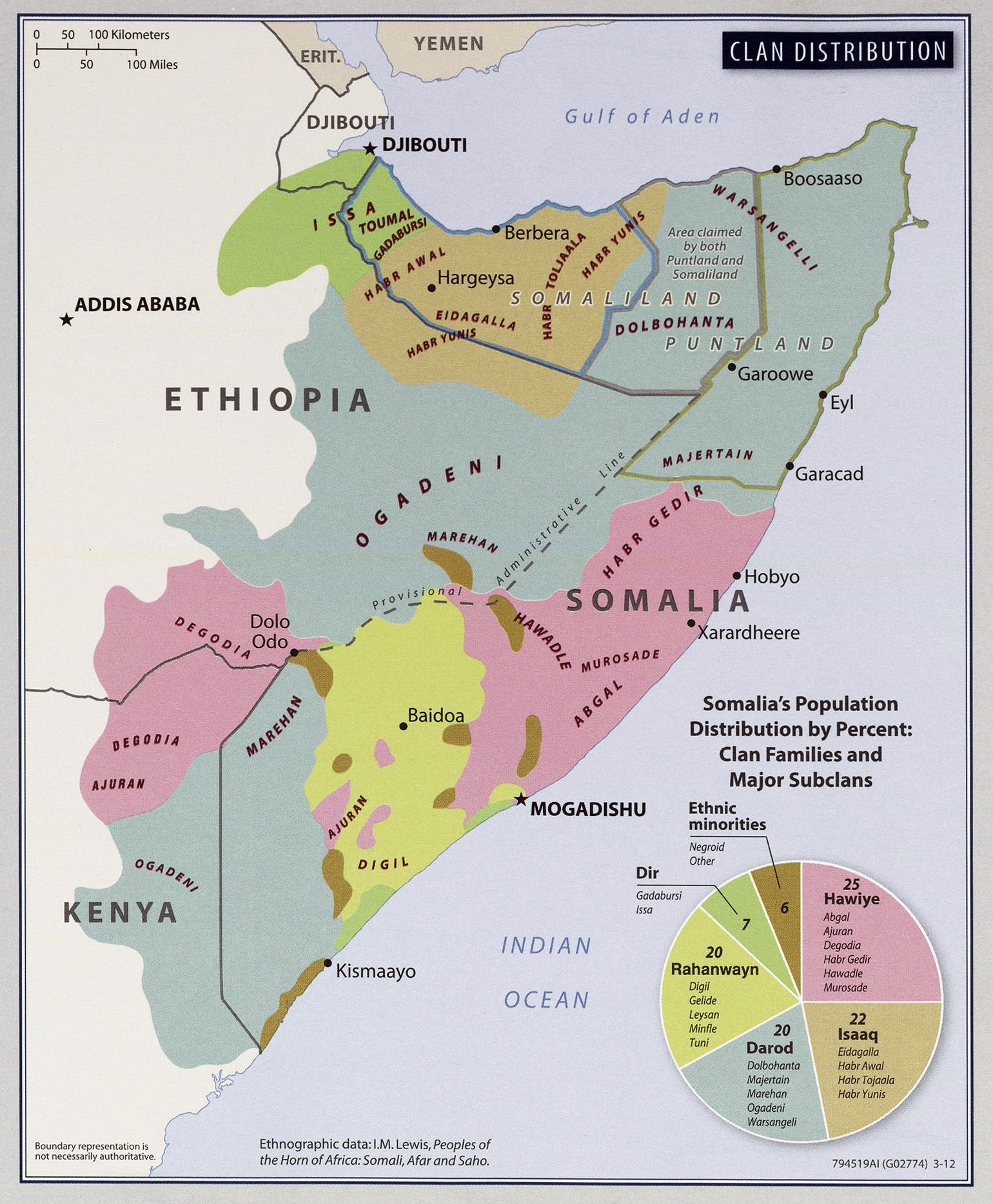
This contrast becomes clearer when one considers the nature of Somalia itself. Somalia was a synthetic state, created through the unification of British Somaliland and Italian Somaliland. The use of the past tense is deliberate. The former British territory has declared independence and has functioned as a de facto state for more than three decades. Part of the former Italian territory, Puntland, has declared autonomy. What remains of Somalia resembles a non-state: a government without administrative depth, monopolised legal violence, or effective public services. Social life is structured around tribal, religious, and criminal factions. In practice, the remnant of Somalia is increasingly evolving into a client polity, with Turkey emerging as its principal external patron.
Strong tribal rivalries—characteristic of the Horn of Africa and of southern Arabian Peninsula—rendered common political life impossible long before formal collapse. At earlier stages—during the late eighties—atrocities to the extent of genocide committed by the central Somali authorities (President Siad Barre) against the population of Somaliland made any return to unity not merely unrealistic, but morally implausible. Puntland, although unwilling to follow the path of full secession, equally rejects Turkish parasitism and the imposition of external maritime control over the Somali coast and the Gulf of Aden. In brief, fragmentation is not accidental; it is structural.
Against this background, the reaction of Djibouti was firm and unambiguous, though initially devoid of public theatrics. The concern of Djibouti is not legal principle but survival. The state has constructed its geopolitical relevance around two pillars: monopoly control of Ethiopian maritime trade, and the extraction of strategic rents from foreign military presences. A recognised Somaliland, anchored by the port of Berbera, threatens both by introducing redundancy. For a micro-state such as Djibouti, redundancy is fatal. Ethiopia, meanwhile, responded with calculated ambiguity. The strategic logic is straightforward: Ethiopia remains structurally constrained by the loss of direct sea access, and any diversification of maritime outlets is a national priority. Berbera offers a credible alternative corridor and, equally important, potential leverage over Djibouti, whose monopoly position has long translated into political and economic leverage over Addis Ababa. At the same time, overt endorsement of Somaliland carries heavy political cost. It would risk provoking Somalia, antagonising Egypt, and unsettling other regional actors who oppose recognition and have already condemned the move of Israel. It would also place Ethiopia in tension with the procedural orthodoxy of the African Union and with commitments within IGAD, where territorial integrity remains a central norm and open endorsement of secessionist entities is treated as a destabilising precedent. Ethiopia therefore maximises benefit through ambiguity: cultivating practical access and bargaining leverage vis-à-vis Somaliland, while avoiding a formal posture that could trigger diplomatic escalation or institutional isolation.
At the regional level, reactions were shaped by theatre-specific balance calculations. Egypt opposed the move vocally, but its objection did not arise from concern for Somali territorial integrity as such. It arose from the perception that recognition could legitimise a future Israeli strategic footprint near Bab el-Mandeb, thereby affecting Red Sea security and, by extension, the Suez Canal—an existential artery of Egyptian economic and strategic survival. Nile geopolitics amplify this sensitivity, as developments in the Horn are inseparable from Egyptian threat perception. In Thucydidean terms, the Egyptian reaction is driven primarily by Fear.
Turkey objected even more strongly, though from a different logic. Somalia constitutes the institutional foundation of extensive Turkish investment, military presence, and political influence in the Horn of Africa. The remnant of Somalia may be understood as a near-client polity. Recognition of Somaliland weakens that foundation and introduces precedents that resonate uncomfortably with unresolved questions elsewhere, most notably the occupied northern part of the Republic of Cyprus. Here, Interest and Honour converge. The objection is not merely defensive; it reflects an effort to preserve a regional project already under construction, and to prevent the emergence of an Israeli counter-presence in a theatre Turkey considers vital.
The Gulf states displayed no unified posture. The United Arab Emirates showed quiet receptivity, consistent with port investments in Berbera and broader Red Sea ambitions. Saudi Arabia remained cautious, prioritising stability over experimentation. An Israeli military presence in Somaliland would partially counterbalance Houthi capabilities and thus relieve part of the Saudi security burden in the southern Red Sea. At the same time, Riyadh remains uneasy with the prospect of Israeli proximity to a critical maritime artery adjacent to the Arabian Peninsula. This ambivalence reflects a tension between short-term security interest and long-term strategic prudence. Qatar, aligned with Somalia and Turkey, is reflecting alliance structures rather than independent assessment. The African Union responded with procedural resistance, invoking the sanctity of post-colonial borders—normative in form, limited in enforcement, and, in the case of Somaliland, practically irrelevant.
The recognition of Somaliland by Israel cannot be fully understood in isolation from the wider reconfiguration of the Eastern Mediterranean–Red Sea–Gulf strategic space. Over the past decade, maritime security, energy flows, digital connectivity, and trade corridors have progressively fused these theatres into a single extended system, linking Greece, Cyprus, Israel, and Egypt with selected Gulf actors and, increasingly, with the Horn of Africa. Within this emerging architecture, recognition functions not merely as a diplomatic gesture but as an instrument of access and positioning along critical nodes of connectivity. Israeli recognition of Somaliland thus represents a southern projection of an already existing logic: the consolidation of secure maritime corridors and nodal partnerships stretching from the Eastern Mediterranean through Suez to Bab el-Mandeb. It is precisely this systemic embedding—rather than any immediate alteration of military balances—that amplifies Egyptian sensitivity, as the move appears to touch not only upon Horn politics but upon Cairo’s long-standing self-conception as gatekeeper of the Red Sea–Mediterranean interface.
Among the great powers, reactions were governed by system management rather than principle. Israel pursued recognition as part of a broader logic of acquiring strategic depth in the Horn, maritime awareness, and influence near the southern entrance of the Red Sea, with possible relevance for future trade corridors, i. e. a parallel “blue” version of IMEC. Counterbalancing Houthi pressure emanating from Yemen and suppressing Somali piracy are additional motives, not least in service of global shipping. Claims that recognition was linked to plans for relocating Palestinians from Gaza emerged only in post-recognition accusations and lack any credible evidentiary basis. From a security perspective, populating a strategic foothold with hostile or unstable populations would undermine, rather than enhance, its value.
The United States adopted cautious neutrality, prioritising stability and freedom of navigation in an already congested theatre. China opposed recognition implicitly, consistent with its doctrine of territorial integrity and its strategic investments in Djibouti. Russia maintained opportunistic ambiguity, exploiting inconsistencies in Western recognition practices without committing to a position. The European Union adopted procedural caution, aligning with African Union norms while leaving recognition, as always, to the national discretion of its members.
Within this landscape, a distinct category of actors merits attention. Polities such as Somaliland, Taiwan, and Kurdish self-governed entities operate under conditions of effective governance combined with contested legitimacy. Cyprus, though a fully recognised polity except by Turkey, shares the lived experience of territorial partition and selective application of international norms. Recognition among such actors would not alter formal legal status, but it would possess symbolic coherence: a horizontal affirmation of earned statehood grounded in governance and resilience rather than inherited recognition alone.
Taken together, the reactions to Israeli recognition of Somaliland expose a deeper reality. The issue is not Somaliland itself, but the erosion of consensus over borders, recognition, and order in a region where chokepoints, fragile polities, and external actors intersect. Local actors respond from existential fear, regional powers from Interest and Honour, and great powers from prudential interest. The case illustrates a transition from rigid post-colonial orthodoxy towards a phase of managed fragmentation, where legitimacy is negotiated rather than assumed—and where Dominance is pursued not through conquest, but through control of access, precedent, and recognition.
The broader strategic environment within which this recognition unfolds—linking the Eastern Mediterranean, the Red Sea, the Gulf, and the Horn of Africa—requires a separate examination of connectivity, corridors, and system management.
See also: The Southern Rimland and the Logic of Strategic Depth