A Strategic Reflection on Israel, Hezbollah, and the Fragile Sovereignty of Lebanon
This essay answers the following question:
How can Israel effectively weaken Hezbollah and secure its northern border in a way that goes beyond purely military force and leads to a more durable, long-term solution?
Summary
Israel, like any sovereign nation, has the fundamental right to defend itself against existential threats (See also footnote). Faced with thousands of attacks from Lebanese territory by Iranian-backed Hezbollah — a heavily armed non-state actor functioning as a 'state within a state' on Israel’s border — exercising that right is both legitimate and necessary.
Lebanon, however, remains a fragile multi-confessional country with weak institutions and limited military capacity, making rapid disarmament of Hezbollah extremely difficult. The situation resembles cancer deeply embedded in the Lebanese body politic. Many Lebanese—especially Maronites, Sunnis, and Druze—recognize that Hezbollah’s independent military posture has repeatedly dragged their country into devastating wars, at great cost to sovereignty, the economy, and civilians. Polling indicates nearly 80% of Lebanese (and overwhelming majorities among non-Shi’a groups) believe only the state army should possess weapons. Targeted military actions are essential for immediate security, but a purely kinetic approach offers limited long-term gains. Israel could strengthen outcomes by cultivating goodwill among moderate Lebanese who seek a sovereign, disarmed nation free from Iranian influence. Discreet diplomacy, reconstruction incentives linked to state authority, and indirect support for the Lebanese Armed Forces could help extend sovereignty south of the Litani and politically isolate Hezbollah. Lebanon and Israel share ancient Levantine cultural roots, including Phoenician-Mediterranean traditions of openness and pluralism. This heritage could serve as a bridge rather than a barrier. Lebanon would do well to seize this rare window of converging interests with Jerusalem and reclaim its full sovereignty before the opportunity closes. As a mature democracy, Israel is well positioned to assist Lebanese decision-makers through calibrated outreach and incentives. A balanced strategy of firmness combined with strategic engagement offers the best path to a secure border enforced by a capable Lebanese state—not perpetual Israeli intervention—benefiting both peoples amid shifting regional dynamics.
This essay is complementary to: “Limits of Sovereignty: The Lebanese Dilemma and the Question of Resolution” .
Introduction
The right of Israel to defend its citizens and its very existence against repeated attacks from Lebanese territory is both understandable and legitimate. No sovereign nation can reasonably be expected to tolerate a heavily armed non-state actor—functioning as an Iranian proxy—entrenched across its northern border and launching thousands of strikes over time. The Israeli Ministry of Foreign Affairs has articulated this position with clarity and firmness, highlighting the failures of the leadership of Lebanon to disarm Hezbollah, enforce its own decisions, or prevent aggression from its soil.
Structural Fragility
Yet the Lebanese context reveals profound structural challenges that complicate any straightforward resolution. Lebanon has always been and still remains a fragile state, its institutions and armed forces constrained by deep sectarian divisions, economic collapse, and limited capacity to assert full sovereignty. Hezbollah operates as a classic “state within a state,” with significant social roots in segments of Lebanese society and substantial external backing from Iran. In metaphorical terms, the situation resembles a cancer embedded in the body politic of Lebanon: accusing the weakened host of harboring the disease misses the deeper reality of its entrenchment, while demanding rapid, complete eradication by a debilitated government risks underestimating the immense constraints involved—much like expecting a gravely ill patient to perform an impossible physical feat or excise advanced malignancy without comprehensive support.
Growing Lebanese Awareness
Recent developments (spring of 2026) underscore both the urgency and the complexity. Polls indicate growing Lebanese sentiment, particularly among Christians (including Maronites), Sunnis, and Druze, in favor of the state holding a monopoly on weapons. A Gallup survey found nearly 80% of Lebanese overall—and overwhelming majorities among non-Shi’a communities—believing only the Lebanese Armed Forces should possess arms. Many citizens across these groups recognize that the independent military posture of Hezbollah has repeatedly dragged Lebanon into devastating cycles of conflict, exacting a heavy toll on national sovereignty, the economy, and civilian lives. Lebanese government statements and actions toward aspects of UN Security Council Resolution 1701 reflect some momentum in this direction, even amid ongoing challenges and renewed flare-ups.
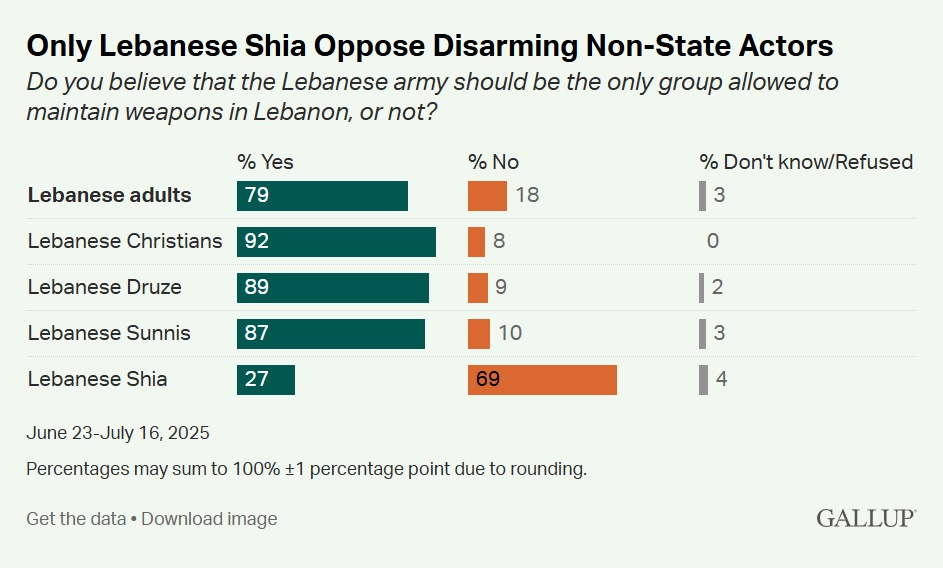
Lebanese public opinion strongly favors disarming Hezbollah (Gullup)
Beyond Kinetic Action
In this environment, a purely military approach—while essential for immediate self-defense—benefits from complementary strategies that build political leverage within Lebanon. Precise, intelligence-driven operations against the infrastructure and leadership of Hezbollah can degrade capabilities effectively; the 2024 pager explosions, which simultaneously targeted operatives with remarkable precision, stand as a cardinal example of such innovative disruption. Yet sustained progress may also require actively cultivating goodwill among Lebanese communities and leaders who genuinely share an interest in a sovereign, disarmed, and stable Lebanon liberated from Iranian proxy control.
Learning from History, Building for the Future
Strengthening ties with moderate voices—through discreet diplomatic channels, economic incentives for reconstruction explicitly linked to the extension of state authority, or unambiguous signals that Israel prioritizes a secure border over the indefinite necessity for belligerent action—could help isolate Hezbollah politically and undermine its “resistance” narrative. Historical precedents caution against repeated attempts to “sterilise” southern Lebanon without sustained follow-through alongside legitimate Lebanese authorities. Such vacuums have, in the past, been rapidly refilled. A forward-looking approach—potentially including indirect support such as training, consultation, or capacity-building assistance to the Lebanese Armed Forces—could help the state extend its writ south of the Litani River while addressing the core security requirements of Israel. This path not only offers greater durability but also helps preserve the standing of Israel with friendly international partners who affirm its right to self-defense yet voice concern when operations appear too broad in scope.
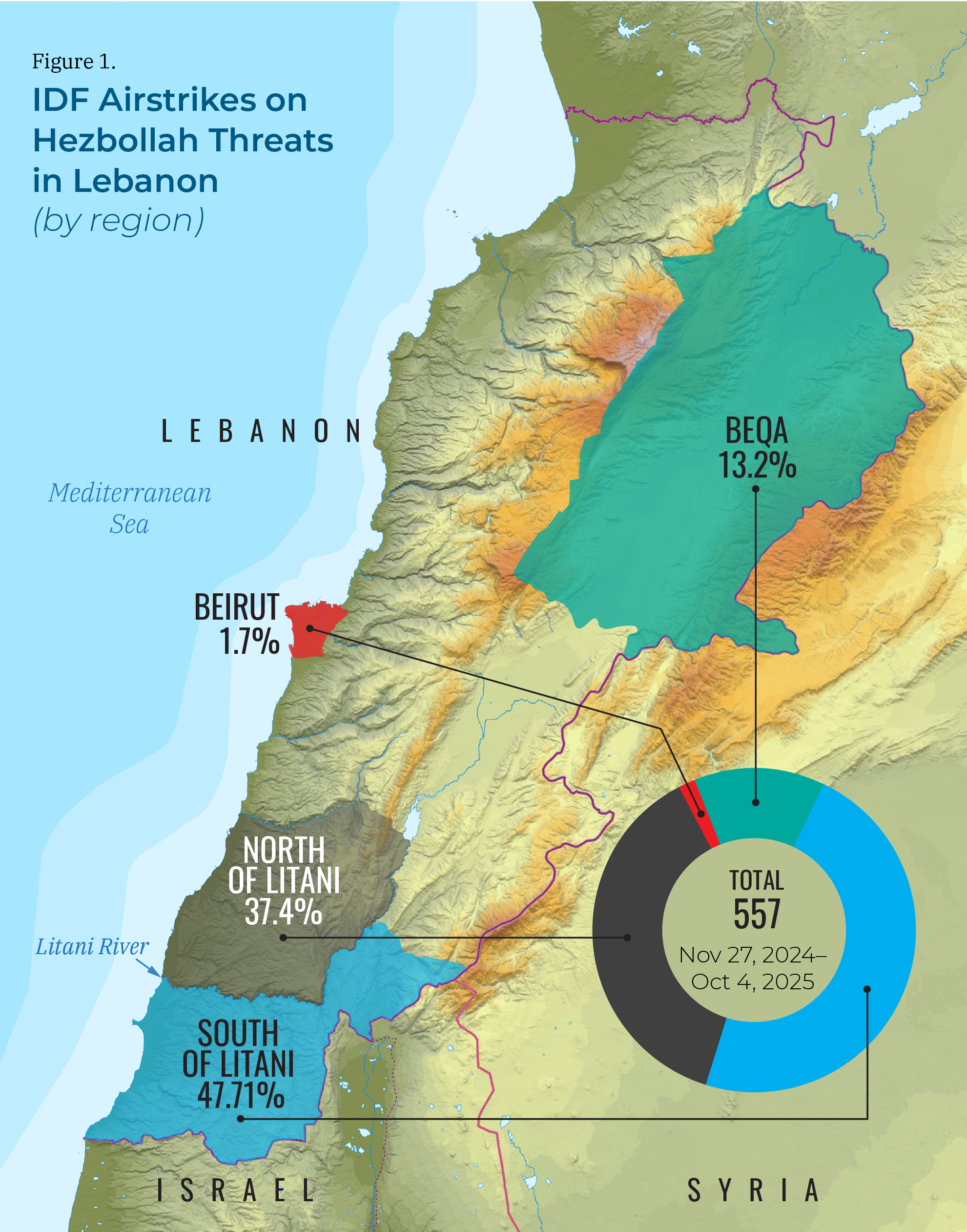
The distribution of IDF airstrikes on Lebanese territory (The Washington Institute for Near East Policy)
Shared Heritage and a Window of Opportunity
Long-term strategy must also weigh the human and societal costs on both sides. Prolonged conflict, even when justified by existential threats, risks shaping national psyches in enduring ways: breeding deep resentment and hate on the Lebanese side, and potential guilt or war fatigue on the Israeli side. These dynamics could erode future resolve and social cohesion over time.
Israel has long demonstrated extraordinary resilience and strategic ingenuity as a democratic outpost of the West in the Levant. These qualities equip it uniquely to balance indispensable security measures with initiatives that weaken Hezbollah’s grip not solely through force, but by empowering those Lebanese who aspire to reclaim their country. Notably, Lebanon itself was historically built on many of the same cultural premises: a Phoenician-Mediterranean heritage of seafaring commerce and openness, a multi-confessional society with strong Western and liberal traditions, and a pre-civil-war identity as one of the region’s most cosmopolitan and pluralistic states. This shared foundation—rooted in ancient Levantine civilizations and a mutual aspiration for democratic governance and regional stability—could and should serve as a bridge to draw the two countries closer rather than keep them apart. By appealing to this common legacy, Israel can more effectively support moderate Lebanese voices who seek to restore the sovereignty and independence of their nation.
Conclusion
Lebanon would do well to seize this rare occasion of converging interests with Jerusalem, and reclaim its full sovereignty before the opportunity closes. As a mature democracy with proven strategic depth, Israel is well positioned to assist Lebanese decision-makers in reaching the right choices—through discreet encouragement, calibrated incentives, and a clear vision of mutual benefit. A combination of firmness and such calibrated outreach to potential internal partners could hasten the day when quiet returns to the border—not because Israel must perpetually enforce it, but because a capable Lebanese state finally does so on its own terms. In an era of shifting regional dynamics, where external patrons like Iran face their own pressures, this nuanced strategy may represent the most effective route to a more secure and stable future for both peoples. Observers who genuinely wish well for Israel and a sovereign Lebanon see value in this balanced path: one that respects hard realities while investing in the political and cultural conditions for lasting change. That said, and under the present circumstances, from the perspective of Israel, the incorporation of the Lebanese front into any Irano-American truce—such as that of 8 April 2026—would entail significant strategic risk. A temporary de-escalation could provide Hezbollah with the opportunity to reorganise and consolidate its position; moreover, even in the event that such a truce were to evolve into a more durable arrangement, the structural threat posed by Hezbollah would still remain unaddressed.
Footnote 1
For details on the rights of Israel, please, consult Papastavrou A-T (2026), Appendix of Chapter 14.
Footnote 2
Lebanon is a confessional, consociational democracy with Western features, yet without full state sovereignty or institutional integration. The state is structured around a delicate equilibrium among religious communities: the President is a Maronite Christian, the Prime Minister a Sunni Muslim, and the Speaker of Parliament a Shi‘a Muslim, with corresponding allocations extending throughout the institutional framework. This arrangement was designed to prevent the domination of one group over the others and to preserve a fragile balance within a deeply plural society.
On the one hand, Lebanon displays recognisable elements of a Western-type democracy: elections, a parliamentary system, a degree of pluralism, and a relatively active civil society with an openness to Western values. On the other hand, political life is not organised primarily around programmes and ideologies, but around ethno-religious identities and networks of power. The state does not function as a unified, neutral framework, but rather as an arena for the distribution of influence among confessional communities.
The most decisive factor distancing Lebanon from the Western model is the absence of a monopoly on the use of force. The presence of Hezbollah as an armed non-state actor operating within the state fundamentally undermines the very notion of sovereignty. No mature Western-type democracy can coexist with a parallel military structure of such scale and autonomy.
Lebanon, therefore, should not be understood simply as a failed democracy, but as a system that survives through equilibrium rather than through institutional normality. It is a polity in which democracy functions less as a fully integrated system of governance and more as a mechanism for managing internal divisions. This is precisely why the demand that “the state disarm Hezbollah”, while theoretically sound, remains in practice unrealistic.
Bibliographic Anchors
Abdul-Hussain, H. (2026). Time for Lebanon to Partner with Israel Against Hezbollah. Foundation for Defence of Democracies. Full article
Frayer, L. (2024). What the Israel-Hezbollah war did to Lebanon's cultural heritage sites. National Public Radio (NPR). Full article
Ghaddar, H., Satloff, R., Yaari, E. (2025). A Roadmap for Israel-Lebanon Peace. The Washington Institute for Near East Policy. Full article
Killebrew, A.E. (2017). Archaeology, Shared Heritage, and Community at Akko, Israel. J East Med Archaeol Herit Stud. Full article
Loft, P., Rajendralal, R. (2025). Lebanon: Introductory country profile. House of Commons Library, UK. Full article
Loschky, J. (2025). Most Lebanese Say Only Army Should Have Weapons; Few favor providing military support to Palestine. Gallup. Full article
Ochsenwald, WL., Kingston, P. (2025). History of Lebanon. Britanica Encyclopaedia. Full article
Papastavrou A-T (2026). Thucydidean Geopolitics for the educated layperson. Ἡδυέπεια (Editors). Link
Salhani, J. (2026). Is Israel reshaping Lebanon, trying to separate Hezbollah from its people? Al-Jazeera. Full article