The Durand Line as a Structural Geopolitical Fault
This essay addresses two central questions:
1. Why does this particular frontier function today as a node of wider regional and global power competition?
2. Why did the 2025–26 confrontation escalate in scope and attract unusual international attention?
Abstract
This essay examines the armed escalation between Pakistan and Afghanistan (2025–26) not as a routine episode of cross-border friction or counterterrorism, but as the reactivation of a structural geopolitical fault line. At the core of the problem lies the Durand Line (1893), a boundary drawn within the framework of the Great Game as an instrument of imperial security rather than as a socially sustainable frontier. The line cuts across the Pashtun—and further south, the Baloch—anthropogeographical space, producing a border that is cartographically precise yet politically contested. Pakistan grounds its position in state succession and the principle of uti possidetis juris, while Afghanistan manages the line de facto without fully accepting it de jure, thereby generating enduring legal asymmetry. The frontier’s functional incompleteness—marked by porous mobility beyond official crossings—transforms closures of border gates and pressures for refugee return into instruments of political leverage. The escalation is analysed through a Thucydidean lens as a configuration of Fear, Honour, and Interest embedded within regional competition involving India, China, and Iran, and within broader Western security frameworks.
Introduction: The Problematic Legacy of the Durand Line
The armed escalation between Pakistan and Afghanistan in 2025–26 is not merely another episode of cross-border confrontation or counterterrorism operations. To understand it properly, it must be viewed as the reactivation of an old and unresolved problem: the Durand Line. The line was drawn in 1893 by the British between colonial India and Afghanistan within the context of the so-called Great Game—the geopolitical rivalry between the British and Russian Empires over Central Asia. The British objective was not the creation of a socially just or ethnically coherent frontier, but the establishment of a security belt against Russian southward expansion. Afghanistan was treated as an intermediate buffer zone.
The Durand Line cuts through the Pashtun anthropogeographical space, which extends across both sides of the frontier. Tribal structures, kinship networks, trade routes, and social codes pre-dated the boundary and continued to operate after its imposition. The same applies in the southern sector to the Baloch space. The result was a boundary that is clear on the map but socially contested among local populations and, at the state level, by Afghanistan.
Legal Foundation: Two Competing Logics
Pakistan regards the Durand Line as an international boundary established through state succession. When British India was dissolved in 1947 and Pakistan emerged as a successor state, the western international frontiers of British India became the frontiers of Pakistan under the principle of uti possidetis juris. This principle, widely applied during decolonisation, aims to prevent widespread revisionism and border wars. From the Pakistani perspective, therefore, the matter is legally settled: the line is valid, definitive, and internationally recognised.
The Afghan position differs. It has periodically been argued that the 1893 agreement was concluded under imbalance of power with the Amir of Afghanistan and that it concerned British India rather than the later state of Pakistan. Politically, the line never achieved full acceptance among local tribes or at the Afghan state level. Rejections have been articulated in political and traditional fora, including the Loya Jirga, the highest traditional consultative assembly of broad Afghan representation.
A fundamental asymmetry thus emerges: Pakistan treats the line as a final international border; Afghanistan administers it de facto while maintaining reservations regarding its de jure legitimacy. This asymmetry is not theoretical. It constitutes a permanent substrate of political friction. The fault line is not circumstantial. It is embedded in geography, in international law, and in the divergence of strategic outlook between the two states. Behind episodic triggers lie enduring motives that Thucydides would recognise as constant: Fear of fragmentation, dependence, or encirclement; Honour tied to national dignity; and Interest in controlling flows and influence. Where these converge upon a boundary never mutually legitimised, tension does not disappear—it merely changes form. The Durand Line is therefore not simply a line on a map; it is a continuous testing ground of power in a region where the local and the global intersect.
From Legal Asymmetry to Functional Incompleteness
The Durand Line never evolved into a fully controlled, tightly monitored border in the Western sense. The rugged geography of the Hindukush, cross-border tribal linkages, and the historically limited capacity of the Afghan state to exercise a full monopoly of force in its periphery produced a frontier that is functionally incomplete—porous.
Official crossing points such as Torkham and Chaman facilitate legal trade and documented movement. Beyond these, however, informal social and tribal mobility persists along much of the frontier’s length.
When, during crises, Pakistan closes official crossings, it does not attempt to hermetically seal a frontier that is structurally difficult to control in its entirety. Rather, it interrupts legal commercial flows and exerts political pressure on Kabul by imposing economic costs. The border thus becomes a lever of negotiation.
Within the same framework fall episodes of mass deportations or pressures for the return of Afghans—primarily Pashtuns—who have resided in Pakistan for decades, especially during periods of tension. Such measures are presented by Pakistani authorities as internal security actions, yet they also function as political messaging toward Afghan leadership. Instead of stabilising the line, however, they intensify social and humanitarian strain on both sides and strengthen the informal cross-border networks that already exist and that facilitate the quiet return of those expelled. The frontier is therefore simultaneously a legal question and a mechanism for the production of instability.
Three Strategic Turning Points
Daily incidents are frequent and analytically unproductive. Certain historical moments, however, have reshaped the strategic structure of the frontier.
1979 — Soviet Invasion
With the Soviet invasion of Afghanistan, Pakistan became the principal conduit through which funding, equipment, and training were channelled to Afghan mujahideen fighting Soviet forces, in cooperation with the United States. The Durand Line functioned as an operational corridor with the collaboration of local tribal structures.
2001 — United States Intervention
The Taliban had ruled Afghanistan between 1996 and 2001. They were overthrown following the United States intervention and remained an insurgent movement for two decades. Pakistan was an official United States ally but was accused of maintaining cross-border contacts with elements of Taliban leadership. The Abbottabad episode—where Osama bin Laden was located and killed on Pakistani territory—deepened the credibility crisis of Pakistani authorities in the eyes of Washington.
2021 — Re-establishment of Taliban Rule
In August 2021, following the withdrawal of United States forces, the Taliban seized Kabul and returned to power. For Pakistani strategic thinking, this development initially appeared favourable. For decades, Pakistan had sought a government in Kabul that would not be hostile and would not align closely with India. The concept of strategic depth in Pakistani doctrine does not imply territorial fallback in the event of invasion, but rather the assurance that the western frontier would not become a second front during confrontation with India.
Yet the new Afghan leadership did not fully satisfy Pakistani expectations. Although the Taliban’s social base is predominantly Pashtun, the Kabul regime seeks to present itself as an autonomous national actor. For reasons of internal legitimacy and international survival, it cannot appear as an extension of Islamabad, nor can it uncritically endorse the Pakistani narrative of final acceptance of the Durand Line while Pashtun irredentist claims remain politically sensitive.
At the same time, India, which had historically supported anti-Taliban forces and the governments of 2001–2021, did not entirely withdraw following the regime change. Instead, it opened communication channels with the Taliban. This does not amount to a strategic alliance but rather to damage limitation: New Delhi aims to prevent Kabul from falling entirely within Pakistani influence and to reduce the risk of Islamist pressure on Kashmir. Afghanistan thus re-emerges as a field of competitive influence rather than as a secure strategic rear for Pakistan.
The Escalation of 2025–26
Recent military actions—air strikes, exchanges of fire at border posts, and accusations of harbouring armed groups—are not isolated tactical events. Along a frontier lacking mutual legal legitimacy, each military act acquires the character of a political statement. The issue is not merely the pursuit of armed organisations; it is the contestation of sovereignty over the frontier itself. Kashmir and Two-Front Pressure
Pakistan’s strategic outlook cannot be separated from confrontation with India and the question of Kashmir. Strategic depth for Pakistan meant stability along the western frontier in order to avoid entrapment in two-front pressure. If the western border remains unstable—and potentially subject to Indian influence—the overall strategic balance is affected.
Jammu, Kashmir and the Two-Front Pressure
The strategy of Pakistan cannot be separated from its confrontation with India over the Kashmir issue. Strategic depth for Pakistan meant stability on its western border, so that it would not be caught in pressure between two fronts. If the western border remains unstable, and indeed under Indian influence, the overall strategic balance is disrupted.
The Regional Dimension
India seeks to limit Pakistani influence in Afghanistan. China prioritises stability in order to safeguard the China–Pakistan Economic Corridor (CPEC) toward the port of Gwadar and to protect the security of Xinjiang, whose Muslim Uyghur population renders it sensitive to transnational ideological spillovers. Iran seeks stability along its eastern frontier while monitoring implications for its broader confrontation with the United States.
The Pakistan–Afghanistan frontier is therefore not an isolated local issue. It forms part of a wider geopolitical matrix in which the Durand Line functions as a node of strategic compression involving regional and major powers. In such nodes, local confrontations acquire disproportionate significance because they serve as indirect testing grounds of broader strategic competition. The frontier is not merely a boundary; it is a surface of contact between competing strategies.
Why the 2025–26 Crisis Became Visible in the West
Clashes along the Durand Line are frequent, yet the latest crisis attracted unusual Western attention.
First, the scale of escalation was atypical: air strikes deep inside Afghan territory, public references by Pakistani leadership to open war against Taliban elements, and fears that the confrontation might move beyond its customary low-intensity threshold. Second, the crisis intersected with pre-existing Western security narratives: the stability of a nuclear-armed Pakistan; the presence of Tehrik-e-Taliban Pakistan (TTP), Islamic State – Khorasan Province (ISKP), and other armed non-state actors; and the vulnerability of CPEC. Each border crisis thus appears as a potential prelude to wider destabilisation.
Third, the temporal overlap with renewed tensions in United States–Iran relations—amid discussions of Iran’s eastward orientation toward Russia and China—has led parts of the analytical community to situate clashes along the Durand Line within a broader competitive framework. While some analyses suggest that Iran, China, or Russia may search for leverage points against Western interests, no direct orchestration of the specific crisis has been demonstrated. The linkage remains hypothetical.
Western attention, therefore, reflects not only developments along the Durand Line itself, but the perception that the Pakistan–Afghanistan frontier constitutes a distant yet critical node within a chain of overlapping crises stretching from the Eastern Mediterranean to Central Asia.
Conclusion
The 2025–26 conflict does not create the problem; it reveals its structural character. The Durand Line is the product of imperial strategy, the object of legal asymmetry, and the locus of functional incompleteness. As long as these three dimensions persist, the frontier will continue to generate crises.
Behind immediate triggers lie enduring motives that Thucydides would recognise: Fear of fragmentation, dependence, or encirclement; Honour bound to national dignity; and Interest in controlling flows and influence. Where these converge upon a boundary never mutually legitimised, tension does not vanish—it mutates. The Durand Line is not merely a cartographic demarcation; it remains a persistent testing ground of power in a region where the local and the global intersect.

Map 1: The Durand Line marks the border between Afghanistan and Pakistan, having been drawn with little consideration for the coherence of the Pashtun and Baloch tribal world, which it effectively partitioned.
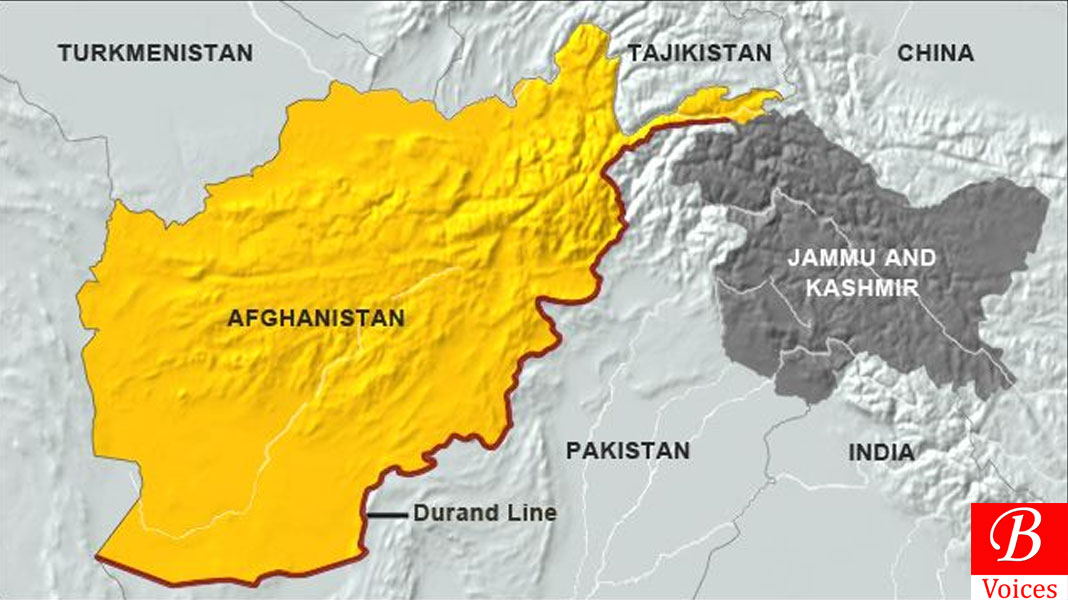
Map 2: The Durand line in relation to the Jammu-Kashmir issue.
Bibliographic Anchors
Editorial. Afghanistan–Pakistan Border Clashes, (2025).Robert Lansing Institute (RLI). https://lansinginstitute.org/2025/10/20/afghanistan-pakistan-border-clashes-2025/
Palmer, A. & Margolis, A. (2026). Why Did Pakistan Announce “Open War” Against the Taliban? Center for Strategic & International Studies. https://www.csis.org/analysis/why-did-pakistan-announce-open-war-against-taliban
MAŢOI, E. A Layered Analysis of the 2025 Afghanistan-Pakistan Crisis: History, Internal Politics, and the Return of Great Power Competition (2025). Middle East Political and Economic Institute (MEPEI). https://mepei.com/a-layered-analysis-of-the-2025-afghanistan-pakistan-crisis-history-internal-politics-and-the-return-of-great-power-competition/
Papastavrou, A-T. (2025). Thucydidean Geopolitics for the Educated Layperson. Ἡδυέπεια (Publishers). https://idiepeia.gr/catalog/thucydidean-geopolitics-for-the-educated-layperson/product-45j44mg.html?q=Aias-Theodoros&page=1&pageSize=4