Parallel Realisms Across Civilisational Space
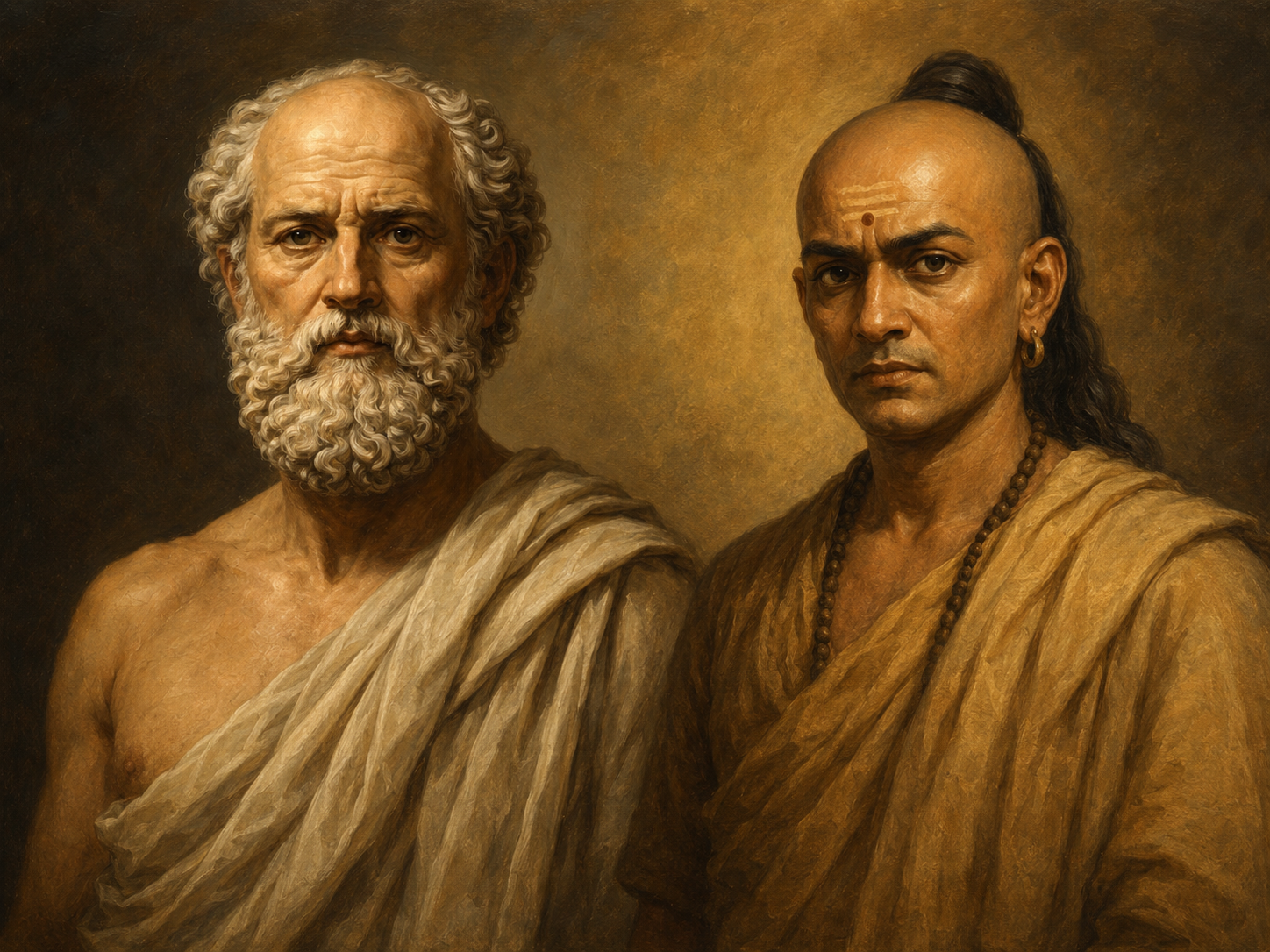 Thucydides and Kautilya: Independent founders of political realism in international relations
(AI-generated image)
Thucydides and Kautilya: Independent founders of political realism in international relations
(AI-generated image)
Abstract
This article offers a comparative reading of Kautilya’s Arthaśāstra and Thucydides’ History of the Peloponnesian War as parallel expressions of structural realism across civilisational space. It argues that both thinkers depict political orders lacking overarching authority, structured by rivalry, and shaped by recurrent pressures of necessity, yet diverge in intellectual architecture: Thucydides develops a descriptive analysis of conflict, whereas Kautilya constructs a prescriptive doctrine of statecraft integrating political economy, administration, and foreign policy. Analytically, the article introduces two concepts—Dominance and the paradox of proximity and intractability of rivalry—to capture, respectively, a drive toward pre‑eminence implicit in both corpora and the tendency of geographic closeness to intensify rivalry. For contemporary International Relations and Global IR, the analysis shows that sophisticated realist reasoning emerged independently in the Indian context and that some of the most enduring insights of realism reflect recurrent structural pressures grounded in human nature rather than a solely Western intellectual lineage.
Keywords
Thucydides, Kautilya, Arthaśāstra, political realism, comparative political thought, international relations, political theory
Introduction
Modern accounts of political realism are usually organised around a predominantly Western genealogy. From Thucydides through Machiavelli to modern theorists of International Relations, realism is commonly presented as an internally continuous intellectual tradition emerging from the historical experience of Europe and later universalised through the discipline of International Relations. This narrative is analytically convenient, but it risks obscuring the extent to which systematic reflection on power, necessity, interstate rivalry, and political survival also emerged outside the Hellenic–European trajectory (Liebig, 2014).
The presence of Kautilya complicates this assumption. The Arthaśāstra, composed in the context of early Mauryan state formation, presents a highly structured and explicitly prescriptive doctrine of statecraft and interstate relations. It articulates a comprehensive framework encompassing the internal constitution of the state, the classification of strategic actors, the conditional selection of foreign‑policy postures, and the calibrated use of diplomacy, inducement, coercion, espionage, and subversion. In contrast to the retrospective and analytical mode of Thucydides, Kautilya offers a systematic theory of political action. The existence of such a doctrine outside the Hellenic intellectual world raises a fundamental question: whether realism should be understood primarily as a historically transmitted tradition, or as a recurrent mode of thought generated under comparable structural conditions (Liebig, 2014).
The possibility of transmission cannot be dismissed a priori. The expansion of Hellenistic power into north‑western regions of the Indian subcontinent after the campaigns of Alexander the Great, followed by the Seleucid–Mauryan interface, created channels through which political, diplomatic, and intellectual contact may have occurred. Encounters between Hellenic and Indian intellectual milieus are documented, and the broader Hellenistic presence in the region cannot be treated as negligible. Yet the evidentiary basis for direct Thucydidean influence on Kautilya remains inconclusive. No textual or historical linkage securely connects the Thucydidean corpus with the formation of Kautilyan doctrine. The question of influence therefore remains legitimate but indeterminate: it may be retained as a heuristic possibility, but it cannot serve as the primary explanatory axis (Gautam, 2013; Black, 2016).
A more robust approach shifts the focus from genealogy to structure. In this respect, the comparison between Kautilya and Thucydides aligns with a broader critique of Western‑centred historical narratives, such as that advanced by Oswald Spengler, who rejected the idea that Western Culture occupies the centre of world‑history and proposed instead a comparative model of multiple, autonomous high Cultures. Within this perspective, similarities across civilisational contexts need not imply transmission; they may instead reflect analogous responses to comparable political environments (Spengler, 1926; Thucydides 2008; Black, 2016).
Spengler’s notion of synchrony—understood here not as exact simultaneity, but as the near‑contemporaneous emergence of structurally analogous forms—offers a useful heuristic. Thucydides belongs to the late fifth century BCE, while Kautilya is traditionally associated with Chandragupta Maurya, whose reign is usually placed in the late fourth and early third centuries BCE. The two thinkers are therefore separated by roughly a century. This chronological proximity is insufficient to prove transmission, but it is sufficient to make the question intellectually legitimate. It also supports a wider theoretical possibility: that similar political pressures may generate parallel forms of realist thought without requiring linear derivation (Liebig, 2014).
Analytically, the article introduces two concepts to capture these structural tendencies. First, alongside the familiar Thucydidean triad of Fear, Honour, and Interest, it identifies a fourth, implicit driver of behaviour: Dominance, understood as a recurrent tendency to seek pre‑eminence that sustains Interests, magnifies Honour, and sharpens Fear, while retaining a partially independent status as the pursuit of power for its own sake. Second, it develops the paradox of proximity and intractability of rivalry, the tendency of geographic closeness between rival powers to intensify competition and render peaceful accommodation more difficult, a logic visible both in Thucydides’ inter‑polis system and in Kautilya’s mandala (Evans, 2014; Liebig, 2014; Papastavrou, 2026).
On this basis, the article advances a comparative rather than genealogical argument. It proposes that Kautilya and Thucydides converge at the level of structural realism—recognising the persistence of rivalry, the constraints of necessity, the centrality of power, and the drive to dominance—while diverging in intellectual architecture and purpose. Thucydides develops a descriptive analysis of political behaviour grounded in historical observation; Kautilya constructs a prescriptive system designed to guide political action. The comparison is further clarified by reference to later European articulations of prescriptive realism, such as Machiavelli, without implying direct transmission, for which no evidence exists (Machiavelli, 2008).
Previous scholarship has identified important parallels between Kautilya and Thucydides, particularly in relation to realism, interstate rivalry, and strategic calculation. The aim here is not merely to restate these similarities, but to examine the deeper structural convergence and architectural divergence between the two systems of political reasoning, and to show how the concept of Dominance and the paradox of proximity‑driven intractability of rivalry can refine both historical understanding and contemporary realist theory (Modelski, 1964; Gautam, 2013; Liebig, 2014; Juutinen, 2018).
Kautilya: Structure, Doctrine, and the Political Economy of Statecraft
Any meaningful comparison with Thucydides requires that Kautilya be reconstructed as a coherent system of political reasoning rather than approached through selective analogy. The Arthaśāstra, attributed to Kautilya and traditionally associated with the reign of Chandragupta Maurya, constitutes one of the most systematic expositions of statecraft in the ancient world. Its orientation is explicitly prescriptive: it does not narrate political events but instructs the ruler in the acquisition, consolidation, and exercise of power under conditions of persistent rivalry (Olivelle, 2016).
At the foundation of this system lies the concept of artha, understood not as wealth in a narrow sense but as the material basis of political order—productive capacity, revenue, and economic organisation. The science of statecraft (arthaśāstra) is therefore inseparable from the management of livelihoods, resources, and fiscal extraction. Agriculture, herding, and trade form the core of this productive base, and the primary task of the ruler is to secure and expand the conditions under which these activities can flourish. Political power, in this framework, is not autonomous from economic life; it is generated by and dependent upon it. The capacity to sustain administration, maintain armed forces, conduct diplomacy, and project influence abroad presupposes a stable and productive economic foundation.
This material base is institutionalised through the doctrine of the saptanga, the seven constituent elements of the state. These comprise the ruler (svāmin), the administrative apparatus (amatya), the territory and population (janapada), the fortified centre (durga), the treasury (kośa), the armed forces (bala), and the network of allies (mitra). The state is thus conceived as an integrated organism whose strength depends on the coordination and relative quality of all its components. No single element is sufficient in isolation; weakness in one part affects the functioning of the whole. The ruler, although central, is not identical with the state but operates through this composite structure.
The formal justification of rule is articulated in normative terms. The ruler is enjoined to pursue the welfare of the subjects, and the legitimacy of authority is tied to their material and social well‑being. Yet this ethical formulation does not displace the underlying logic of power. Rather, it aligns the stability of the state with the prosperity of its population: a productive and secure society strengthens the fiscal and military capacity of the ruler. Normative language and strategic necessity thus converge, producing a doctrine in which welfare and power are mutually reinforcing rather than opposed.
Externally, Kautilya conceptualises the political environment through the mandala, or circle of states. This framework describes a structurally competitive system in which spatial proximity tends to generate hostility. Immediate neighbours are treated as natural adversaries, while more distant powers may assume the role of allies. The mandala is not a fixed geography but a relational configuration, within which each actor occupies a position defined by proximity, capability, and alignment. Strategic behaviour is therefore contingent and positional, rather than governed by permanent categories of friendship or enmity.
Within this system, Kautilya identifies a typology of strategic actors. The central figure is the vijigīṣu, the ruler who seeks expansion and consolidation. Opposed to him stands the enemy, while other roles are occupied by allies, intermediary powers capable of influencing the balance, and neutral actors possessing sufficient strength to remain outside immediate conflict. These categories are functional rather than moral: they describe positions within a competitive structure, not intrinsic qualities of states. The vijigīṣu thus personifies a rationalised drive to dominance: the normal orientation of a capable ruler is toward expansion, subject to prudential calculation.
The operational dimension of Kautilya’s doctrine is articulated through the upāyas, the principal instruments of political action: conciliation (sāma), inducement or gift (dāna), division (bheda), and coercion (daṇḍa). These instruments apply across both domestic and external domains and are to be employed in combination, according to circumstance. Political success depends not on the exclusive use of force, but on the calibrated integration of persuasion, economic leverage, psychological manipulation, and coercive capacity. Complementing these instruments is a set of foreign‑policy postures, commonly enumerated as six measures: peace, war, neutrality, preparation, alliance, and dual policy. These are not fixed orientations but strategic options, to be selected and revised according to relative strength and changing conditions. No posture is permanent; adaptability is the governing principle.
Conflict itself is differentiated into multiple forms. Kautilya distinguishes between open warfare, covert operations, and indirect or silent forms of conflict conducted through espionage, subversion, and the exploitation of internal divisions within rival polities. Intelligence gathering occupies a central place in this framework. The systematic use of spies is treated as indispensable to both internal security and external advantage, reflecting a conception of politics in which information and deception are integral components of power.
Strategic choice is governed by a conditional logic grounded in relative capability. Inferior actors are advised to avoid direct confrontation and to rely on alliance, negotiation, or indirect methods. Actors of comparable strength engage in balancing behaviour, while superior powers may resort to open conflict when conditions are favourable. This calculus is further refined by a typology of conquest, which distinguishes between restrained, acquisitive, and destructive forms. Although expressed in normative language, these distinctions function primarily as classifications of strategic outcomes rather than as binding moral constraints.
Underlying this entire system is an implicit anthropology often summarised by the notion of matsya‑nyāya, the “law of the fish”, according to which, in the absence of political order, the strong prey upon the weak. The state emerges as the mechanism that prevents such a condition by imposing order, securing property, and enabling productive activity. Yet this same logic extends outward: the international environment remains competitive and potentially predatory, requiring constant vigilance and strategic calculation (Boesche, 2003; Olivelle, 2016).
Taken together, these elements form a highly integrated doctrine of statecraft. The Arthaśāstra does not merely recognise the existence of rivalry and conflict; it systematises the internal foundations, external conditions, and operational instruments through which power is generated and exercised. Its distinctiveness lies in the fusion of political economy, administrative organisation, and strategic reasoning into a unified framework. It is this level of systematisation, including a normalised drive to dominant position within the mandala, that renders comparison with Thucydides both possible and analytically demanding (Liebig, 2014).
Thucydides: History, Necessity, and the Logic of Power
The work of Thucydides differs fundamentally in form and intention from that of Kautilya. Whereas the Arthaśāstra is a prescriptive treatise designed to instruct the ruler, the History of the Peloponnesian War is an analytical account of a specific historical conflict. Its declared purpose is not to provide a manual of action, but to offer an understanding of political behaviour that will remain valid “for all time” [ktēma es aei – κτῆμα ἐς ἀεί (Eliou, 1980)]. The result is not a doctrine in the formal sense, but a sustained investigation into the causes, dynamics, and consequences of power under conditions of inter‑polis rivalry.
At the centre of this investigation lies a conception of political life governed by necessity. Thucydides identifies as the deepest cause of the war the growth of Athenian power and the fear this inspired in Sparta (1.23.6). This formulation, although not systematised into an explicit theoretical framework, reveals a recurrent pattern: the interaction between rising power and established power generates structural tension, which in turn produces conflict. Political decisions are thus constrained by pressures that exceed the intentions or preferences of individual actors (Evans, 2014).
Within this framework, Thucydides presents a triadic pattern of motivation—Fear, Honour, and Interest—as recurring drivers of state behaviour. These are not formal categories articulated by the historian as a doctrine, but analytical regularities that emerge from the narrative. Fear operates as a response to perceived threats and often leads to pre‑emptive action; Honour relates to status, reputation, and the avoidance of humiliation; Interest concerns material advantage, security, and strategic gain. Together, they form a dynamic set of incentives that shape decisions under conditions of uncertainty and competition.
Alongside this triad stands a fourth, implicit motive: Dominance. The Athenians insist in Book 1 that they are not the first to “take such a course”, since “it has always been the established rule that the weaker should be constrained by the stronger” (Thuc. 1.76.2). They further praise those who, though not “so superior to human nature as to refuse dominance”, nonetheless respect justice more than their position compels them to do (Thuc 1.76.3). Later, in his analysis of stasis at Corcyra, Thucydides attributes the atrocities of civil strife to a “lust for power, driven by greed and ambition” (Thuc. 3.82.8), presented as a recurrent feature of human nature that guarantees the repetition of such events “as long as human nature remains the same” (Thuc. 3.82.2). These passages suggest a structural tendency to seek pre‑eminence — an animating drive to dominance — that cannot be reduced entirely to Fear, Honour, or Interest, even though it sustains and is sustained by them (Ignatieff, 2025; Papastavrou, 2026).
The inter‑polis environment of the Greek city‑states described by Thucydides is neither ordered by overarching authority nor stabilised by enduring norms. Alliances shift, calculations change, and actors adapt to evolving circumstances. The behaviour of states is therefore situational, conditioned by relative power, opportunity, and risk. While formal agreements and moral language are present, they are shown to be contingent upon the underlying distribution of power. When vital interests are at stake, normative constraints weaken or collapse.
This logic is most explicitly articulated in the Melian Dialogue. There, the Athenians reject appeals to justice in favour of a stark formulation of political reality: “right is only in question between equals in power, while the strong do what they can and the weak suffer what they must” (Thuc. 5.89.1). The dialogue does not merely describe a particular episode; it distils a general principle concerning the limits of moral argument in asymmetrical power relations. Dominance here is not only instrumental—secured for gain—but also treated as a natural law of interaction between unequal actors.
At the same time, Thucydides does not reduce political behaviour to a single principle. His narrative shows that decisions are rarely determined by one motive alone. Fear may coexist with ambition, Honour with calculation, and Interest with misperception. The complexity of political life is preserved, and the consequences of action are often unintended. Strategic misjudgment, overextension, and internal instability play a significant role in shaping outcomes. Power, while of central importance, does not guarantee success; its effective use depends on prudence and accurate assessment (Thucydides, 2008).
The role of material resources is clearly recognised, though not systematised in the manner found in Kautilya. Financial capacity, control of resources, and the ability to sustain military operations are repeatedly shown to influence strategic possibilities. The capacity to wage war, maintain alliances, and endure prolonged conflict presupposes access to money, manpower, and logistical support. Yet these factors are integrated into the narrative rather than abstracted into a separate analytical category. Greek political thought more broadly recognised the same practical constraint, as later orators such as Demosthenes would insist that without money nothing necessary can be accomplished (δεῖ δὴ χρημάτων, καὶ ἄνευ τούτων οὐδέν ἐστι γενέσθαι τῶν δεόντων – Dimosthenes, Olynthiac I 20).
Geography also exerts a persistent influence. Proximity generates friction, and the spatial distribution of power shapes strategic interaction. Conflicts between neighbouring states are recurrent, while distant powers are drawn into alliances that reflect shifting balances. This spatial dimension is not formalised into a theory comparable to the mandala, but it is consistently present as an underlying condition of political behaviour. The growth of Athenian power and the resulting Spartan fear exemplify how overlapping spheres of influence among proximate powers generate enduring tension (Evans, 2014).
Taken together, these elements produce a distinctive form of realism. Thucydides does not construct a systematic doctrine of statecraft; he reveals the patterns through which power operates in practice. His analysis is descriptive, historically grounded, and attentive to contingency. It exposes the constraints imposed by necessity, the instability of alliances, the fragility of norms, and the interplay of material and psychological factors in political decision‑making. It also normalises a drive to dominance as part of the human condition, even as it demonstrates the tragic consequences of its unbridled pursuit (Roest, 2004; Papastavrou, 2026).
Convergence and Divergence: Two Realist Horizons
The comparison between Thucydides and Kautilya reveals both a striking convergence and a decisive divergence. The convergence lies in their shared recognition of political necessity under conditions of rivalry and the drive to predominance; the divergence lies in the form through which this recognition is articulated.
At the most general level, both thinkers describe a political environment characterised by the absence of overarching authority and the persistence of competition among organised political units. In Thucydides, the inter‑polis environment is structured by shifting alliances, fear of rising power, and the constant possibility of conflict. In Kautilya, the mandala presents a similarly competitive configuration in which geographic proximity tends to produce overlapping spheres of ambition and thus recurrent conflict. This dynamic may be described as a paradox of proximity and intractability: proximity, which might be expected to facilitate cooperation through repeated interaction and mutual benefit, instead intensifies competition by increasing both the overlap of strategic interests and the salience of threat perception, thereby rendering durable accommodation difficult. Thucydides’ account of Spartan fear at the growth of Athenian power (1.23, 1.66–88) and Kautilya’s presumption that neighbouring kings are “natural enemies” both reflect this tragic logic of neighbouring rivalries (Modelski, 1964; Liebig, 2014; Evans, 2014; Heraklidis & Çakmak, 2021).
This convergence becomes clearer when one examines the drivers of behaviour. Thucydides identifies recurring motives—Fear, Honour, and Interest—as shaping decision‑making under pressure. Kautilya, while not presenting an equivalent triad, constructs a framework in which strategic action responds to comparable incentives: security, advantage, and status—categories that may be read as functional expressions of what can be analytically rendered in Thucydidean terms as Fear, Interest, and Honour—are pursued through a calibrated use of policy instruments. The difference lies not in the recognition of these motives, but in their treatment. Thucydides observes them as patterns emerging from historical events; Kautilya incorporates them into a system designed to guide action (Liebig, 2014; Evans, 2014).
The role of material resources further reinforces this parallel. Thucydides repeatedly shows that the capacity to wage war and sustain alliances presupposes access to money and manpower. Kautilya develops this insight further by integrating it into the very foundation of his system through the concept of artha, transforming what appears in the Greek case as an empirical constraint into a formal principle of statecraft. Material production, revenue, and economic organisation are not auxiliary factors but constitutive elements of state power (Roest, 2004; Liebig, 2014).
At the level of strategic choice, both thinkers recognise that behaviour is conditioned by relative power. In Thucydides, weaker actors appeal to justice or alliance, while stronger actors act with greater freedom, as exemplified in the encounter between Athens and Melos. In Kautilya, this logic is rendered systematic: inferior rulers are advised to avoid direct confrontation and to rely on alliance, negotiation, or indirect methods, whereas superior rulers may resort to open conflict when conditions are favourable. The underlying principle is identical, but the mode of expression differs—empirical and situational in Thucydides, codified and prescriptive in Kautilya (Modelski, 1964; Liebig, 2014; Ignatieff, 2025).
Beyond the motives commonly associated with Fear, Honour, and Interest, both frameworks reflect a normalised tendency toward asymmetry in power relations. In Thucydides, this appears in the recurrent assumption—articulated by the Athenians—that it is an established rule for the stronger to constrain the weaker (1.76.2) and that those who cannot “refuse dominance” may nonetheless be praised for restraining its exercise (1.76.3). This formulation does not prescribe dominance as an explicit doctrine, but records it as a persistent feature of political behaviour and a near‑universal human tendency. In Kautilya, the same tendency is embedded in the figure of the vijigīṣu, the ruler who seeks consolidation and extension of control as part of rational statecraft, and in the typology of conquest that assumes expansion as a normal objective. Although neither thinker isolates this tendency as a named principle, it can be analytically described as a drive toward Dominance: not reducible to immediate advantage, but oriented toward the reduction of vulnerability through preponderance. Dominance sustains Interest, reinforces Honour, and intensifies Fear in adversaries; it is thus both derivative and partially autonomous (Liebig, 2014; Ignatieff, 2025).
Seen through this lens, the contrast between Thucydides and Kautilya becomes sharper. Thucydides exposes the pursuit of pre‑eminence as both pervasive and self‑defeating: the transformation of the Delian League into empire and the overreach of the Sicilian expedition illustrate how the “lust for power” ultimately unravels Athenian strength (2.65, 6–7). Kautilya, by contrast, incorporates the drive to dominance into a rationalised programme of expansion, differentiating restrained from destructive conquest and embedding conquest within a broader doctrine of artha and saptanga. Dominance is thus simultaneously a point of convergence and a key axis of divergence: both thinkers normalise it, but only Kautilya systematically codifies how to pursue it (Roest, 2004; Liebig, 2014; Molloy, 2026).
The difference in intellectual architecture is equally significant. Thucydides offers no systematic doctrine of rule, no classification of instruments comparable to the upāyas, and no integrated model of state structure analogous to the saptanga. His work remains analytical, historically grounded, and attentive to contingency. Kautilya, by contrast, constructs a comprehensive framework that unifies internal organisation, economic management, and external strategy into a single doctrine of statecraft. Thucydides reveals the constraints and tendencies of political life; Kautilya translates them into a structured guide for action (Roest, 2004; Liebig, 2014).
This distinction has implications for the question of influence. The parallels between the two are sufficiently precise to invite comparison, yet they do not display the markers of direct transmission. The absence of textual, terminological, or structural borrowing suggests that these similarities are better understood as independent responses to analogous political conditions rather than as products of a single lineage. The chronological sequence of the two thinkers, and the fact that there was a point of contact between the two civilizations during the time of Kautilya, makes it conceivable that there may have been some indirect transmission or indistinct intercultural contact (Gautam, 2013; Liebig, 2014).
Conclusion: Realism Beyond Genealogy
The comparison of Kautilya and Thucydides suggests that realism is not simply a Western intellectual tradition diffusing outward from the Hellenic world, but a recurrent mode of thought generated under comparable structural conditions of insecurity, rivalry, and the drive to dominance. Both thinkers describe political environments lacking overarching authority, structured by proximity‑driven competition, and marked by a persistent tendency of the strong to constrain the weak. Both normalise the pursuit of pre‑eminence as a rational response to vulnerability, even as they differ in their assessment and codification of its consequences.
The concepts of Dominance and the paradox of proximity and intractability help clarify this convergence. Dominance captures the structural tendency towards pre‑eminence that underlies and extends beyond Fear, Honour, and Interest in Thucydides, and that is doctrinally embedded in Kautilya’s vijigīṣu and mandala logic. The paradox of proximity and intractability of rivalry illuminates why neighbouring powers—from Athens and Sparta to regional rivals in South Asia or the Eastern Mediterranean—so often find peaceful coexistence elusive despite strong material incentives for cooperation. Together, these concepts show how non‑Western and classical Western texts can be read in a common structural vocabulary without reducing one to the other (Juutinen, 2018; Evans, 2014; Liebig, 2014; Heraklidis & Çakmak, 2021).
For contemporary International Relations, this comparative exercise has two implications. First, it supports the ambition of “Global IR” to decentre Western canons by demonstrating that sophisticated realist reasoning emerged independently in the Indian context and that its integration into theoretical debate enriches, rather than merely supplements, existing frameworks. Second, it suggests that some of the most enduring insights of realism—about necessity, dominance, proximity—are not the property of any single civilisation, but expressions of recurrent structural pressures in political life grounded in the human nature. Recognising this may allow realism to be re‑articulated less as a lineage to be defended and more as a family of structurally grounded responses to the perennial problem of how states survive, compete, and seek to rule.
Bibliography
Black, A. (2016). A World History of Ancient Political Thought. Oxford University Press.
Boesche, R. (2003). Kautilya’s Arthasastra on War and Diplomacy in Ancient India. J Milit Hist , 67(1), 9–37. https://muse.jhu.edu/article/40432
Bruseker, G. (2008). The Conquests of Alexander and Greek Knowledge of Indian Philosophy: a Context of Understanding. An Anthology of Philosophical Studies,
Philosophy volume. https://www.academia.edu/3780646/The_Conquests_of_Alexander_and_Greek_Knowledge_of_Indian_Philosophy_A_Context_of_Understanding
Chaniotis, A. (2018). Age of Conquests: The Greek World from Alexander to Hadrian (ISBN: 978-0674659643, Trans.). Harvard University Press. https://www.hup.harvard.edu/books/9780674659643
Eliou, E. (1980). Thucydides' message. Kedros (Publ). [Ἠλιοῦ, Ἠ. (1980). Το μήνυμα του Θουκυδίδη. Κέδρος].
Evans, T. R. (2014). The Themes of Fear, Honor, and Interest in Thucydides. University of Utah, Salt Lake City. https://www.academia.edu/22145777/_The_Themes_of_Fear_Honor_and_Interest_inThucydides
Gautam, P. K. (2013). One Valley, Many Masters: Kautilya’s Arthashastra and the Peloponnesian War. In P. K. Gautam, S. Mishra, & A. Gupta (Eds.), Indigenous Historical Knowledge: Kautilya and His Vocabulary (pp. 83–104). Institute for Defence Studies and Analyses.
Heraklidis, A., & Çakmak, G. A. (Eds.). (2021). Greece and Turkey in Conflict and Cooperation: From Europeanization to De-Europeanization.
Ignatieff, M. (2025). The strong do what they can And the weak suffer what they must. Substack. https://michaelignatieff518703.substack.com/p/the-strong-do-what-they-can?r=3u7v3&utm_campaign=post&utm_medium=web&triedRedirect=true
Juutinen, M. (2018). Kautilyan foreign policy analysis: Sino-Indian dynamics in South Asia and the Indian Ocean region. J Indian Ocean Reg, 14(2), 206–226. https://doi.org/10.1080/19480881.2018.1472859
Liebig, M. (2014). Kauṭilya’s Arthaśāstra: A Classic Text of Statecraft and an Untapped Political Science Resource (Vol. 74). https://d-nb.info/1192448529/34
Machiavelli, N. (2008). The prince (M. Viroli, Ed.; Peter Bondanella, Trans.). Oxford University Press.
Modelski, G. (1964). Kautilya: Foreign Policy and International System in the Ancient Hindu World. Am Pol Sci Review, 58(3), 549–560.
Molloy, S. (2026). Do the Strong Suffer When They Do What They Want? Logos - a Journal of Modern Society and Culture. https://logosjournal.com/between-the-issues/do-the-strong-suffer-when-they-do-what-they-want/
Olivelle, P. (2016). King, Governance, and Law in Ancient India: Kautilya’s Arthaśāstra (Olivelle, Patrick, Trans.). Oxford University Press.
Papastavrou, A.-T. (2026). Thucydidean Geopolitics for the educated layperson. Idyepia Publications. https://thucydidean-geopolitics.eu/
Roest, B. (2004). Review (Richard Ned Lebow, The tragic vision of politics : ethics, interests, and orders. Cambridge: Cambridge University Press, 2003, Trans.). Bryn Mawr Classical Review . https://web.archive.org/web/20260516095945/https://bmcr.brynmawr.edu/2004/2004.08.22/
Spengler, O. (1926). The Decline of the West, Vols I & II. Alfred A. Knopf Inc.
Thucydides. (2008). History of the Peloponnesian War. Angelos Vlachos (Translator). Estia Bookstore I. D. Kollarou & Co. [Θουκυδίδου. (2008). Ιστορία του Πελοποννησιακού Πολέμου (Μετάφραση Αγγέλου Βλάχου). Βιβλιοπωλείον της Εστίας Ι. Δ. Κολλάρου & Σια]. https://www.greek-language.gr/digitalResources/ancient_greek/library/index.html?author_id=160&utm_source=chatgpt.com