 Kibutz ceremony in 1951 (Wikimedia Commons)
.
Meaning, Historical Evolution and Contemporary Misconceptions
Abstract
This essay examines the meaning of Zionism, its historical evolution and the misunderstandings that increasingly accompany its contemporary use. The starting point is a distinction between the enduring national identity of the Jews and the much later political movement that sought to secure statehood in the ancestral homeland.
The establishment of Israel in 1948 fundamentally altered the purpose of Zionism. What had begun as a movement for the creation of a state became an ideological undertaking concerned with the preservation, consolidation and future character of a state already in existence. This transformation brought both a widening of its ambitions and a growing indeterminacy in the meaning of the term itself.
The analysis distinguishes Zionism from non-Zionism, anti-Zionism and post-Zionism, and considers the often divergent meanings of these labels when adopted as personal identities or imposed by others. Particular attention is given to non-Jewish Zionism and to the possibility that actors holding fundamentally incompatible convictions may nevertheless pursue an identical, limited political objective.
The essay also examines the distinction between anti-Zionism and antisemitism, taking account of differing contemporary interpretations and the international political exploitation of these terms.
Its central conclusion is that ideological allegiance, acceptance of the existence of Israel and support for particular policies are not interchangeable positions. To understand Zionism, one must look beyond uncertain or emotionally charged labels and examine the actual convictions, purposes and political conduct to which they refer.
Introduction
A recent controversy in Israeli politics, in which some Jewish political forces were described as Zionist and others as non-Zionist, revived a question whose answer is considerably less self-evident than might be supposed: what, precisely, does Zionism signify today, both within Israel and beyond its borders?
How can Jewish individuals who favour the preservation, and even the strengthening, of the Jewish character of Israel decline to call themselves Zionists? How can others, profoundly divided over religion, political principles and the territorial configuration of the state, lay equal claim to the Zionist designation? And how are we to explain the existence of Zionists who are not Jewish, including historical instances in which support for a Zionist objective arose from sentiments decidedly hostile to Jews?
Such confusion is not confined to the vocabulary of everyday political disagreement. It reflects a gradual transformation in the content of an ideology whose original historical objective was achieved without thereby bringing its political existence to an end.
An adequate understanding consequently requires us to distinguish historical Zionism from its subsequent ideological development and, no less importantly, from the different meanings attached to the word by those who employ it today.
1. Etymology and Original Meaning
The term Zionism derives from Zion (Hebrew צִיּוֹן, Ṣiyyôn), originally the name of a fortified site in ancient Jerusalem. In biblical usage, Zion gradually acquired wider geographical and symbolic associations, coming to signify Jerusalem, the ancestral homeland and, by extension, the Jewish nation itself. The precise etymology of this ancient place-name remains uncertain.
The modern political designation emerged from the German Zionismus, introduced around 1890 by Nathan Birnbaum, a Jewish intellectual. It gained currency with the development of the organised Zionist movement, particularly following the First Zionist Congress at Basel in 1897, held under the leadership of Theodor Herzl (McCullough, 2009).
The political aspiration, however, predated the word devised to describe it. Zionism arose as an expression of modern Jewish nationalism, taking shape within the wider European emergence of national movements and the political claims associated with them.
Its fundamental premise was that Jews constituted not merely a religious community but a nation possessing historical continuity and entitled to national self-determination. This understanding drew upon a consciousness of common ancestry, the memory of ancient Jewish statehood, the survival of distinctive cultural and communal traditions, and an enduring attachment to the ancestral homeland. Jewish religion was indispensable to that continuity: it preserved collective history, inherited memory, the language of sacred writings and an elaborate framework of observance and ritual. Thus, notwithstanding geographical dispersion, the loss of a shared vernacular and the absence of political sovereignty, essential elements of an enduring national identity survived (Cohen, 1999; Smith, 2003; Yerushalmi, 1982). Modern Zionism appropriated and rearticulated that inheritance in the political language of modern nationalism (Shimoni, 1995).
Yet the emergence of political Zionism did not inaugurate the return of Jews to the ancestral homeland. From 1882 onwards, a substantial current of migration had already developed, animated by religious, economic and incipient national motives. Settlement proceeded without assured collective political or legal protection, a circumstance that gave particular significance to the later diplomatic strategy pursued by Herzl (Mandel, 1974; Reimer, 2019).
The Basel Programme of 1897 declared the objective of establishing a home for the Jewish nation in Palestine 1, secured under public law. Its wording did not yet expressly demand the immediate foundation of a sovereign state. Rather, it sought the political and legal conditions for a national enterprise that would progressively develop into a claim to state sovereignty (World Zionist Organization, 1897).
Zionism was, accordingly, a movement of national restoration. Its emergence was inseparable from antisemitic persecution and the precarious condition of Jews within European societies. Yet its ambition cannot be reduced to the search for an immediate place of refuge: settlement itself was undertaken in an unpromising and politically uncertain environment. Above all, the movement sought the political reconstitution of a nation in the land regarded as its historical home.
Zionism did not create Jewish national identity out of nothing. It drew upon an existing historical continuity and attempted to endow it with modern political and territorial expression (Conforti, 2021).
A distinction must therefore be maintained between historical continuity, national self-consciousness and the pursuit of sovereign statehood. These are different phenomena, and their emergence need not occur at the same historical moment.
2. One National Objective, Divergent Ideologies
Agreement upon a national objective never made Zionism a wholly uniform ideology.
The political Zionism associated with Herzl placed the greatest emphasis upon diplomacy and the attainment of international recognition. Cultural Zionism, represented prominently by Ahad Ha'am, insisted upon the creation of a Jewish intellectual and cultural centre. Labour Zionism combined national restoration with socialist conceptions and the construction of a new productive society. Revisionist Zionism, associated with Ze'ev Jabotinsky, attached greater weight to national sovereignty, territorial claims and military strength.
Alongside these currents arose religious Zionism, which interpreted national restoration through the traditions and expectations of Judaism (Shimoni, 1995; Conforti, 2021).
These differences were anything but marginal. They concerned the social character of the future national community, the proper relationship between religion and government, the territorial extent of the proposed state and the means by which the national objective should be pursued.
What united the various currents was therefore not a single programme of government, nor a common economic or social doctrine. Their shared foundation was the conviction that Jewish national self-determination in the ancestral homeland constituted a legitimate and desirable political objective.
The distinction remains of considerable importance. To be a Zionist does not, in itself, imply a particular degree of religious observance, an economic model, a settled attitude towards democracy or an agreed conception of national frontiers.
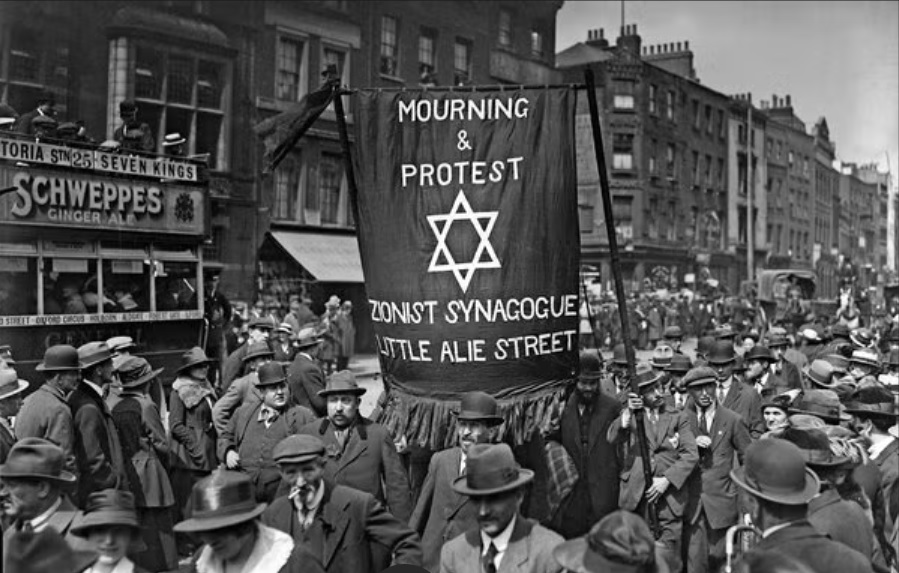 _A Jewish procession in London, probably on June 26, 1919. The Zionist Synagogue on Little Alie Street. A demonstration of mourning and protest.
The photograph may be related to the nationwide Jewish protest against the pogroms in Poland following the First World War. The exact date, the photographer and the original archival source remain unverified._
3. The Transformation of Zionism after 1948
The proclamation of the State of Israel on 14 May 1948 fulfilled the fundamental political purpose of Zionism. Thereafter an important conceptual question arose. Once a Jewish nation-state had come into existence, what distinctive purpose remained for the Zionist movement?
The continuing immigration of Jews to Israel, known as aliyah, offered an obvious but incomplete answer.
Later Zionism 2 enlarged its mission to encompass the preservation and strengthening of the Jewish character of the state, national and cultural cohesion, security, education, and the maintenance of close relations with the Diaspora. Depending upon the ideological current concerned, it also embraced different visions of territorial and national fulfilment.
The transformation acquired an institutional expression in 1951, when the Twenty-Third World Zionist Congress adopted a declaration concerning the tasks of Zionism after the foundation of Israel. That declaration formed the starting point of what became known as the Jerusalem Programme, the formal ideological statement of the World Zionist Organization (WZO), which is not an organ of the Israeli state. The supreme authority within the Organization is the World Zionist Congress; between congresses, many of its powers are exercised by the Zionist General Council. It is thus understandable that the Programme was reformulated by the Twenty-Seventh Congress in 1968 and by the General Council in 2004. In February 2024, Article 2 of the Constitution of the Organization, which incorporates the Programme, underwent further amendment (World Zionist Organization, 2024a). In its present form, the Programme calls, among other objectives, for the preservation of Israel as a Jewish, Zionist, democratic and secure state, the encouragement of Jewish immigration and the reinforcement of ties with the Diaspora (World Zionist Organization, 2024b).
The consequence is significant. A movement originally dedicated to attaining statehood became an ideology concerned with preserving and shaping an established state.
This was a substantive transformation, not merely a change in terminology (Shimoni, 1996).
Once an independent state exists, security, economic development, international influence and the protection of territory become ordinary functions of state policy. It does not follow that every undertaking directed towards such ends must necessarily be described as specifically Zionist.
Conversely, an objective arising from Zionist ideology need not invariably coincide with the national interest as understood by a particular Israeli government.
This distinction between ideology and the interests of the state does not, however, imply that the World Zionist Organization exists in institutional isolation from Israel. Although the WZO is not a state agency, it enjoys a special relationship of co-operation with the Israeli state, recognised in legislation enacted in 1952. As an institutional advocate of Zionist principles, it seeks their continued advancement; through established legal and political connections, it also participates in the implementation of certain government policies. Influence operates in both directions. Israeli Zionist political parties are represented at the World Zionist Congress in proportion to their parliamentary strength and thereby take part in determining the leadership and priorities of the Organization. The relationship is therefore one of ideological and institutional interaction, through which Zionist principles remain connected to the practical exercise of state policy (Knesset, 1952; World Zionist Organization, n.d.).
The Jewish national character of Israel has, moreover, received constitutional recognition. The Basic Law of 2018 concerning the nation-state declares Israel to be the nation-state of the Jewish people and specifies that the exercise of national self-determination within the state is unique to the Jewish people (Knesset, 2018).
Such constitutional recognition does not abolish the fundamental distinction: Zionism, as an ideology, and Israel, as a sovereign state, are intimately connected but are not identical. The former continues to influence the character and aspirations of the latter, without every policy pursued by the state necessarily constituting an expression of Zionist doctrine.
The distinction becomes more important still when one considers the populations involved. The Jewish national community extends far beyond the territory of Israel, while the citizenry of Israel also includes non-Jews. Neither, therefore, can the Jewish nation be confined to the population of Israel, nor can the Israeli body politic be equated with the Jewish nation.
4. Zionists, Non-Zionists, Anti-Zionists and Post-Zionists
Beyond its historical and ideological significance, Zionism now also serves as a form of political self-identification. The designation is frequently employed with a certain conceptual looseness: individuals who adopt it may not possess a clearly articulated understanding of its meaning, or may invest the same word with markedly different content.
A Zionist, in the fundamental political sense, recognises Jewish national self-determination as a legitimate objective and supports the continued existence of Israel as a Jewish nation-state. Such a position requires no allegiance to a particular government, political ideology or interpretation of Judaism.
A non-Zionist (or, in certain contexts, an a-Zionist) does not subscribe to Zionist ideology, yet need not oppose the existence of Israel or its Jewish national character.
Many ultra-Orthodox Jewish communities, collectively described as Haredim, provide an instructive example. These communities place religious tradition and the observance of its rules above the claims of modern political nationalism, which they do not necessarily regard as a legitimate foundation for Jewish national restoration. Nevertheless, they may actively favour the survival and strengthening of Israel, and may even seek a more pronounced Jewish religious character for the state. As the research of Peter Lintl demonstrates, most ultra-Orthodox communities have historically belonged to the non-Zionist sphere despite participation in the institutions of the state (Lintl, 2020).
The anti-Zionist, by contrast, actively rejects the Zionist political project. Such opposition may arise from religious, national or ideological convictions. Certain ultra-Orthodox groups object to the establishment of Jewish sovereignty by human political initiative, believing that national redemption and the restoration of Jewish sovereignty must await the coming of the Messiah. Other opponents of Zionism reject the principle of a specifically Jewish nation-state because they favour alternative constitutional arrangements.
Anti-Zionism, therefore, does not necessarily imply a wish to abolish the Israeli state physically or to remove its inhabitants. It may signify rejection of the national ideology upon which the state was founded. There are, nevertheless, anti-Zionist movements that also deny the legitimacy of the present Israeli state itself.
Post-Zionism represents a different category again. It is not simply a position midway between Zionism and anti-Zionism. It encompasses distinct intellectual and political currents that question whether Zionist ideology remains an adequate framework for interpreting history and organising contemporary Israeli society now that the original national objective has been achieved (Silberstein, 1999).
These classifications cannot be arranged along a straightforward scale of increasing or diminishing attachment to Israel.
A non-Zionist may be an ardent supporter of the state. A Zionist may be profoundly opposed to the policy of the government in office. An anti-Zionist may favour the continued existence of a state within the same territory, albeit with a different national or constitutional character.
Acceptance of the state, preference concerning its national or religious character, and allegiance to Zionist ideology are three separate matters.
5. The Ambiguity of Self-Identification
The conceptual difficulty becomes greater when these terms are used to define personal or political identity.
One citizen may call himself or herself a Zionist because Jewish national self-determination is regarded as legitimate. Another may use the same designation merely as a synonym for Israeli patriotism. A third may reject the label because of an association with particular political choices, even while unequivocally recognising the right of Israel to exist as a Jewish state.
Such ambiguity is not merely a theoretical possibility.
In a survey conducted by the Jewish People Policy Institute in December 2025, approximately 85 per cent of Jewish Israelis identified as Zionist, compared with only 4 per cent of Arab Israelis. Respondents could also choose non-Zionist, post-Zionist or anti-Zionist, or decline to select any of the available categories (Jewish People Policy Institute, 2025).
The contrast illustrates the very different relationship of the two population groups to Zionist identity. It does not establish, however, that respondents choosing the same designation necessarily understood it in the same ideological sense.
Still more revealing are the findings of a survey undertaken in March 2025 by the Jewish Federations of North America, with the relevant results released in February 2026.
Among Jewish respondents in the United States, 88 per cent recognised the right of Israel to exist as a Jewish and democratic state, whereas only 37 per cent identified themselves as Zionists. Thirty per cent considered that none of the offered classifications represented their position, while a further 18 per cent expressed uncertainty (Jewish Federations of North America, 2026).
The divergence is striking. If Zionism is understood simply as recognition of the right to Jewish national self-determination, why should acceptance of that right be so much more widespread than willingness to adopt the corresponding ideological label?
An important part of the explanation lies in the differing meanings assigned to the term. Some associate Zionism with national self-determination; others attach to it unconditional approval of Israeli actions, particular territorial ambitions or even the notion of Jewish national superiority.
None of these additional assumptions is an indispensable component of the historical definition of Zionism.
Consequently, self-description cannot be treated as a reliable substitute for actual ideological conviction unless we first establish what meaning a particular individual attributes to the designation employed.
6. External Labelling and the Political Uses of Language
The uncertain meaning of self-identification is accompanied by a further difficulty: the attribution of political labels by others.
For those who embrace it, Zionist may be a designation of considerable pride. The same word may be employed by an adversary as an expression of contempt. Conversely, anti-Zionist may describe a deliberate ideological commitment, yet may also be imposed as an accusation of national disloyalty or hostility towards Israel.
This is a familiar feature of political language. A word that initially identifies a particular ideological position comes to acquire an additional evaluative significance, becoming an instrument through which individuals and groups are praised, stigmatised or dismissed.
In the case of Zionism, the process is intensified by the historical experience and emotional associations surrounding the concept. To some, Zionism evokes national emancipation and security for a nation subjected to centuries of persecution. To others, it calls to mind above all the consequences of the Zionist enterprise for the Arab population of Palestine, together with the subsequent policies of the State of Israel (Penslar, 2023).
Thus, the same expression may constitute an affirmation of national identity or an accusation directed against a political opponent, depending upon the speaker and the circumstances.
External labelling is not, therefore, necessarily reliable evidence of the beliefs of the person to whom a designation is applied. Frequently, it tells us more about the ideology and purposes of the person who applies it.
7. Jewish and Non-Jewish Zionists
A further source of confusion is the habitual equation of Zionism with Jewish religious or national identity.
The equation fails in both directions.
Not all Jews are Zionists, and not all Zionists are Jews.
Support for Jewish national self-determination may come from individuals of very different national or religious backgrounds. An Arab citizen of Israel, for example, may accept the Jewish national character of the state and wish to preserve it. Equally, a Jew may reject Zionism on religious grounds or out of allegiance to a secular political philosophy.
Christian Zionism is a particularly instructive instance.
It is a religious tradition with important roots in British Protestantism, attributing particular biblical or eschatological significance to the return of Jews to their ancestral homeland. In some forms, Jewish national restoration is associated with scriptural prophecies and expectations concerning the Second Coming (Lewis, 2010).
Christian Zionists may thus support the same practical political objective as Jewish Zionists without sharing either the theological premises or the national aspirations that originally informed the Jewish movement.
There is, however, a more paradoxical possibility: support for a Zionist objective motivated by hostility towards Jews themselves.
Historically, the wish to remove Jews from the societies in which they lived could coincide with the practical objective of encouraging Jewish migration to Palestine. Such coincidence did not necessarily entail recognition of Jewish national self-determination, still less ideological adherence to Zionism.
The policies adopted by the Nazi regime during its early years provide a particularly revealing example. Research by Francis Nicosia has demonstrated how the Nazi desire to promote Jewish emigration could, at particular moments, create limited opportunities for practical dealings with Zionist organisations seeking to rescue persecuted Jews. The participants nevertheless pursued fundamentally opposed purposes and proceeded from irreconcilable ideological premises (Nicosia, 2008).
Nothing in this historical episode justifies equating Zionism with antisemitism. On the contrary, it demonstrates that agreement upon one limited practical objective does not establish any identity of ideological commitment.
Ideological allegiance, political support and a temporary convergence of interests are different phenomena.
The distinction is of particular importance for any understanding of the international political dimensions of Zionism.
8. Zionism, Anti-Zionism and Antisemitism
Conceptual confusion reaches its most acute form when Zionism and anti-Zionism are automatically equated with approval of, or hostility towards, Jews.
Antisemitism denotes prejudice, discrimination or hostility directed against Jews because they are Jews. Anti-Zionism denotes opposition to a particular national ideology and the political undertaking associated with it. The terms are not synonymous by definition, although in practice the phenomena may overlap.
Criticism of an Israeli government does not in itself amount to anti-Zionism, just as criticism of Zionism does not, without further evidence, establish antisemitism.
Conversely, the use of Zionist as a substitute for Jew, particularly when accompanied by assertions of collective guilt, supposedly clandestine power or a single, coordinated Jewish political will, may constitute an expression of antisemitism.
A particularly revealing form of conceptual distortion is the conspiratorial invocation of international Zionism. Here the phrase no longer refers to an actual political movement operating internationally. Instead, it designates an imagined, concealed and virtually omnipotent centre of world power. This phenomenon is neither peculiar to Greece nor confined to any one ideological tradition. In the Soviet Union, official propaganda during the 1980s depicted “international Zionism” as an instrument of American imperialism bent upon global domination (Friedgut, 2010). In communist Poland in 1968, the same supposed mechanism was accused of instigating anti-government demonstrations and undermining the Polish state (Gansinger, 2016). The founding covenant of Hamas in 1988 3 attributed to “world Zionism” a conspiratorial plan to manipulate Arab states (Hamas, 1988, Article 32). In Greece, comparable ideas have appeared in certain extremist religious and nationalist circles, including public allegations that “international Zionism” seeks world government, religious manipulation and the subversion of Orthodox Christianity (Seraphim, 2010). Thus, across radically different ideological environments, the same label serves to personify an imagined transnational conspiracy, to which a remarkable assortment of often unrelated misfortunes is attributed. This is not an analysis of Zionism as a political phenomenon, but the substitution of a conspiratorial explanation for a historical concept.
Disagreement over the boundaries between these concepts is reflected in two distinct approaches within contemporary scholarship and institutional practice.
The Working Definition of Antisemitism adopted by the International Holocaust Remembrance Alliance in 2016 includes examples in which hostility towards Israel may constitute antisemitism, while expressly recognising that criticism of Israel comparable to that directed at any other country is not, of itself, antisemitic (IHRA, 2016).
The Jerusalem Declaration on Antisemitism of 2021 draws a more explicit distinction between opposition to Zionism as a form of nationalism and hostility towards Jews, while likewise treating the use of anti-Jewish stereotypes and the imposition of collective responsibility upon Jews as manifestations of antisemitism (Jerusalem Declaration on Antisemitism, 2021).
The dispute extends well beyond academic definition. It has also become an issue in international politics. In 1975, the United Nations General Assembly adopted Resolution 3379, declaring Zionism to be a form of racism and racial discrimination. That declaration was formally revoked in 1991 by Resolution 46/86 (United Nations General Assembly, 1975, 1991).
The episode demonstrates that the definition of Zionism is not invariably a disinterested scholarly exercise. The word itself can become an object of international political contention, invoked at one moment to substantiate, and at another to challenge, the legitimacy of particular political claims.
Conceptual precision therefore requires us to examine not merely the designation attached to a position, but the actual substance of the convictions and demands being advanced.
Conclusion
Zionism began as a national movement with a comparatively definite political objective: the establishment of an internationally secured Jewish national home and, ultimately, an independent state in the ancestral homeland.
The achievement of that objective in 1948 did not bring the ideology to an end. Zionism developed into a broader undertaking concerned with the preservation and strengthening of the established state, while retaining its transnational dimension through relations with the Jewish Diaspora and through movements of support among non-Jews.
This evolution was accompanied by a gradual broadening, and corresponding loss of precision, in the meaning of the term.
Today, Zionism may denote a particular historical ideology, a programme for the character and future of Israel, an element of political identity or a label applied by outsiders, often with the intention of conferring approval or expressing condemnation.
The essential difficulty is not the existence of diverse Zionist interpretations. Such plurality is characteristic of many national movements. The difficulty arises when these meanings are confused and treated as though they were equivalent.
Three distinctions emerge from the foregoing examination as fundamental.
First, the historical continuity of the Jewish nation, the Zionist pursuit of political sovereignty and the subsequent existence of the Israeli state are not identical phenomena.
Secondly, adherence to Zionist ideology, acceptance of the existence of Israel and support for particular Israeli policies are not equivalent political positions.
Thirdly, the actual ideological identity of a political actor cannot be inferred solely from self-identification, from a designation imposed by others, or even from support for a particular political objective.
The political significance of an ideology resides not merely in its name, but in the meaning attributed to it by those who profess it, the purposes it serves and the means employed to realise them.
This conclusion takes us from conceptual clarification towards geopolitics.
For the next, and arguably more consequential, question is no longer simply what Zionism means. It is how a national movement which initially possessed no sovereign power succeeded in aligning its aspirations with the strategic calculations of the great powers, and how that relationship changed following the creation of Israel.
That is the subject of the companion study, “Zionism: Its Geopolitical Dimension”.
Links
“Zionism: Its Geopolitical Dimension”.
Photorientalist: Photographs from the 19th and 20th centuries relating to Palestine of that time
Bibliography
Abu-Manneh, B. (1978). The rise of the Sanjak of Jerusalem in the late nineteenth century. In G. Ben-Dor (ed.), The Palestinians and the Middle East Conflict (pp. 21–32). Ramat Gan: Turtledove Press. Source
Cohen, S. J. D. (1999). The Beginnings of Jewishness: Boundaries, Varieties, Uncertainties. Berkeley: University of California Press.
Conforti, Y. (2021). The cultural origins of Jewish nationalism: Early Zionism and the weight of the pre-modern tradition. Studies in Ethnicity and Nationalism, 21(3), 225–239.
Dowty, A. (2019). Arabs and Jews in Ottoman Palestine: Two Worlds Collide. Bloomington: Indiana University Press.
Friedgut, T. H. (2010). Anti-Zionist Committee of the Soviet Public. YIVO Encyclopedia of Jews in Eastern Europe. Source
Gansinger, S. (2016). Communists Against Jews: The Anti-Zionist Campaign in Poland in 1968. Fathom, Autumn 2016. Source
Gelvin, J. L. (2021). The Israel-Palestine Conflict: A History. 4th edn. Cambridge: Cambridge University Press. See especially Chapter 5, pp. 99–124.
Halperin, L. R. (2020). Forging beginnings: Commemorative cultures and the politics of the “First Aliyah”. Journal of Israeli History, 38(1), 53–76.
Hamas (1988). The Covenant of the Islamic Resistance Movement. 18 August 1988, Article 32. Yale Law School, Avalon Project. Source
Hurewitz, J. C. (1979). The Middle East and North Africa in World Politics: A Documentary Record. Vol. 2: British-French Supremacy, 1914–1945. New Haven: Yale University Press, pp. 180–182.
International Holocaust Remembrance Alliance (IHRA) (2016). Working Definition of Antisemitism (adopted 26 May 2016). Source
Jacobson, D. M. (1999). Palestine and Israel. Bulletin of the American Schools of Oriental Research, 313, 65–74.
Jerusalem Declaration on Antisemitism (2021). Jerusalem Declaration on Antisemitism (25 March 2021). Source
Jewish Federations of North America (2026). Survey of Jewish Life since October 7: Zionism Findings (survey conducted 5–25 March 2025; results released February 2026). Source
Jewish People Policy Institute (2025). JPPI Israeli Society Index for December 2025: Greater Concern over Social Polarization than the Iranian Threat (20 December 2025). Jerusalem: JPPI. Source
Jewish Telegraphic Agency (1951). World Zionist Congress closes; votes $207,200,000 budget; elects new executive (31 August 1951). Source
Knesset (1952). World Zionist Organisation–Jewish Agency (Status) Law, 5713–1952. Source
Knesset (2018). Basic Law: Israel – The Nation-State of the Jewish People (adopted 19 July 2018), Article 1. Source
Krämer, G. (2008). A History of Palestine: From the Ottoman Conquest to the Founding of the State of Israel. Princeton: Princeton University Press. Source
Lewis, D. M. (2010). The Origins of Christian Zionism: Lord Shaftesbury and Evangelical Support for a Jewish Homeland. Cambridge: Cambridge University Press. Source
Lintl, P. (2020). The Haredim as a Challenge for the Jewish State: The Culture War over Israel’s Identity. SWP Research Paper 2020/RP 14. Berlin: Stiftung Wissenschaft und Politik. DOI
Mandel, N. J. (1974). Ottoman policy and restrictions on Jewish settlement in Palestine: 1881–1908—Part I. Middle Eastern Studies, 10(3), 312–332. DOI
McCarthy, J. (1990). The Population of Palestine: Population History and Statistics of the Late Ottoman Period and the Mandate. New York: Columbia University Press. DOI
McCullough, S. K. (2009). Zionism. In I. Ness (ed.), The International Encyclopedia of Revolution and Protest: 1500 to the Present. Wiley-Blackwell. DOI
Nicosia, F. R. (2008). Zionism and Anti-Semitism in Nazi Germany. Cambridge: Cambridge University Press. Source
Papastavrou, A.-T. (2026). On the Appropriation of Gaza. In Thucydidean Geopolitics for the educated layperson (pp. 320–324). Hedyepia. https://thucydidean-geopolitics.eu/el/availabilty
Penslar, D. J. (2023). Zionism: An Emotional State. New Brunswick, NJ: Rutgers University Press. Source
Reimer, M. J. (2019). The First Zionist Congress: An Annotated Translation of the Proceedings. Albany: State University of New York Press. DOI
Seraphim, Metropolitan of Piraeus (2010). Clarificatory Statement by the Metropolitan of Piraeus [original Greek title: Διευκρινιστική δήλωση του Μητροπολίτου Πειραιώς]. Reproduced 29 December 2010. Greek-language source
Shimoni, G. (1995). The Zionist Ideology. Hanover, NH: Brandeis University Press / University Press of New England. Source
Shimoni, G. (1996). Reformulations of Zionist ideology since the establishment of the State of Israel. In Studies in Contemporary Jewry, Vol. XI, Values, Interests, and Identity: Jews and Politics in a Changing World (pp. 11–36). Oxford: Oxford University Press. DOI
Silberstein, L. J. (1999). The Postzionism Debates: Knowledge and Power in Israeli Culture. New York: Routledge. Source
Smith, A. D. (2003). Chosen Peoples: Sacred Sources of National Identity. Oxford: Oxford University Press. DOI
United Nations General Assembly (1975). Elimination of All Forms of Racial Discrimination. Resolution 3379 (XXX), 10 November 1975. Source
United Nations General Assembly (1991). Elimination of Racism and Racial Discrimination. Resolution 46/86, 16 December 1991. Source
World Zionist Organization (1897). The Basel Program. Adopted at the First Zionist Congress, Basel, August 1897. Source
World Zionist Organization (2024a). Constitution of the World Zionist Organization (as amended February 2024), Article 2. Source
World Zionist Organization (2024b). The Jerusalem Program (2004 programme, as amended February 2024). Source
World Zionist Organization (n.d.). About the Zionist Congress. Accessed 30 October 2026. Source
Yerushalmi, Y. H. (1982). Zakhor: Jewish History and Jewish Memory. Seattle: University of Washington Press. Source
Footnotes
-
The name Palestine is attested as early as Herodotus (fifth century BC), as a geographical designation for a region of southern Syria between Phoenicia and Egypt. Following the suppression of the Bar Kokhba revolt (AD 132–135), the Roman authorities adopted the name Syria Palaestina for the province formerly known as Judaea. The designation survived, albeit with changes to administrative boundaries, throughout the Byzantine period. Following the Arab conquest (AD 634–640), it also acquired an administrative application in the form Jund Filastin (Jacobson, 1999; Krämer, 2008).
During Ottoman rule (1517–1917), Palestine remained in use as a geographical designation, but it did not correspond to a single Ottoman administrative district officially bearing that name. In 1897, the southern portion of the region lay principally within the separate Sanjak of Jerusalem (Kudüs-i Şerif), administered directly from Constantinople, whereas the sanjaks of Nablus and Acre had belonged to the Vilayet of Beirut since 1888. Nevertheless, Filastin continued to appear as a geographical expression, including in certain Ottoman maps and official documents (Abu-Manneh, 1978; Mandel, 1974; Krämer, 2008).
Jewish migration to the region long antedated the emergence of organised political Zionism. From 1882 onwards, a more substantial and better organised migratory movement developed, subsequently designated by Zionist historiography as the First Aliyah (1882–1903/1904). The Hebrew word Aliyah (עֲלִיָּה) literally means ‘ascent’; in this context it denotes Jewish immigration to the ancestral homeland, with its attendant religious and historical associations. The qualification First does not imply that no earlier migrations occurred. Rather, this particular movement was retrospectively recognised as the beginning of modern, organised Jewish national settlement.
The First Aliyah comprised principally Jews from the Russian Empire and Romania, together with migrants from Yemen, whose motives ranged across religious, economic and national considerations. Anti-Jewish persecution, notably the pogroms in the Russian Empire after 1881, helped to accelerate migration. Organisations such as Hovevei Zion (‘Lovers of Zion’) and BILU—an acronym drawn from Isaiah 2:5, Beit Ya'akov Lekhu Ve-Nelkha (בֵּית יַעֲקֹב לְכוּ וְנֵלְכָה), ‘House of Jacob, come, let us go forth’—were already promoting settlement in the ancestral homeland as an instrument of Jewish national renewal. Such settlement, however, lacked assured political protection. From 1881, the Ottoman authorities had sought to restrict Jewish immigration and settlement in the region, although enforcement varied considerably from one locality to another (Mandel, 1974; Reimer, 2019; Halperin, 2020).
Estimates of the population in the late nineteenth century differ appreciably, owing to changes in the geographical area under consideration, incomplete enumeration and the distinction between Ottoman subjects and foreign residents. For 1896–1897, McCarthy estimates approximately 475,000 Muslims, 60,000 Christians and 21,000 Jews holding Ottoman nationality. The last figure does not encompass the entire Jewish population. By way of comparison, an estimate presented to the Second Zionist Congress in 1898 placed the total number of Jewish inhabitants, including foreign nationals, at approximately 45,000 (McCarthy, 1990, p. 10; Dowty, 2019). The overwhelming majority of the population was therefore composed of Arabic-speaking Muslims and Christians. The Jewish population included long-established communities, principally in Jerusalem, Hebron, Safed and Tiberias, as well as nineteenth-century immigrant groups, among them those belonging to the First Aliyah. Smaller communities of other backgrounds were also present (Krämer, 2008; Dowty, 2019).
The geographical designation must, however, be distinguished from the later national designation Palestinian. During the late Ottoman period, the local identity of Arabic-speaking inhabitants coexisted with wider Syrian and Arab affiliations. The adjective Filasṭīnī (‘Palestinian’) is documented in the Arabic press between 1908 and 1914, although its occurrence does not, in itself, establish the existence of a fully consolidated national consciousness (Beška & Foster, 2021). As late as 1919, the First Palestine Arab Congress regarded Palestine as an integral part of Arab Syria and advocated political union with it (Hurewitz, 1979). The years 1917–1923 were especially important in the emergence of a distinct Palestinian Arab national consciousness. In 1925, under the British Mandate, Palestinian citizenship was instituted; subject to the relevant statutory conditions, this was not confined to Arabs but extended to Jewish inhabitants as well (Banko, 2016). The Arab Revolt of 1936–1939, directed against British administration and the expansion of Jewish immigration and settlement, demonstrated the capacity of Palestinian Arab nationalism to mobilise on a mass scale (Khalidi, 1997; Gelvin, 2021). The formation of this modern national identity was thus a historical process which must not be projected retrospectively upon the ancient or Ottoman use of the geographical name Palestine (Lockman, 1993; Khalidi, 1997; Beška & Foster, 2021; Banko, 2016; Papastavrou, 2026).
Accordingly, the use of Palestine in the Basel Programme of 1897 was geographical: it referred to a region within the Ottoman Empire, without implying the existence of either an independent state or a unified Ottoman administrative district bearing that name. ↩
-
Later Zionism is used here to denote Zionism as redefined following the establishment of the State of Israel in 1948. ↩
-
The reference to Hamas relates expressly to the founding covenant of 1988. It should not be understood as a description of the subsequent Document of General Principles and Policies issued in 2017. ↩