Fear, Honour, and Interest in the Reversal of the Kurdish Alliance
This essay answers the following questions: Why were the Syrian Kurds abandoned after serving as key wartime partners? How do Fear, Honour, and Interest shape the stability of the post-autonomy settlement?
Strategic Abstract
This essay examines the rapid transition of the Syrian Kurds from central wartime partners of the United States to a subordinated minority within a recentralising Syrian state. It analyses this reversal not as an isolated betrayal but as the product of converging strategic calculations by Damascus, Ankara, Washington, Jerusalem, and secondary actors such as Greece. The Kurdish question is treated as a dependent variable of wider regional equilibria rather than as an autonomous political project.
Using a Thucydidean framework, the essay traces how Fear, Honour, and Interest shape the behaviour of each actor. Syrian recentralisation reflects regime survival and territorial logic; Turkish policy prioritises the elimination of any Kurdish precedent; United States policy privileges force protection and alliance management over long-term credibility; Israeli restraint maximises operational freedom against Iran at the cost of abandoning a potential northern buffer. Greek interests are analysed as partially convergent with Kurdish autonomy but structurally marginalised in the present configuration.
The resulting settlement is characterised as a managed abandonment rather than a durable peace. While it may prevent immediate collapse, it rests on fragile assumptions regarding Kurdish acquiescence, Turkish restraint, and external monitoring. The essay argues that enforced compression of Kurdish autonomy is unlikely to resolve the Kurdish question and may instead defer instability, leaving open the prospect of renewed alignment, miscalculation, and strategic reversal over time.
The Kurds of Syria have been pushed from the position of de facto partner of the United States and semi-autonomous power to that of a shrinking and pressured actor being folded into a recentralising Syrian state. Each regional and extra-regional player now treats the Kurdish question primarily as a function of its own security calculus rather than as a strategic project in its own right. The emerging arrangement promises recognition and rights, yet simultaneously strips the Kurds of strategic depth. Whether this configuration proves “stable” or merely a prelude to a larger overturn depends on how Ankara, Damascus, Washington, and Jerusalem read their long-term Interest, and on the extent to which Kurdish ambitions and Honour are accommodated or suppressed.
From Damascus, the offensive of 2026 and the subsequent integration agreements represent the restoration of the core objective of territorial unification under a single authority after the fragmentation that followed the post-Assad collapse. The strategy of the Al-Sharaa leadership has aimed at transforming the Kurds from United States-backed quasi-autonomous actors into a minority constituency embedded within a reconstructed Syrian state. This has taken the form of individual integration of SDF fighters into the Syrian army and police, the transfer of border control, energy installations, dams, and ISIS detention facilities, and the reassertion of administrative authority, in exchange for citizenship, recognition of language rights, and cultural guarantees. Through this process, Syrian sovereignty has been restored over strategic assets in Deir ez-Zor, Raqqa, and critical water infrastructure, while simultaneously testing the outer limits of United States tolerance for coercion directed against a former ally.
For Damascus, the current formula appears rational. It eliminates a rival armed structure, removes foreign-protected enclaves in the north-east, and allows the regime to present itself to Western capitals as a responsible counter-terror partner now allegedly capable of managing ISIS detainees and border security. The risk lies in overreach. When Syrian forces moved beyond agreed zones and disregarded ceasefire understandings, expressions of anger from Washington and renewed discussion of sanctions demonstrated that excessive coercion against the Kurds still carries the potential to trigger Western backlash and complicate regime consolidation.
From Ankara, any form of Kurdish armed autonomy along the southern border is interpreted as an existential threat. Turkish policy has therefore consistently pressed for the dismantling of the SDF and the DAANES framework, framed as extensions of PKK structures. The Al-Sharaa offensive, combined with signals from Washington that a Syrian move would be tolerated so long as civilian protection and ISIS-related sites were responsibly managed, delivered a double gain for Turkey. Kurdish forces were territorially compressed and institutionally weakened, while the primary security burden shifted from Turkish forces to Damascus.
Turkey also benefits from the way this recentring shifts Syria away from a Kurdish-centric security order towards one in which a central state—over which Ankara retains leverage through economic ties and prior coordination—administers the borderlands. The longer-term concern in Ankara is that any formalised recognition of Kurdish cultural or political rights inside Syria, whether through language guarantees, delineated regions, or local security arrangements, could create a precedential template for Kurdish claims inside Turkey itself. For that reason, pressure is likely to continue against any arrangement that resembles entrenched Kurdish autonomy, even when embedded within a formally unified Syrian framework.
The strategic interests of Israel have historically pointed towards the existence of a friendly Kurdish entity as a buffer against Iranian logistics corridors and Islamist militias. Nevertheless, Jerusalem has refrained from overt backing of the SDF during the present crisis, in continuity with a long-standing policy of caution. Rhetorical condemnation of attacks on Kurdish areas has been paired with a clear prioritisation of freedom of action against Iranian targets in Syria and Lebanon, the preservation of coordination mechanisms with Damascus and Moscow, and the maintenance of security understandings with the Al-Sharaa government under United States auspices. Open military support for the Kurds would threaten these channels, provoke Turkey, and risk the opening of a northern Syrian front that Israel cannot afford while already engaged in Gaza, Lebanon, and the Iranian theatre.
Viewed through a Thucydidean lens, this behaviour appears rational in terms of Interest yet problematic in terms of Honour. Operational freedom against Iran is maximised, and a de-escalatory framework with Damascus is preserved, at the cost of treating Kurdish losses as an acceptable externality. There is also a concern in Israeli strategic discourse that overt backing would brand the Kurds as “Israeli proxies”, thereby inviting harsher Syrian and Turkish repression and potentially worsening their position. The price of this calculation is the sacrifice of a clearly aligned Kurdish buffer in favour of a more ambiguous, state-centric arrangement involving a former jihadist leader whose reliability remains uncertain. This is a policy driven by necessity rather than preference.
The current line in Washington seeks to terminate the role of protector of a separate Kurdish power centre and instead treat the Al-Sharaa government as the primary Syrian counterpart, with Kurdish forces absorbed into that framework. Officials emphasise that the original mission—the defeat of ISIS and the interim control of detention facilities—has largely been accomplished, and that a recognised central authority can now assume these functions. In return, the United States seeks a reduction of Iranian influence, prevention of an ISIS resurgence, and a working relationship with both Ankara and Jerusalem that avoids open conflict among allies.
From a narrow and temporary Interest perspective, this approach appears rational. Sustaining open-ended military protection of a Kurdish proto-state against both Damascus and Turkey would demand significantly greater resources, risk confrontation with a NATO ally, and divert attention from global priorities. On a broader reading, however, this posture appears heavily shaped by Turkish preferences and runs counter to longer-term United States interests. A strategically aligned Kurdish autonomous or semi-autonomous entity, coupled with a structurally constrained Turkey, would arguably serve Washington better than an ambitious and assertive Turkey positioned in equilibrium with Israel on the margins of an unstable Iran.
In terms of alliance credibility and long-term regional architecture, recent policy choices remain deeply ambiguous. They reinforce a pattern whereby partnership with non-state minorities, and with the Kurds in particular, remains highly contingent and reversible once larger state-to-state bargains emerge. This continuity with earlier cases, including Afghanistan and South Vietnam, carries reputational costs that cannot pass unnoticed. Over time, such costs risk undermining leverage not only among Kurdish actors but also among other local partners who observe how rapidly battlefield alliances can be dissolved in favour of recentralisation deals.
From Athens, the shift appears as a rebalancing that validates Turkish security narratives while eroding an implicit Greek and broader Western interest in a Kurdish counterweight to Ankara across the Levant and northern Iraq. Greek strategic analysis has long viewed Kurdish autonomy as a structural constraint on Turkish neo-Ottoman ambitions and on the projection of power by a Turkey–Qatar–Islamist axis into Syria and the Eastern Mediterranean. Under the new arrangement, that counterweight is significantly reduced. The SDF no longer functions as a quasi-state actor controlling extensive energy and water resources but as a set of forces under pressure to integrate into, or be neutralised by, a central authority with which Turkey negotiates from a position of strength.
At the same time, the re-emergence of a recognisable Syrian state creates secondary opportunities for Greece to project stabilising influence through reconstruction initiatives, cultural diplomacy, and support for Christian and other vulnerable minorities, in coordination with France and other European actors. Here the Thucydidean Triad applies with particular clarity. Fear of Turkish regional overreach argues for continued advocacy of Kurdish and Druze autonomies. Interest suggests the use of engagement with both minority actors and the new Syrian centre to limit Turkish monopoly of influence. Honour points towards a Greek role as protector of vulnerable communities and of an independent Orthodox presence, leveraging the Patriarchate of Antioch and related ecclesiastical networks as instruments of soft power.
The behaviour of Israel and the United States can therefore be judged rational only within narrowly defined parameters. Israeli policy minimises short- to medium-term risk, preserves deconfliction channels, and concentrates resources against Iran and Hezbollah, yet does so at the expense of a missed opportunity to entrench a structurally pro-Israeli Kurdish buffer and to shape a plural, non-jihadist order capable of diluting both Turkish and Iranian influence in the Levant. United States policy reduces force exposure and aligns with global prioritisation, yet remains strategically incoherent insofar as it abandons one of the few secular governance experiments in the region and leaves Turkey with an effective veto over the design of any Kurdish future. In Thucydidean terms, both actors operate under the pressure of Fear and Interest, at a considerable cost to Honour. Miscalculation remains an ever-present source of instability in such constellations.
The emerging configuration—Syrian recentralisation with the Kurds recognised but subordinated as a minority, Turkish satisfaction with the territorial and institutional compression of the SDF, and United States and Israeli focus on Iran and its proxies—does not constitute a moral settlement. It represents an attempt to prevent collapse. Alternatives such as a clean quadritomisation or formal confederalisation of Syria have not been favoured at this stage.
The viability of this arrangement depends on a delicate balance. Integration of Kurdish fighters and administrators must proceed without systematic purges or ethnic retribution, and language and cultural guarantees must be implemented rather than merely proclaimed. Turkey must tolerate a limited and demilitarised Kurdish political presence inside Syria rather than pursue total erasure through continued pressure or covert sponsorship of hostile militias. Western actors must sustain monitoring and conditional assistance to ensure the security of ISIS detention facilities, the return of displaced populations where feasible, and equitable resource-sharing. Israel must balance security understandings with Damascus against the imperative of preventing mass violence in Kurdish and Druze areas and containing Iranian entrenchment across Syrian territory.
Taken together, these dynamics may generate a de facto movement towards a form of soft confederation without formally delineated zones, as previously proposed. The Syrian state is reassembled, yet functional differentiation persists beneath the surface. The decisive question is whether a structured equilibrium of Fear, Honour, and Interest can be institutionalised, or whether outcomes will remain contingent on ad hoc bargains and arbitrary exercises of power.
There is little indication that the Kurds themselves view the present outcome with satisfaction. Political and military leaders speak openly of betrayal and loss. Territorial holdings, strategic infrastructure, and direct control over ISIS detention facilities have largely been surrendered, while armed structures face dissolution or absorption on explicitly non-federal terms. The promise conveyed through United States diplomacy is that integration will deliver full citizenship, constitutional recognition of language and culture, and a role in local governance. For many Kurds, this represents a return to minority status within a state in which discrimination and statelessness were historically the norm.
This reversal may yet generate the very overturn it seeks to avoid, albeit on a longer horizon. Failure of the new Syrian order to deliver substantive rights and meaningful local control would incentivise the reconstruction of autonomous structures, whether political or clandestine, and the search for new external patrons beyond the United States and Israel. The apparent Turkish “double win” remains fragile. A humiliated and demobilised Kurdish movement can either acquiesce or radicalise, with potential spillover into Kurdish regions inside Turkey itself, thereby weakening rather than consolidating internal cohesion. For Israel and Greece, the structural logic underpinning a Kurdish–Druze–Israeli axis remains intact. Even if suppressed in the short term, incentives for external support of Kurdish autonomy persist. Once confrontation with Iran stabilises, renewed overt engagement with Kurdish actors remains likely. The concept of a northern corridor has remained latent for decades.
The present arrangement, therefore, does not resolve the Kurdish question in Syria. It marks a phase of enforced compression. Whether it evolves into a durable accommodation or becomes the prelude to a more radical redrawing of the Syrian order will depend on whether Damascus and Ankara can convert battlefield gains into a political framework that satisfies not only their Fear and Interest but also, at least minimally, the Honour and security of the Kurds themselves.
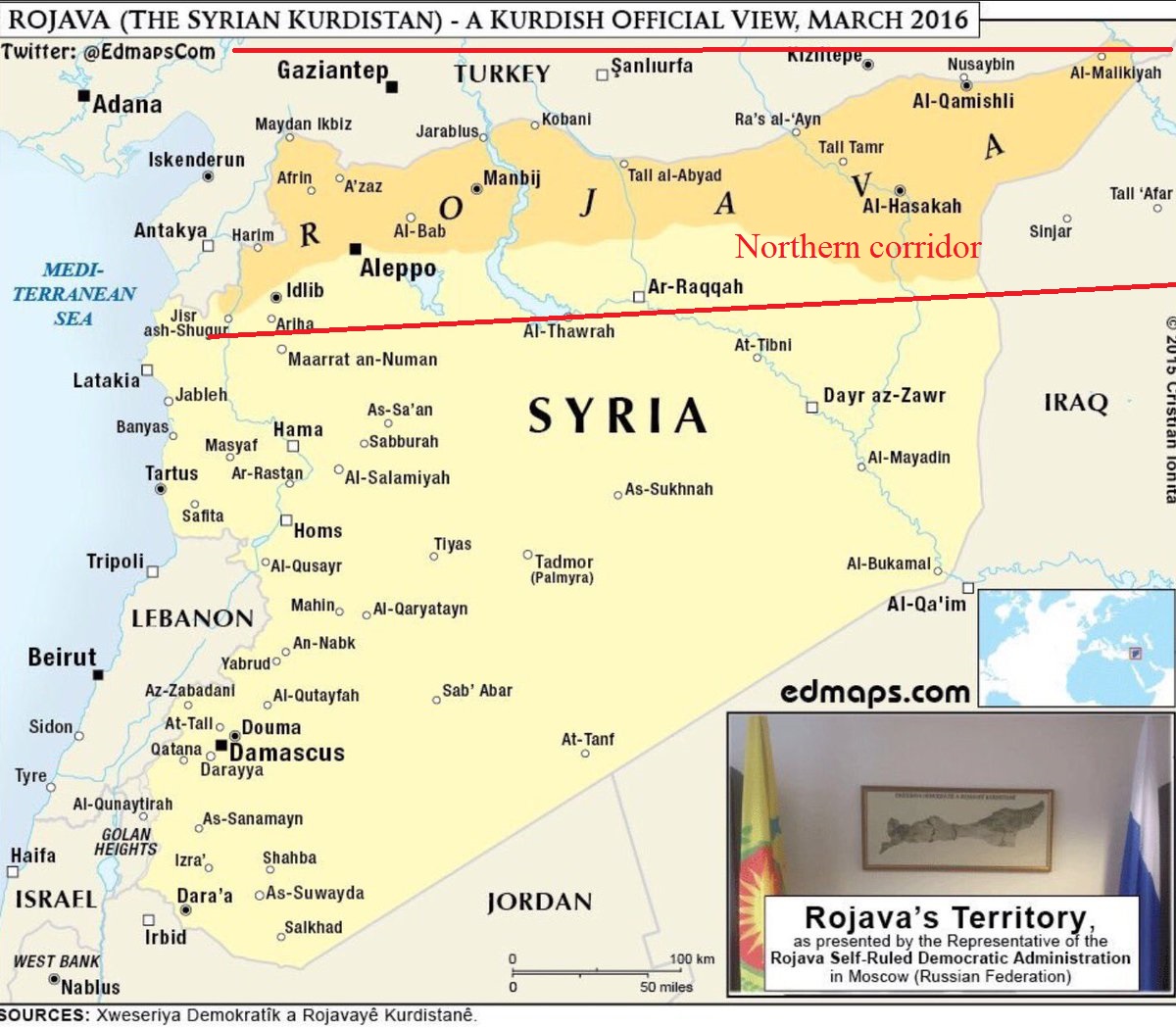 The alleged Northern Security Kurdish Corridor: The Kurds of Syria would feel more secure, if implemented, but Turkey would feel the threat of dismemberment
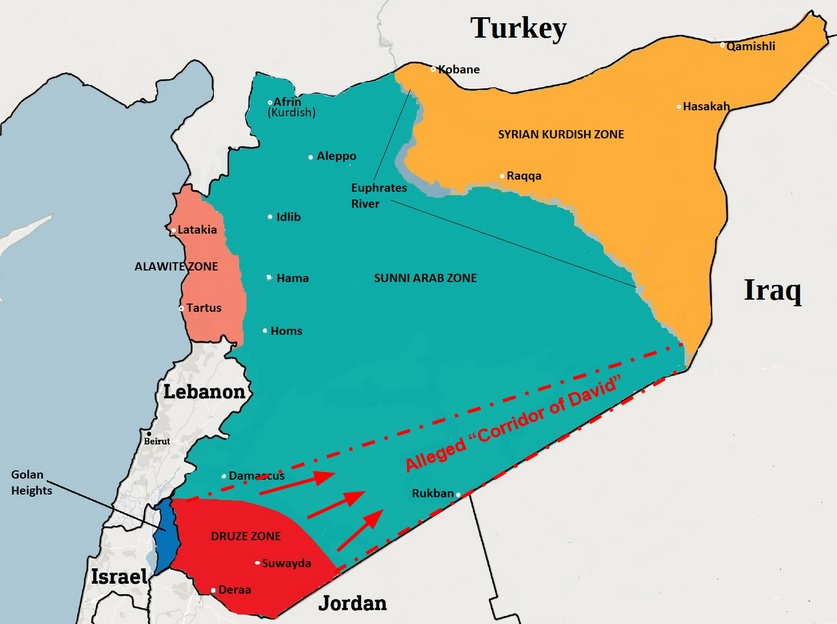 The alleged Corridor of David is a plan conceived in the '90s; it is here projected roughly in a map of quadritomised Syria, proposed by Papastavrou (2025)
Bibliographical anchors
Balanche, F. (2017). Rojava Seeks to Break Out in Syria. https://middleeasttransparent.com/rojava-seeks-to-break-out-in-syria/
Bowman, B. (2019). Rojava, Lost? Turkish Offensive Threatens to Destroy a Radical Democratic Experiment. https://theglobepost.com/2019/10/23/rojava-revolution-turkey/
Editorial, (2026). Rojava. https://kurdishpeople.org/rojava/
Gebeily, M. (2026). Syria hopes to hold new talks with Kurdish forces (A. Williams, Ed.). Reuters. https://www.reuters.com/world/middle-east/syria-hopes-hold-new-integration-talks-with-kurdish-forces-tuesday-2026-01-27/
Gebeily, M., & Pamuk, H. (2026). How Syria’s Sharaa captured Kurdish-held areas while keeping the US onside. Reuters. https://www.reuters.com/world/middle-east/how-syrias-sharaa-captured-kurdish-held-areas-while-keeping-us-onside-2026-01-21/
Hasano, M., & Taha, J. (2026). Syria government, Kurdish forces agree sweeping integration to end clashes. Reuters. https://www.reuters.com/world/europe/syrian-forces-advance-deeper-into-usbacked-kurdishcontrolled-northeast-2026-01-18/
Lister, C. (2026). Integration or conflict in northeastern Syria? Ten key points to consider. Middle East Institute - MEI. https://mei.edu/publication/integration-or-conflict-in-northeastern-syria-ten-key-points-to-consider/
Matin, K. (2026). US abandons Syria’s Kurds, risking regional turmoil and an IS resurgence. The Conversation Media Group Ltd. https://theconversation.com/us-abandons-syrias-kurds-risking-regional-turmoil-and-an-is-resurgence-274169
Papastavrou, A.-T. (2025). Thucydidean geopolitics for the educated layperson. Lulu.com (Publisher) https://www.lulu.com/shop/aias-theodoros-papastavrou/thucydidean-geopolitics/ebook/product-45j44mg.html?q=Aias-Theodoros&page=1&pageSize=4
ToI Staff. (2026). Israel condemns Sharaa regime’s ‘attacks against Kurdish minority’ in Syria’s Aleppo. The Times of Israel. https://www.timesofisrael.com/israel-condemns-sharaa-regimes-attacks-against-kurdish-minority-in-syrias-aleppo/
Tol, G. (2026). Ankara’s double win: Kurds, Israel, and the new Syria. Middle East Institute - MEI. https://mei.edu/publication/ankaras-double-win-kurds-israel-and-the-new-syria/