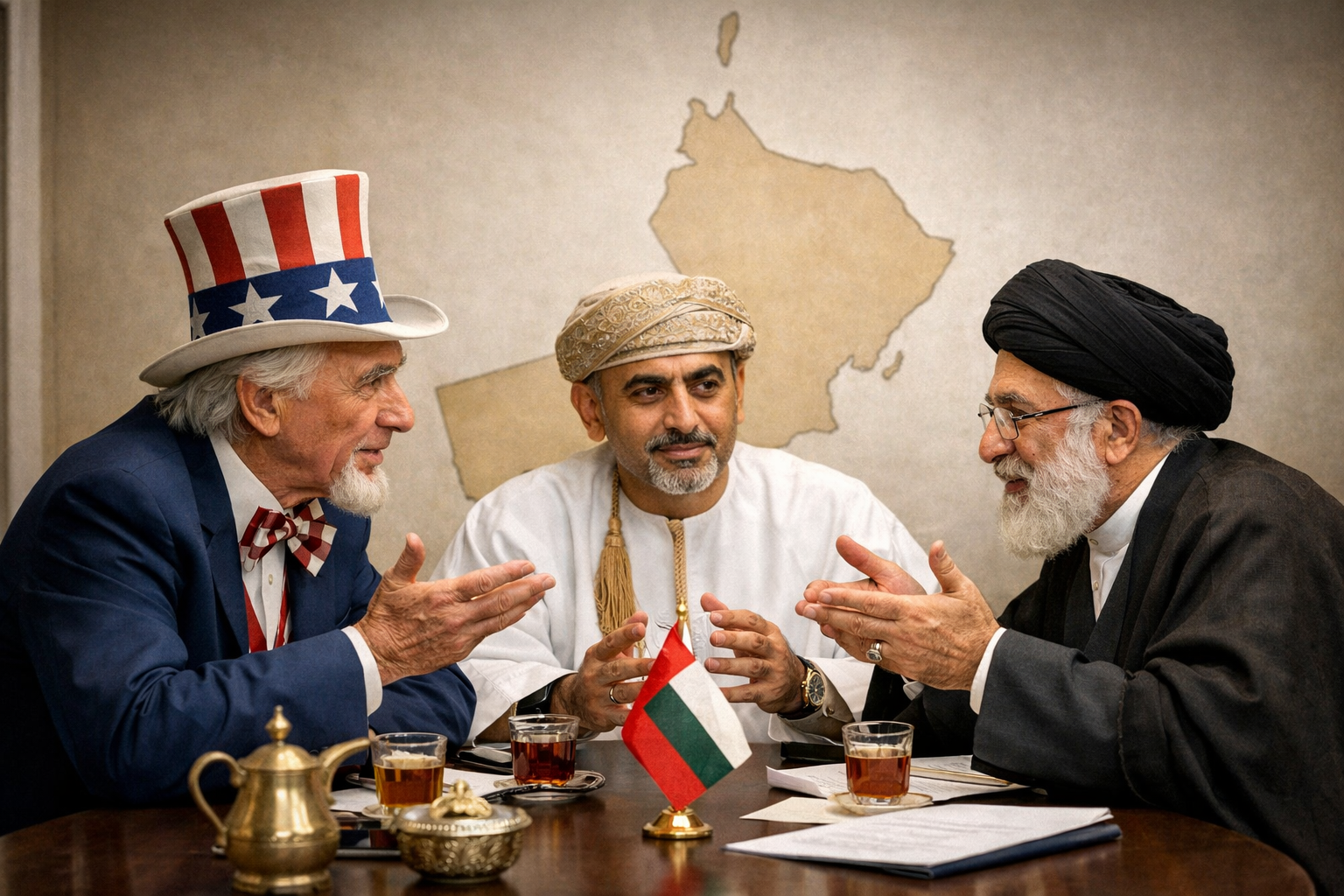
Strategic Ambiguity, and the Architecture of Managed Rivalry
This essay answers the question: How does strategic ambiguity serve the interests of regional and global actors more effectively than a definitive settlement of the Iranian problem?
Abstract
This essay examines why repeated negotiations between the United States and Iran persist without producing a definitive resolution, and why this outcome should not be understood as diplomatic failure. It argues that strategic ambiguity functions as a stabilising condition within a broader regional and global system, rather than as an anomaly to be corrected. The Iranian nuclear issue is treated not as an isolated technical problem, but as a structural node embedded in a wider configuration involving Turkey, Russia, China, Israel, and the United States. Drawing on a Thucydidean framework, the essay shows how Fear, Honour, and Interest converge to sustain a condition of suspended rivalry that benefits multiple actors. Ambiguity preserves political dignity, defers systemic disruption, and allows incremental adjustment without forcing decisive outcomes that could destabilise existing balances. Classical analogy, particularly the Peace of Nicias, illustrates how peace often functions historically as a pause rather than a resolution.
The essay concludes that the persistence of the Iranian standoff reflects incentives shared by adversaries and partners alike, and that genuine resolution remains unlikely so long as ambiguity continues to serve the strategic needs of the system as a whole.
Negotiation as Structure Rather Than Failure
Once again, indirect talks between the United States and Iran flicker to life in Oman, amid military deployments, regional volatility, and ritualised expressions of diplomatic optimism. As strategic pauses go, this episode feels familiar. Yet beyond the immediate tactical manoeuvring lies a deeper structural reality: the repeated failure to reach a conclusive settlement is not accidental. It reflects a system in which prolonged ambiguity serves the interests of multiple actors more reliably than genuine resolution.
Nuclear Capability and Regime Continuity
It is important to distinguish clearly between two issues often conflated in public debate. The containment or abolition of an Iranian nuclear programme is not equivalent to a transformation of the Iranian regime itself. A non-nuclear Iran governed by the same ideological and institutional structure would remain adversarial, revisionist, and regionally disruptive. The persistence of tension in the Near East is therefore rooted not only in enrichment levels or technical thresholds, but in the political order that directs Iranian power and defines its external posture. Strategic Ambiguity as a Functional Condition
For this reason, strategic ambiguity performs a practical function. It preserves a condition of managed tension that is predictable, familiar, and controllable. By contrast, a genuinely transformed Iran would introduce uncertainty on a scale that few regional or global actors are prepared to manage. Resolution, in the deeper sense, would not stabilise the system; it would unsettle it. Iran Within a Tripolar Regional Configuration
This logic becomes clearer when Iran is viewed not in isolation, but as part of a broader triangular configuration involving Turkey and Russia [see Papastavrou A.-T. (2025). Thucydidean geopolitics for the educated layperson, Chapter 16 — Geopolitical Connection of Turkey-Russia-Iran. E-Book, Lulu.com (Publishers)]. These three powers form a loose and unstable constellation in which rivalry, tactical cooperation, and mutual suspicion coexist. Their relationship is neither alliance nor open hostility. Instead, it resembles a balance maintained through constant adjustment, where none of the actors seeks decisive resolution precisely because such resolution would disrupt the equilibrium from which each derives advantage. Regional Actors and the Benefits of Non-Resolution
For Turkey, Iranian antagonism underpins geopolitical relevance in ways that directly affect Western interests. The role of Ankara as a Sunni counterweight, mediator, and military pivot across the Eastern Mediterranean and the Levant depends on the persistence of a Shiite revolutionary pole. This antagonism sustains a regional architecture in which Turkey presents itself as indispensable to containment, crisis management, and mediation. A genuinely pacified Iran would reduce this strategic centrality, forcing Western powers to reassess the weight and leverage accorded to Turkey within regional planning.
Israel would also face a qualitative shift. The removal of the Iranian threat would not merely relieve existential pressure; it would alter the balance of competition in the Levant, particularly in relation to Turkey. Freed from the constant logic of Iranian deterrence, Israel would gain greater strategic autonomy, including greater freedom to contest influence in the Levantine theatre. For Washington, such autonomy is not an unambiguous gain. The current standoff with Iran sustains a framework of alignment, military assistance, and operational coordination that ties Israel closely to American strategic management of the region.
Russia benefits in parallel from the persistence of the Iranian question as a permanent source of friction for Western policy. Energy coordination, military cooperation, and proxy pressure contribute to a broader strategy of distraction and attrition. Iran functions as a multiplier of instability on the periphery of Europe, absorbing attention and resources that might otherwise be concentrated elsewhere. A resolved Iranian issue would compress strategic competition into arenas where Russian leverage is weaker and costs are higher.
China occupies a similar position from a different angle. Iran has become a useful indirect instrument within a wider contest with the United States. Arms transfers, technological cooperation, and financial insulation enable pressure without direct confrontation. Iran functions as a testing ground for capabilities and doctrines, allowing competition to unfold at one remove. A politically normalised Iran would remove this buffer, forcing confrontation to shift more directly toward the Indo-Pacific, where the stakes for Beijing are far greater.
Honour, Fear, and the Politics of Suspended Rivalry
Taken together, these dynamics explain why negotiations continue for years with performative commitments and without conclusion. The process is not failing inadvertently; it is functioning structurally. Prolonged ambiguity allows Iran to advance its capabilities incrementally, enables the United States to signal deterrence while performing the role of mediator, and permits secondary actors to extract leverage from an unresolved system. In Thucydidean terms, this condition resembles not peace, but a suspended contest sustained by Fear and Interest rather than resolved by agreement. It also preserves Honour on both sides. The Iranian regime can present survival itself as vindication, proof of resilience under pressure, while American policy makers can point to negotiated limits and inspection regimes as evidence of restraint and responsible stewardship.
Why Force and Sanctions Fail Against Fundamentalist Regimes
This functional ambiguity is reinforced by the nature of the Iranian regime itself. Like other fundamentalist Islamist systems, it displays a form of resilience that resists decisive defeat. Limited military action does not weaken such regimes; it often strengthens them. Partial strikes, proxy clashes, and symbolic losses are absorbed into a narrative of existential struggle, producing martyrs, radicalising younger cohorts, and consolidating elite cohesion.
Historical experience illustrates this pattern repeatedly. The endurance of Hezbollah after successive Israeli campaigns, the persistence of Hamas under prolonged bombardment, and the survival of the Iranian regime after targeted killings all point in the same direction. Force applied short of total occupation, which remains politically and practically untenable, acts less as a solvent of power than as ideological reinforcement.
Elite Insulation and the Limits of Economic Pressure
Broad economic sanctions follow a similar logic. Economic pressure is transferred to the population through inflation and scarcity, while responsibility is displaced onto external enemies. The governing elite adapts through informal finance, intermediaries, and alternative trade networks. Regime survival depends not on popular welfare, but on the insulation of a narrow ruling class composed of military commanders, clerical networks, and aligned economic actors whose material interests remain protected.
A genuinely disruptive approach would therefore focus on this class directly. Precision measures restricting elite mobility and access to assets would strike at the core of regime self-preservation. Denial of access to financial centres, luxury property, medical services, and educational institutions would impose costs where they matter most. Such measures require coordination and enforcement rather than escalation, and cost a fraction of sustained military deployments.
Yet this path remains largely unexplored. The reason is not technical feasibility, but political calculation. Serious pressure on the Iranian elite risks accelerating internal fracture and elite defection, introducing uncertainty that cannot be easily managed. Such a development would unsettle regional alignments, weaken proxy architectures, and remove a central organising threat around which many strategies are built.
Iran as a Strategic Hinge in a Wider Rimland Contest
For these reasons, ambiguity persists. It preserves a system in which no major actor is forced to confront the full consequences of success. The cost is borne elsewhere: by the Iranian population, trapped between repression and isolation, and by a global order increasingly accustomed to permanent crisis management. Seen in this light, the talks in Oman resemble choreography rather than negotiation. Until Western actors confront the incentives that bind them to the status quo, the Iranian issue will remain not a problem awaiting solution, but a pause endlessly renewed.
Viewed from a wider horizon, the Iranian standoff cannot be confined to the Near East alone. It forms part of a continuous strategic belt linking the Eastern Mediterranean, the Red Sea, the Indian Ocean, and ultimately the Indo-Pacific. Ambiguity in Iran absorbs attention, resources, and strategic focus, delaying the full consolidation of rival blocs further east. In this sense, Iran functions not merely as a regional problem, but as a hinge within a broader Rimland contest, where unresolved tension in one theatre helps defer decisive alignment in another. The persistence of ambiguity is therefore not an anomaly of regional politics, but a stabilising mechanism within a far larger and increasingly interconnected geopolitical continuum.
See also: The Planet in Orbits?