A Thucydidean Reflection on Emerging Power Dynamics
This essay seek to answer the following questions:
1. Could Turkey fill a regional power vacuum created by a weakening or collapse of the regime in Iran?
2. What could be done to keep the balance of power in the region?
Abstract
This essay examines the potential geopolitical consequences of a collapse or significant weakening of the regime in Iran through a Thucydidean analytical framework. It argues that such a development could create a strategic vacuum across the broader Levant and toward the frontiers of Central Asia, a vacuum likely to attract expansion by nearby regional powers. Among possible candidates, Turkey appears the most structurally positioned to attempt such expansion. Under the leadership of President Erdoğan, foreign policy of Turkey has gradually evolved from a cooperative posture toward a more assertive and revisionist orientation commonly described as neo-Ottomanism. While remaining formally embedded in Western institutions such as NATO, Ankara increasingly pursues autonomous geopolitical ambitions and employs transactional diplomacy to advance national interests.
The essay further argues that Turkish revisionism is not merely opportunistic but rooted in structural incentives, including efforts to enhance the geopolitical value of Turkish geography through the development of Eurasian transit corridors such as the Middle Corridor. The analysis concludes that restoration of strategic balance across the Eastern Mediterranean and the broader Levant may require stronger regional counterweights, including deeper cooperation among Greece, Cyprus, and Israel and renewed consideration of Kurdish autonomy as a stabilizing factor in the regional balance of power.
Regional Fluidity and the Prospect of a Power Vacuum
The contemporary geopolitical landscape of the broader Levant, extending toward the gates of Central Asia, remains fluid and uncertain. This condition is shaped by the overthrow or weakening of established regimes, the emergence of regional middle powers, and the declining capacity—or willingness—of external actors to impose durable political order. Within such an environment, one strategic possibility deserves careful consideration: the potential collapse or severe weakening of the regime in Iran. Should such an event occur—which, despite intense military pressure, remains uncertain—a significant power vacuum could emerge across parts of this extensive region. The central question is which regional actor might attempt to fill that vacuum.
Turkey as the Most Likely Successor Power
The most plausible candidate seem to be Turkey. After the collapse of state authority in Iraq following the invasion of 2003, Iran expanded influence through political networks, militias, and ideological affinity across several regional societies. A comparable strategic opportunity could appear should the political structure of Iran unravel. The logic is structural rather than ideological. Where a vacuum of power emerges, nearby states with sufficient capability and ambition tend to expand influence. In a Thucydidean sense the motives would be familiar—Fear, Honour, and Interest, complemented by the perennial aspiration toward Dominance—manifested through competition for security, prestige, and strategic depth.
From “Zero Problems” to Neo-Ottoman Ambition
Under the leadership of President Erdoğan, foreign policy of Turkey has gradually moved away from the earlier doctrine of “zero problems with neighbors” (Papastavrou, 2026, p. 300) toward a more assertive and revisionist posture commonly described as neo-Ottomanism (ibid.). Formal membership in Western institutions, particularly NATO, has not ceased; however, strategic orientation has become increasingly ambiguous. This dual posture—formal integration combined with strategic divergence—has produced a relationship with Western institutions that is increasingly transactional rather than normative. The government of Ankara has demonstrated a readiness to challenge preferences of Western capitals, pursue autonomous geopolitical initiatives, and leverage crises in order to obtain political or economic concessions. Examples include the instrumentalization of migration flows toward Europe during negotiations with the European Union and the willingness to obstruct consensus within NATO decision-making procedures in order to extract concessions on issues such as arms sales or Kurdish policy.
Military Reach Without Great-Power Depth
Despite military strength sufficient to support such ambitions, Turkey lacks the demographic, economic, and technological depth characteristic of a great power (Papastavrou, 2026b). Armed forces of Turkey constitute the second-largest military establishment within NATO and have repeatedly been deployed across multiple theatres. Sustained military operations continue in northern Syria, while presence of Turkish forces or Turkish-backed formations can be observed in Libya, the South Caucasus, Somalia, and—above all—in the continuing military occupation of northern Cyprus. Across most of these regions, conventional military power has been combined with proxy forces, drone warfare, and active diplomatic maneuvering in order to expand strategic reach.
The Practice of “Extortion Diplomacy”
At the same time Ankara has demonstrated a notable capacity for what may be described as “extortion diplomacy.” The most visible example concerns the issue of migration. Periodic signals regarding the opening of refugee routes toward Europe have been used as leverage in negotiations with the European Union. Comparable bargaining behavior appears in disputes concerning the Aegean archipelago, maritime jurisdiction in the Eastern Mediterranean, and negotiations inside NATO structures. From a realist perspective this behavior is not irrational. It reflects a classical Thucydidean logic in which a state employs available instruments in order to maximize advantage. The problem lies less in the rational pursuit of interest by Turkey than in the frequent absence of comparable strategic coherence among European and American actors, many of which hesitate to pursue clearly defined interests of their own and of their closest allies.
Strategic Divergences with Western Allies
Relations between Turkey and Western allies have also been complicated by several substantive policy divergences. The government of Ankara has openly opposed elements of policy of the United States in Syria, particularly cooperation between Washington and Kurdish armed formations. For the leadership of Turkey the Kurdish question is not merely tactical but existential. Since the foundation of the modern Turkish state, fear of territorial dismemberment through Kurdish secession has remained deeply embedded within strategic culture of Ankara. This fear explains both domestic repression of Kurdish political movements and cross-border military operations against Kurdish forces in Iraq and Syria.
Further tensions emerged after the acquisition of the Russian S-400 air defense system, which represented a direct break with interoperability standards of NATO and triggered sanctions under United States legislation. At the same time large-scale energy cooperation with Russia—including construction of the Akkuyu nuclear power plant—illustrates readiness of Ankara to maintain strategic partnerships outside the traditional Western security framework.
Implications of a Possible Iranian Collapse
Should the regime in Iran collapse or experience significant weakening, these tendencies could acquire far greater geopolitical significance. Iran currently maintains influence across a wide arc extending from Iraq and Syria to Lebanon and Yemen through networks of allied militias and political movements. Removal of that system would not necessarily produce stability. Instead, it could generate contested political space across several fragile states. Under such circumstances Turkey might attempt to expand influence rapidly, particularly in Iraq and Syria, where Turkish military presence and political networks already exist. At the same time, renewed pressure on western neighbors could emerge, accompanied by greater emphasis on expansionist concepts associated with the doctrine of “Mavi Vatan”—a strategic vision that promotes Turkish maritime and geopolitical expansion in the Aegean and Eastern Mediterranean at the expense of Greece and Cyprus, and ultimately challenges the strategic position of the European Union in the region.
A Direct Strategic Challenge for Europe
For Europe such a development would represent a qualitatively different strategic challenge. Influence of Iran, although significant, remains geographically distant from the core architecture of European security. Turkey, by contrast, is a member of NATO located at the southeastern gateway of Europe. A substantial expansion of regional power of Turkey would therefore affect directly the strategic balance of Europe, migration dynamics, energy corridors, and cohesion of the Atlantic alliance.
Europe’s Strategic Ambivalence
Yet the difficulty lies partly within Europe itself. While Turkey increasingly pursues revisionist policies in the Eastern Mediterranean and beyond, several European governments continue to prioritize bilateral economic arrangements with Ankara over the collective security concerns of southeastern members of the European Union. In some instances this tendency has gone further still, with European institutions considering the integration of Turkish defense industries and strategic infrastructure into European security initiatives such as the SAFE programme. The result is a strategic paradox: a state whose policies increasingly challenge European geopolitical interests is simultaneously treated by parts of Europe as a partner in the very architecture intended to defend those interests. Such prioritisation of pecuniary interest over collective European security reveals an erosion of strategic coherence within the European Union and does not bode well for the long-term viability of the Union.
Emerging Proposals for Containment
In light of these developments some analysts have begun to advocate a containment strategy aimed at limiting unilateral expansion of Turkish power. Such a strategy could involve reconsideration of sensitive arms transfers, restrictions on advanced technology cooperation, and tighter limits on intelligence sharing with Ankara. It could also include the strengthening of alternative regional partnerships capable of balancing Turkish influence. Greece and Cyprus, together with Israel and several Arab states, already participate in emerging security and energy arrangements in the Eastern Mediterranean that could function as partial counterweights.
Greece as a Structural Counterweight
From a historical perspective Greece occupies a particularly significant place within this balancing structure. For roughly two centuries Greece has represented the principal regional actor capable of challenging aspirations of Turkish dominance in the Eastern Mediterranean. Although the modern Greek state possesses far fewer demographic and territorial resources than those once controlled by the Ottoman Empire, Greece occupies a strategically important position within both the European Union and NATO. During recent years Greece has also developed security partnerships with Israel, Egypt, and several Gulf states, partnerships that could contribute to the formation of a broader equilibrium of power in the region.
Diplomatic and Military Signals of Balance
Diplomatic and economic instruments could also play a role in discouraging further unilateral initiatives. Coordinated Western responses to maritime disputes in the Eastern Mediterranean, together with clear signals concerning unacceptable military escalation in Syria, Iraq, or Iran, could influence strategic calculations of Ankara. A recent illustration emerged during the ongoing confrontation between the United States, Israel, and Iran, when a protective military presence was organized in support of the Republic of Cyprus. The initiative originated in Greece, which moved rapidly to ensure the security of Cypriot territory and subsequently attracted the participation of several European states. This development acquires particular significance when viewed in historical perspective: part of the territory of the Republic of Cyprus has remained under military occupation by Turkey for five decades, while European response has often been hesitant and Greece itself had previously adopted a markedly restrained posture toward escalation in the region. The episode therefore suggests that more coherent balancing behavior may still emerge within Europe when strategic pressure becomes sufficiently visible.
Costs and Strategic Pressure
Costs imposed upon Turkey for destabilizing actions would need to extend beyond symbolic sanctions. Measures could include restrictions on access to advanced military technology, suspension of joint defense programs, limitations on financial cooperation with Turkish defense industries, and increased military presence in sensitive regions where coercive pressure might otherwise appear attractive.
Two Competing Interpretations in Western Strategy
Despite these concerns, debate within Western strategic circles remains divided. One school of thought increasingly portrays Turkey as a potential successor strategic challenge should influence of Iran decline. According to this view, expansion of regional power of Turkey combined with revisionist ambitions could transform Ankara into the principal destabilizing actor across the extended Levant and Eastern Mediterranean.
A second school of thought rejects this conclusion. According to this perspective Turkey remains a complex but indispensable member of NATO whose cooperation remains essential for balancing Russian influence in the Black Sea region and for limiting expansion of Chinese economic corridors across Eurasia. Advocates of this position argue that excessive pressure from Western governments could accelerate the strategic drift of Ankara toward alternative power centers such as Russia, China, or a loose alignment of revisionist middle powers.
The Questionable Assumption of Western Alignment
Yet this argument rests on a questionable assumption: that Turkey remains fundamentally committed to Western strategic structures. In reality, foreign policy of Ankara increasingly reflects pursuit of autonomous geopolitical ambition. A central objective appears to be the enhancement of strategic value of Turkish geography through development of transit corridors linking the Far East with Europe. The so-called Middle Corridor constitutes one such project. It simultaneously serves economic interests of China by offering an alternative route to maritime transport networks largely protected by Western naval power, within which the Hellenic commercial fleet occupies a dominant position. Alignment between Turkish and Chinese interests in this context therefore does not arise from ideological affinity but from parallel calculations of advantage.
Structural Revisionism in Turkish Strategy
Even in the absence of a collapse of Iran, such ambitions already shape behavior of Ankara. When implementation of major transit corridors proves difficult, pressure is often redirected toward competing projects developed by neighboring states. In this sense revisionist activism of Turkey is not merely opportunistic but structural, rooted in a long-term effort to transform geography into geopolitical leverage (Papastavrou A-T, 2026b).
Restoring Regional Balance
The challenge for Western policymakers therefore lies not merely in reacting to individual initiatives of Ankara, but in understanding the structural incentives that drive them. Restoration of balance across the Eastern Mediterranean and the broader Levant may require a clearer architecture of regional counterweights. Strengthening of the Greece–Cyprus–Israel axis (Papastavrou, 2026a, p. 251), combined with recognition of Kurdish autonomy—or eventual Kurdish independence—across parts of Iran, Iraq, Syria, and Turkey, could provide a structural framework for re-establishing equilibrium across the wider region extending from the Eastern Mediterranean to the frontiers of Central Asia.
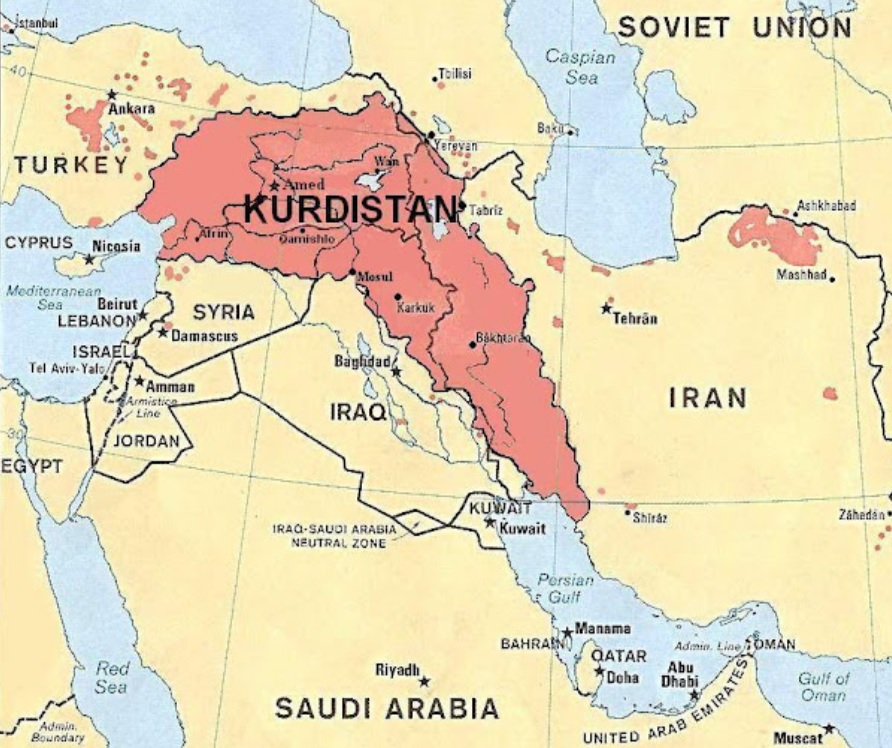
A maximalist representation of Kurdistan spanning four countries-members of the UN; the Kurds are the largest stateless nation (old map of the soviet era)
The Logic of Geopolitical Vacuums
Geopolitics rarely tolerates empty space. When a vacuum appears, actors possessing ambition and capability will move to fill it. The only question is whether surrounding powers are prepared to anticipate the consequences before the next cycle of expansion begins.
Bibliographic Anchors
Papastavrou, A.-T. (2025b). The Material Foundation of Turkish Neo-Ottomanism