Between Memory and Materiality in the South Caucasus
Abstract
Though formal diplomatic ties exist, the relationship between Israel and Armenia remains structurally thin and strategically subordinate to a triangular configuration in which Azerbaijan occupies the decisive position. The present analysis reframes this dyad through a Thucydidean lens, integrating the categories of Fear, Honour, and Interest into a realist framework that is complemented—though not displaced—by constructivist and neoclassical insights. The alignment of Israel with Azerbaijan rests not merely on transactional considerations but on the imperatives of energy security, proximity to Iran, and the preservation of regional optionality. Armenia experiences this alignment as both a security liability and a symbolic affront, intensified by the question of genocide recognition and the legacy of Nagorno-Karabakh. The presence of Turkey reinforces Armenian perceptions of encirclement and indirectly constrains the manoeuvrability of Israel through the alignment between Ankara and Baku. Any prospect of substantive rapprochement depends on a reconfiguration of this triangular structure; absent such a shift, the relationship is likely to remain cautious, sectoral, and strategically marginal.
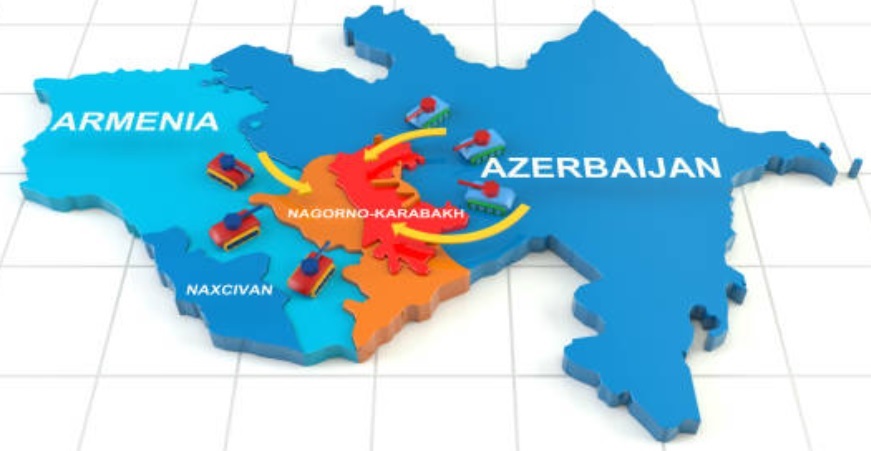 Map of southern Caucasus: the complexity of geography of Armenia and Azerbaijan, and the Nagorno-Karabakh conflict
This essay seeks to cast light on the questions:
(a) Is a rapprochement of Armenia and Israel feasible?
(b) To what extent?
(c) What are the constraints?
Structural Premise: The Triangle Over the Dyad
The relationship between Israel and Armenia cannot be understood as a self-contained bilateral system. The presence of Azerbaijan imposes a triangular geometry that overrides any direct affinity. Israel derives concrete strategic benefits from Azerbaijan—hydrocarbon supply, intelligence proximity to Iran, and access to a receptive defence market—none of which Armenia can offer in comparable magnitude. The result is not active hostility but structural marginality, an asymmetry of relevance that prevents the emergence of depth.
The Turkish factor amplifies this configuration. The alignment between Turkey and Azerbaijan—grounded in ethnic affinity, military cooperation, and convergent regional ambitions—forms a contiguous bloc that Armenia must treat as a unified strategic pressure. Yet this alignment is not devoid of internal differentiation. It allows for a degree of compartmentalisation in domains where the calculus of Baku diverges from that of Ankara. The strategic partnership between Azerbaijan and Israel endures despite periods of tension in the relationship between Israel and Turkey, indicating that Baku preserves autonomy in matters tied to security and advantage. Similarly, Azerbaijan policy on recognition of the occupied northern part of the Republic of Cyprus as an independent turkic state evinces no full subordination to Ankara preferences, reflecting caution in entanglement beyond immediate national priorities. Israel remains formally outside this bloc; however, the partnership between Israel and Azerbaijan places it in functional adjacency to it in the perception of Armenia. This adjacency, even when unintended, reinforces the narrative of encirclement.
Realist Lens Recast: A Thucydidean Core
A strictly realist reading would describe the conduct of Israel as a rational calibration of gains and losses. Such a description is accurate but incomplete unless articulated through the Thucydidean triad.
Interest is the most immediately visible driver. Azerbaijan provides a substantial share of energy imports of Israel and offers a forward strategic position in proximity to Iran, which constitutes a primary concern of Israeli security doctrine. The export of defence systems reinforces a mutually beneficial relationship that enhances both material capabilities and geopolitical reach.
Fear operates at a deeper structural level. Israel seeks to mitigate vulnerability by maintaining a degree of influence along the northern periphery of Iran. Within this context, Azerbaijan functions simultaneously as buffer, listening post, and potential lever. The alienation of Baku would not simply entail the loss of benefits; it would risk a contraction of strategic space in a theatre where perceptions of encirclement are already present.
Honour, although less visible, is not absent. The self-understanding of Israel as a resilient state operating within a hostile environment favours alignments that reinforce agency, credibility, and deterrence. By contrast, the insistence of Armenia on genocide recognition expresses a different configuration of Honour, rooted in moral validation and historical justice. The divergence does not oppose morality to realism; it reveals the coexistence of distinct codifications of Honour that are not easily reconciled.
Within this framework, the logic of Thucydides becomes evident. The prioritisation of survival and advantage in conditions of anarchy leads Israel to favour a relationship that maximises Interest and mitigates Fear, even when this entails a cost in symbolic alignment. No active intent to disadvantage Armenia is required for such an outcome to emerge.
The Turkish Vector: Amplifier of Perception and Constraint
The role of Turkey is best understood as catalytic. The strategic partnership between Ankara and Baku, reinforced during the conflicts of Nagorno-Karabakh, consolidates a regional axis that Armenia perceives as existentially adverse. The historical memory of the Ottoman past is thus not confined to the past; it is reactivated through contemporary patterns of cooperation, producing a continuous perception of threat.
The relationship between Israel and Turkey has oscillated between phases of cooperation and tension. Nevertheless, the persistence of ties between Israel and Azerbaijan situates Israel, in Armenian perception, within a broader network associated with Turkish pressure. This does not imply coordination, yet the perception itself carries strategic weight. In Thucydidean terms, perception becomes a generator of Fear, independent of intention, and thereby shapes behaviour.
Constructivist Undercurrent: Memory as Strategic Friction
Material asymmetry alone does not suffice to explain the intensity of Armenian responses. The question of genocide recognition introduces a symbolic dimension that elevates a secondary issue into a central source of friction. The national identity of Armenia is deeply intertwined with the events of 1915, while the historical memory of Israel is anchored in the experience of the Holocaust. The absence of formal recognition by Israel is therefore interpreted not as diplomatic caution but as a form of denial.
A paradox emerges. Two states shaped by foundational trauma do not converge in solidarity but diverge through mutual misrecognition. Armenia interprets the position of Israel as moral inconsistency; Israel regards the insistence of Armenia as strategically inconvenient. The result is a persistent dissonance that reinforces structural distance.
Neoclassical Mediation: Domestic Filters and Policy Inertia
Systemic incentives do not translate automatically into policy outcomes. Within Israel, debates over genocide recognition intersect with diaspora sensitivities, legislative considerations, and concerns regarding precedent. Within Armenia, political leadership must take into account public sentiment that resists any rapprochement perceived as compromising national dignity.
These domestic filters slow the process of adaptation. Even where structural conditions permit limited cooperation in fields such as technology, agriculture, or medicine, political constraints remain operative. The relationship evolves gradually, without a decisive redefinition.
Concluding Synthesis
The relationship between Israel and Armenia is best interpreted as a constrained interaction within a triangular structure dominated by Azerbaijan, with Turkey reinforcing the surrounding pressure. A Thucydidean reading clarifies that the behaviour of Israel is anchored primarily in Interest and Fear, while divergent forms of Honour complicate the possibility of convergence.
In the absence of a redistribution of strategic value within the triangle, or a weakening of the alignment between Azerbaijan and Turkey, the relationship is likely to remain confined to cautious and sectoral engagement. The proximity of symbolic narratives will continue to generate expectations that the underlying structure is not capable of fulfilling.
Bibliographic Anchors
Papastavrou A-T (2026). Thucydidean Geopolitics for the educated layperson. Ἡδυέπεια (Editors). Link
Salhani, J. (2026). Is Israel reshaping Lebanon, trying to separate Hezbollah from its people? Al-Jazeera. Full article