From Battlefield Justice to Thucydidean Equilibrium
This essay answers the following question: Why do exhaustion and escalation control, rather than justice, shape negotiated endings?
Strategic Abstract
This essay examines why modern high-intensity wars between major powers tend to end not through decisive victory or moral settlement, but through negotiated equilibria shaped by exhaustion and escalation control. Taking as its point of departure President Zelensky’s remarks at the 2026 Davos Forum—where long-range conventional missiles were presented as potentially decisive for peace—the analysis situates such weapons within a broader Thucydidean framework.
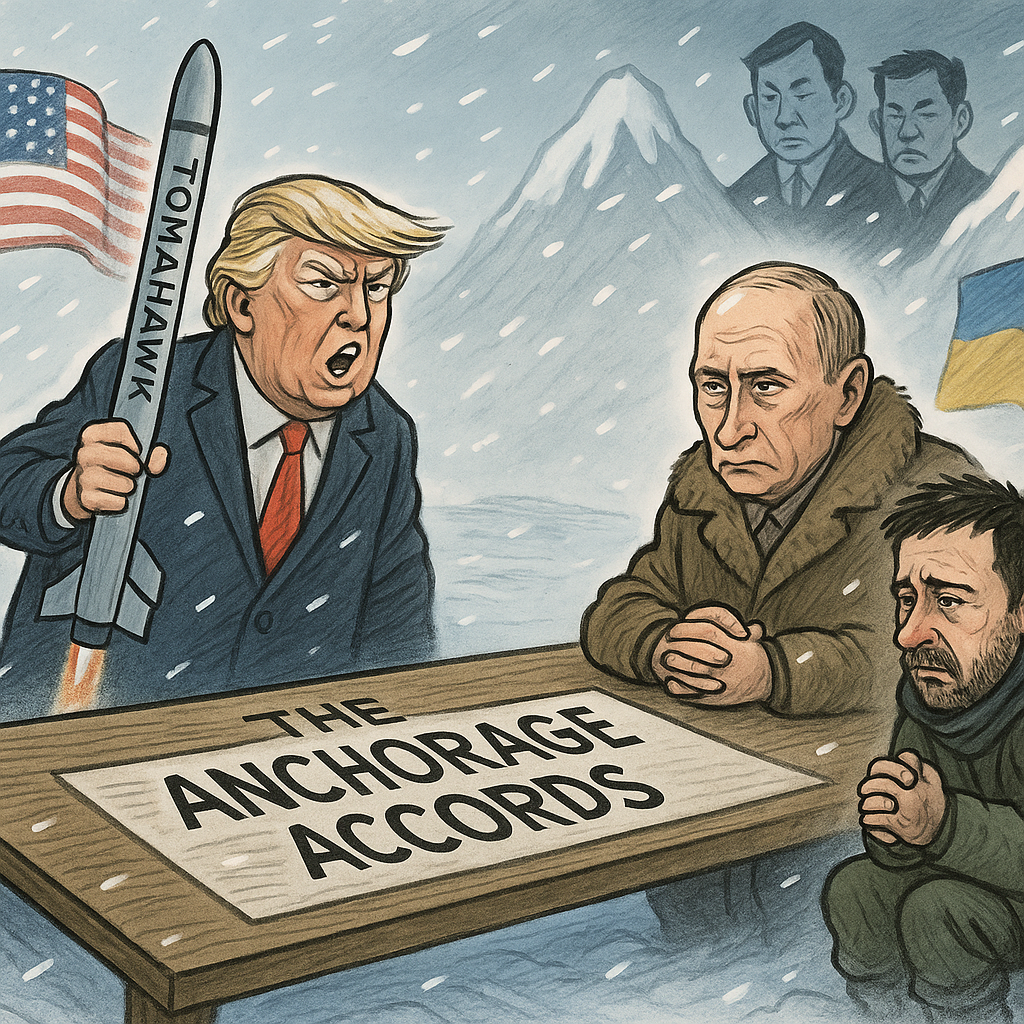
Using a hypothetical settlement model—the Anchorage Accords—developed in the author’s book Thucydidean Geopolitics, the essay explores how long-range strike capabilities, asymmetrical fatigue, and the preservation of political Honour constrain both victory and defeat in the war in Ukraine. The central claim is that sustainable ceasefires emerge not from justice, but from the management of Fear, Interest, and Honour under conditions of strategic stalemate.
Introduction
At the 2026 World Economic Forum in Davos, President Volodymyr Zelensky made a striking observation. He did not frame peace in Ukraine as a question of justice or moral redress, but pointed instead to long-range conventional weapons—specifically Tomahawk and Taurus missiles—as potentially decisive for achieving a negotiated outcome. The implication was clear: peace would not be produced by righteousness, but by altered risk calculations.
This intuition reflects a recurring historical pattern. Wars rarely end when some abstract notion of justice is satisfied. They end when continuation becomes more dangerous than compromise. The war in Ukraine increasingly exhibits this logic. After years of sustained combat, neither side can plausibly achieve its maximal objectives without incurring costs that threaten internal stability, alliance cohesion, long-term welfare, or escalation beyond controllable limits. Under such conditions, peace ceases to be a moral outcome and becomes an instrument of damage limitation. Exhaustion alone, however, does not generate negotiation. What converts stalemate into diplomacy is escalation control: the credible threat that further pressure could cross thresholds neither side is prepared to breach. In contemporary conflicts involving nuclear-armed or nuclear-adjacent powers, long-range conventional weapons occupy a decisive strategic space. They do not guarantee victory, but they reshape incentives by making continued resistance increasingly irrational.
At the same time, negotiated endings must remain politically survivable. Settlements that present defeat as total humiliation tend to collapse. Preserving a minimum of Honour—allowing loss to be framed as constraint rather than annihilation—reduces incentives for revision and facilitates compliance. The hypothetical framework of the Anchorage Accords, first developed in the author’s book, is used here to illustrate how exhaustion, escalation control, and managed ambiguity interact to produce a provisional peace.
Exhaustion as the Background Condition
After prolonged high-intensity warfare, both Russia and Ukraine face exhaustion, though of different kinds. Russia confronts cumulative economic strain, demographic pressure, growing internal insecurity, and jeopardised long-term welfare. Ukraine faces battlefield attrition, societal fatigue, and dependence on external support whose political limits are increasingly visible. Exhaustion does not affect the two sides symmetrically, but it narrows the strategic space for both.
At this stage, war no longer functions as a rational instrument for securing additional gains. Each marginal advance risks disproportionate retaliation, widening escalation, or domestic destabilisation. Historically, such conditions have produced not resolution but truce—what Thucydides recognised as peace born of necessity rather than reconciliation.
Escalation Control and Long-Range Missiles
The decisive variable that converts exhaustion into negotiation is escalation control. Long-range conventional strike systems—such as Tomahawk or Taurus missiles—alter the strategic geometry by threatening deep targets without immediately crossing the nuclear threshold. Their value lies less in their actual use than in their credible availability.
For Moscow, the prospect of sustained deep strikes introduces a new form of vulnerability: not territorial loss at the front, but internal erosion—political, economic, and psychological. For Washington, signalling such capability without deploying it functions as coercive diplomacy. For Kyiv, it strengthens bargaining position without guaranteeing battlefield victory.
This dynamic reflects a classic realist mechanism: Fear disciplines ambition. Negotiation becomes possible when escalation risks exceed the tolerable margin for all actors involved.
The Anchorage Accords: A Provisional Equilibrium
The Anchorage Accords represent a hypothetical settlement structured around this logic. They freeze front lines, impose monitored disengagement, and establish Ukrainian neutrality for a defined long period without retroactively legitimising aggression. Crimea remains under de facto Russian administration without de jure recognition; Donbas returns formally to Ukraine under extensive autonomy and international supervision.
Sanctions relief is phased and conditional. Reconstruction is funded through escrow mechanisms drawing indirectly on immobilised Russian assets. Arctic and energy clauses aim to weaken the Sino–Russian axis while offering Moscow tangible incentives for compliance. The framework does not deliver justice. It delivers balance.
Honour, Defeat, and Thucydidean Stability
A central feature of the Anchorage Accords is their management of Honour, particularly for Ukraine. The distinction between de facto and de jure outcomes allows Kyiv to avoid the appearance of annihilating defeat. Territorial loss is constrained, provisional, and legally contested rather than conceded. This ambiguity is not cosmetic; it is functional.
History suggests that peace is more durable when the weaker party is not publicly stripped of dignity. Preserving a narrative of constrained survival—rather than total loss—reduces incentives for immediate revisionism and facilitates domestic acceptance. Honour, in this sense, is not moral vanity but a condition of political continuity.
The Anchorage Accords thus embody a Thucydidean equilibrium: a peace sustained by Fear, stabilised by Interest, and made tolerable through the preservation of Honour. No actor achieves its ideal outcome. Each receives enough to prefer peace over renewed war, yet not enough to claim victory. Like the Peace of Nicias, such an arrangement would endure only while exhaustion, deterrence, and mutual dependence outweigh ambition and pride. Its imperfection does not negate its necessity. In international politics, peace rarely emerges from justice; it emerges from necessity.
In this sense, long-range missiles do not win wars—but they help end them by shaping the geometry within which negotiated endings become rational. The Anchorage Accords operate on the same logic: they do not deny defeat, but defer its formalisation, allowing the weaker party to retain legal continuity and symbolic agency. What might otherwise appear as annihilation is reframed into a tolerable equilibrium—endurable, though never celebratory.
Endnote
The Anchorage Accords are developed in detail in:
Papastavrou, A.-T., Thucydidean Geopolitics for the educated layperson, Chapter 8 (pp. 217-221)—The War in Ukraine: “A Thucydidean Peace for Ukraine”.
Edition Lulu.com, 2025 (e-book) and Idiepeia, 2026 (paperback)